Followers

Showing posts with label Edom. Show all posts

Tuesday, July 8, 2025

The Israelite-Hebrew Mountain Covenants


Dr. Alice C. Linsley

Do you grasp the distinction between the terms Hebrew and Israelite? And between Israelite and Jew? If not, please read this: Hebrew, Israelite or Jew?

Do you recognize that Judaism is not the faith of Abraham the Hebrew? If not read this: Judaism is Not the Faith of Abraham.

Before Abraham's time (c.2000 BC), the Hebrew ruler-priest caste had dispersed in many directions. They moved into the land of Canaan long before the time of Moses. That is why the Israelites met kinsmen in many places. The Israelites who left Egypt are described as a mixed multitude (Exodus 12:38). Some were descendants of the Hebrew who had been living in the Nile Valley for at least 2000 years before the time of Moses.  Some were the descendants of the Hebrew chief Jacob or Israel. 

Detailed study of the ancestry of Terah, Abraham, Nahor, Isaac and Jacob reveals that these families and the Hebrew living in Canaan, Edom and Midian share common ancestors. Canaan is named for Cain whose descendants, the Kenites, lived in Canaan. Edom or Idumea was the land of red people such as Esau, Isaac's proper heir. Some of the Horite Hebrew chiefs of that region are listed in Genesis 36. The land of Midian is named for one of Abraham's sons by his cousin wife, Keturah (Gen. 25).

After leaving Egypt, Jacob's descendants (the "Israelites") journeyed east-northeast by stages, making contact with Hebrew kinsmen at each stage. The first people to help them were their cousins among the Midianites in the region of Horeb, the Midianite sacred mountain (Deut. 29:1). 

The Israelites also received help from the Hebrew chiefs of Edom. These Hebrew were kin to Seir the Horite Hebrew named in Genesis 36. The Edomite sacred mountain was Paran (Deut. 33:2). 

Crossing through Edomite territory (where Aaron was buried), the Hebrew people moved into Moab. They visited with Lot’s descendants and worshipped on Mount Nebo (Deut. 32:49), where Moses died.

 At each of these sacred sites, the reunion of kin was celebrated by a covenant that included animal sacrifice and a night of feasting. These covenants likely resembled the covenant made between Jacob and Laban at Mizpah (Gen. 31:44-54). The Hebrew ruler-priests had established themselves at sheltered high places throughout the Ancient Near East well before the time of Moses and the Exodus. 


Related reading: The Exodus Narrative from a Different AngleHorite and Sethite MoundsThe Hebrew were a CasteHazor's Destruction: Another TheoryThe Edomites and the Color RedAdam Was a Red ManThe High PlacesThey Believed in a Messiah 6000 Years Ago


Wednesday, February 1, 2023

The Obed-Edom Connection


These Egyptian winnowing shovels date to 1300-1200 BC (roughly the time of Boaz), making them a good indication of the tools he might have used at his threshing floor in Bethlehem.

Alice C. Linsley


John the Forerunner’s father, Zechariah, was a priest of the division of Abijah (Luke 1:5, 8). Abijah's was the eight division of priests. John’s mother, Elizabeth, was also of the Hebrew ruler-priest caste. Hebrew priests only married the daughters of Hebrew priests (caste endogamy).

There are at least four men named Zechariah or Zecharias among the temple gatekeepers in 1 Chronicles 26 which also mentions that "God had blessed Obed of Edom." These Hebrew men are called "porters" (2 Chron. 23:4) or "keepers of the threshold" of the temple (2 Sam 18:26; 2 Ki 7:10,11). Psalm 84:10 speaks of the preference to be a "doorkeeper in the house of the Lord" rather than to "dwell in the tents of the wicked." Besides opening and closing the doors, they were responsible for the care of the sacred vessels (2 Ki 12:9; 22:4; 23:4). Their clan chiefs drew lots for which gates they would guard.

Ruth was the mother of Obed, a name associated with the early Horite Hebrew of Edom. Details about the clan of Seir the Horite are found in Genesis 36. 

Korah refers to a priest who has ritually shaved before serving in the temple. Korah's descendants are praised in 1 Chronicles 26, where they are grouped with the gatekeepers of Obed-Edom. Obed was the father of Jesse, the father of David. We note that David’s sons are identified as priests in 2 Samuel 8:18.

Naomi and Ruth were the wives of Hebrew priests who were living in Moab. When Ruth returned to Bethlehem with Naomi, she became the wife of Boaz, a ruler of Bethlehem. Boaz fathered Obed, but by levirate marriage law Obed was the heir of Ruth's late husband.

Ruth’s great grandson was David of Bethlehem. He had royal kin in Moab which explains why he sent his parents to the citadel of the king of Moab for protection while he was being pursued by Saul (1 Sam. 22:3).

According to I Chronicles 2:54 and I Chronicles 4:4, Bethlehem was a Hebrew settlement associated with Hur (HR/Hor/Horite). The priests who resided there believed in God Father and made grain offerings to the High God and his son, HR ("Horus" in Greek). Horus names are found among the early Hebrew. In ancient Egyptian HR means "Most High".

After David became king, he brought the Ark "from the house of Abinadab, that was in Gibeah” (Saul's hometown) to Jerusalem (II Sam. 6:1-12). However, for three months the Ark rested in David’s hometown of Bethlehem on the property of Obed-Edom. 

Genesis 36:31 states that there were kings in Edom long before there was a king in Israel. This suggests the antiquity of David's royal lineage. That lineage is traced back to Abraham whose territory was entirely in ancient Edom, and Edom is where Aaron was buried.

Edom was called Idumea by the Greeks, meaning "land of red people". Esau of Edom is described as red (Gen. 25), and David is described as red (1 Sam. 16:12). Given that the Hebrew married only within their caste, we should expect certain physical traits to consistently appear among them.


Saturday, February 15, 2020

Who were the Nabataeans?


Alice C. Linsley


The term "Nabataean" refers to the empire and city-building royal house of Idumea. Idumea is a Greek word meaning "Land of Red People" and is another reference to ancient Edom. According to Josephus, Idumea extended in antiquity from Hebron (where Sarah resided) to Beersheba (where Keturah resided). This is the extent of Abraham's territory. The map shows Abraham's territory extending between the settlements of his two wives in Hebron and Beersheba.


Some have speculated that the Magi were Nabataeans. This is not an unreasonable thesis (though the biblical text says the Magi came from the east, not the south.) The rulers of Idumea were heirs to a body of astronomical knowledge and a Messianic expectation that was common to the people of Idumea (ancient Edom) and Judah. Ancient Edom once included what is today a large section of Judah. 

The antiquity and prestige of the Edomite rulers is expressed in Jeremiah's reference to Edom and Teman of Edom as ancient seats of wisdom (Jeremiah 49:7). Genesis 36 explains, "These are the kings who reigned in the land of Edom, before any king reigned over the children of Israel."

The Nabataeans are the heirs of that wisdom. They are mentioned in historical records such as Diodorus Siculus' Bibliotheca (book 19), dating to 312 BC, and in an Egyptian papyrus dating to 259 BC. They are mistakenly classified as Arabs. Jan Retso's excellent paper on Nabataean origins indicates that it is misleading to apply the label "Arabs" to the Nabataeans. Retso observes that in 1 Maccabees 5 (v. 25) the Nabataeans were allied with Judas Maccabees while the Arabs are named as his enemies (v. 39).

The Nabataean capital of Petra reflects the pillared architecture of the Horite shrines of the Nile, and the first ruler of Petra, Obodas, took his name from the Edo/Edomite name for ruler which is Oba.

According to the linguist Helene Longpre, Nabataean Aramaic most closely correspond to Meroitic or Old Nubian. (See H. Longpre, "Investigation of the Ancient Meroitic Writing System", Rhode Island College, 1999.) 


Saturday, August 10, 2019

The Horite Hebrew Wisdom of Elihu


Alice C. Linsley

"There was a man in the land of Uz, whose name was Job..." (Job 1:1)

Job was a Horite Hebrew of the clan of Uz. Uz was a grandson of Seir the Horite ruler of Edom (Genesis 36). Edom was where Abraham the Hebrew settled. Jeremiah speaks of Edom as one of the ancient seats of wisdom.

The divine name YHWH was known among the Horite Hebrew of Edom before the time of Moses. According to Jewish tradition, Moses was born around 1393 BC. However, the name YHWH appears in connection to the Seirites of Edom as early as 1500 BC. Lists of place names in the Nubian temples of Soleb and Amara West record six toponyms associated with the Horites of Edom, “the land of Shasu.” A monument of Ramesses II claims that he “has plundered the Shasu-land, captured the mountain of Seir; a 19th Dynasty letter mentions “the Shasu-tribes of Edom,” and Ramesses III declares that he has “destroyed the Seirites among the tribes of the Shasu.”

The description of Job fits that of the Horite Hebrew ruler-priests. Though accused of being a sinner by his friends, Job was a righteous man who "feared God and shunned evil" (Job 1:1). He rose early to offer prayers and burnt offerings for his children, one by one. He comes to be afflicted by a "ha-satan," the Accuser. Satan's power is limited as he is a creation. He must ask God's permission to afflict God's servant and God puts limits on what Satan may do to Job. The Hebrew did not regard God and Satan as equals. The faith of Abraham was not dualistic.

The trial of Job in which Satan acts as the accuser parallels Zechariah 3:2-6 where Satan accuses the High Priest Joshua (Yeshua/Jesus). In that trial God acquits Joshua and commands that he be clothed in pure garments and crowned with two crowns (ataroth). This points to Jesus who, as the Son of God, would wear a double crown according to Horite Hebrew expectation. The double crown represents how Messiah unites two peoples: the faithful of Israel (Old Covenant) and the faithful of the Church (New Covenant).

Elihu is the last of Job's kin to speak. In Strong's Concordance Elihu is said to mean "He is my God". However, it is more likely that the name relates to God's Word since El refers to God and hu was a Horite word for the divine Word that overcomes chaos. Hu refers to the authoritative word in ancient Egyptian belief and is mentioned in the Old Kingdom Pyramid texts (PT 251, PT 697). There is a close resemblance to the Logos of John's Prologue in that Hu is depicted as the falcon of the Son of God, or the ram, the totem of the Son that overcomes death. (A ram was provided for sacrifice on Mt. Moriah).

Elihu is of the clan of Buz. Buz, Huz and Uz were a three-clan Hebrew confederation. I Chronicles 5:14 tells us that the son of Buz was Jahdo (Hebrew Yahdo), and Jahdo's son was Yeshishai, the Aramaic form of Yeshua/Jesus. With the names Yahdo and Yeshishai we see the initial Canaanite Y that indicates a divinely appointed ruler.

Assuming that Elihu is an historical person, he likely was the brother-in-law of Tamar's son Hezron. (See dark triangle below.) Tamar was the daughter of a shrine priest. This suggests that Elihu lived with his father Barachel in the territory of Buz, but belonged to the household of Elihu, his maternal grandfather, also a priest. Elihu's mother would have been the daughter of Elihu the Elder. In other words, we have further evidence of intermarriage between two Horite Hebrew lines: the ruler-priest lines of Judah and Elihu the Elder.


Evidence of endogamy among the Hebrew Lines of Judah and Elihu (2019)

   Judah                                                    Elihu the Elder
      ∆    =   O Tamar                                                                       ∆
                       Hezron  ∆  =  O Elihu the Younger’s sister                                 O Elihu’s mother
                                                                                                                              Elihu the Younger


Both Elihu the Elder and Elihu the Younger were of the ruler-priest caste and ancestors of King David. Elihu the Younger takes us beyond the wisdom of Eliphaz, Bildad and Zophar. He moves us from the retributive justice espoused by Job's three friends to the reality that "God is greater than any human being. Why then quarrel with Him for not replying to you word for word? God speaks first one way and then in another, although we do not realize it." (Job 33:12-14 NJB)

Friday, July 29, 2016

The Antiquity of the Edomite Rulers


Alice C. Linsley

Note that both Hebron (where Sarah lived) and Beersheba (where Keturah lived) are in Idumea or ancient Edom. Abraham's territory extended on a north-south axis between the settlements of his two wives and was entirely in the region the Greeks called Idumea. Idumea means "land of red people" and Esau is described in Genesis has having a distinctive red skin tone, typical of the Edomite rulers. The words Edom and Adam both relate to the word dam/dm - blood, and signify the color red.

Edom
Even the hills of Edom appear red due to the iron deposits. Deuteronomy 8:9 describes Edom in these words: "A land whose stones are iron and out of whose hills you can dig copper."

Edom was ruled by Horite kings. Seir the Horite is listed in Genesis 36 as one of the Edomite kings. He was a contemporary of Esau the Elder.

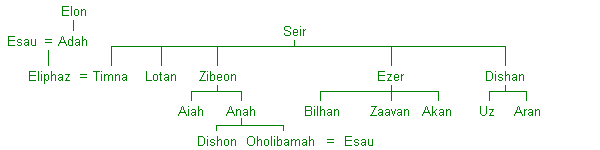
In this diagram of the Edomite rulers listed in Genesis 36 we see that there were two chiefs named Esau. Esau the Elder married Adah. Esau the Younger married Oholibamah.


Jeremiah refers to Edom and Teman of Edom as seats of wisdom. The prophet writes: Concerning Edom: This is what the Lord Almighty says: 'Is there no longer wisdom in Teman? Has counsel perished from the prudent? Has their wisdom decayed? (Jeremiah 49:7)

The wisdom to which Jeremiah refers is that of the Horite ruler-priests who were renown in the ancient world for their wisdom and skill at metal work. The Horites were a caste of royal priests and sages who were devotees of Ra, Horus and Hathor. Hathor was the patroness of metal workers. The word "Horite" is the English variant of the word Horim, the term Jews use when speaking of their ancestors.

Timna or Tema plays an important role in early Biblical history. Known by Arabs as Taima, this water source lies about 70 miles north-east of Dedan. During the Chalcolithic Period, Kushite artisans lived here in subterranean dwellings carved out of the limestone with metal tools. The Bible refers to these cave-dwellers as Dedanites. Dedan, Tema and Buz comprized a Horite confederation. Rock drawings from the 13 century BC have been found at Timna.

Timna is the site of 6,000 years old mines. The oldest mines were worked almost continuously until the Roman Period. There are ancient rock carvings showing warriors in chariots, holding axes and shields. A temple dedicated to Hathor was discovered at the southwestern edge of Mt. Timna by Professor Beno Rothenberg of Hebrew University.

The Chalcolithic metal works at Timna were found at the Wadi Nehushtan in the foothills along the western fringe of the southern Arabah Valley. The smelting works, slag and flints at this site were found to be identical to those discovered near Beersheba where Abraham spent much of his time. The metal workers of Timna and the metal workers of Beersheba were kin and the patroness of their mining operations was Hathor, the mother of Horus, who the Horite venerated. Hathor's temple there dates to 1318-1304 BC. In the temple courtyard there was a workshop for casting copper figurines as votive offerings.

In his book Timna, Rothenberg concluded that the peoples living in the area were "partners not only in the work but in the worship of Hathor." (Timna, p. 183)

The wisdom of the Horites extended to medicine, astronomy, commerce, navigation, natural sciences, metal work, stone work, architecture, and writing. They were wise men, prophets and scribes. The term "Nabatean" is derived from the name Naba or Nabu, the guardian of scribes and prophets. The cult of Nabu was introduced into Mesopotamia and Babylon by the Kushites. Some Kushite kings bore the name Nabu, as with Nabu-shum-libur, an early Kushite king in Babylon, and Nabu-aplu-iddina. The Hebrew word nabi, meaning prophet is related.

Genesis 36 speaks to the antiquity of the Edomite rulers
"These are the kings who reigned in the land of Edom, before any king reigned over the children of Israel. Bela, the son of Beor, reigned in Edom. The name of his city was Dinhabah. Bela died, and Jobab, the son of Zerah of Bozrah, reigned in his place. Jobab died, and Husham of the land of the Temanites reigned in his place. Husham died, and Hadad, the son of Bedad, who struck Midian in the field of Moab, reigned in his place. The name of his city was Avith. Hadad died, and Samlah of Masrekah reigned in his place."
An archaeological survey in the early 2000's, led by Dr. Thomas E. Levy, yielded early dates than had usually be assigned to the Edomite culture. The team uncovered scarabs, ceramics, metal arrowheads, hammers, and grinding stones and found slag heaps.

Edom had a large copper ore zone with industrial scale copper production. Radiocarbon analysis of charred wood, grain and fruit in several sediment layers revealed two major phases of copper processing, first in the 12th and 11th centuries, and later in the 10th and 9th BC.

Evidence was found of the construction of fortifications and over 100 building complexes. Khirbat en-Nahas is 30 miles north of Petra in Jordan. Khirbat en-Nahas means "ruins of copper" in Arabic. Nahash means serpent in Hebrew. As an adjective it means shining bright, like burnished copper. Khirbat en-Nahas was one of the first ancient occupation sites in the Edomite lowlands to be investigated. The ruins spread over 24 acres, and the fortifications enclose an area 240 by 240 feet. 

Dr. Levy stated, "Only a complex society such as a paramount chiefdom or primitive kingdom would have the organizational know-how to produce copper metal on such an industrial scale." 

Nabatean warriors on camels
The 400-acre Edomite complex at Petra reflects Horite beliefs. At Petra we find the same pillared architecture of the Horite shrines of the Nile. The first ruler of Petra, Obodas, took his name from the Edo/Edomite name for ruler which is Oba.

The linguist Helene Longpre points out that Demotic Egyptian (7th-5th century BC) and Nabatean Aramaic most closely correspond to Meroitic or Old Nubian. (Longpre, "Investigation of the Ancient Meroitic Writing System", Rhode Island College, 1999.) 

The mysterious Shasu were related to the Horites of Edom and according to monument inscriptions in Nubia, they called upon the God YHWH.  Lists of place names in Nubian temples of Soleb and Amara West record six toponyms located in “the land of Shasu.” A monument of Ramesses II claims that he “has plundered the Shasu-land, captured the mountain of Seir” in Edom; a 19th Dynasty letter mentions “the Shasu-tribes of Edom” and Ramesses III declares that he has “destroyed the Seirites among the tribes of the Shasu.” Clearly, the Egyptians regarded the Shasu as a prominent part of the Edomite population which is described in Genesis 36.


Friday, June 24, 2016

Dismantling Outdated Interpretations


Alice C. Linsley

A reader of JUST GENESIS left a comment after reading the article Why Prejudice Against A Scientific Approach to the Bible?  This was the question asked by Manna: "Is archeology biased and based more on a european type of model than facts? Or, is current research and evidence dismantling the bias of the past? Are we closer to a more accurate picture or further away?"

Hathor
I responded that archaeological findings constitute important physical evidence, but artifacts are often misinterpreted or assigned significance that is not consistent with the larger picture. I have seen many examples of this over the years.

One example is the unfortunate misrepresentation of the solar image overshadowing the queen at the Yazilikaya shrine in Turkey (shown below). This relief of great significance shows the divine appointment of a royal couple. The woman wears the Sun in the horns as a sign of divine overshadowing of the Sun, the Creator's emblem. This is consistent with the image of Hathor, the mother of the "son" of the Creator (shown right). Hathor was venerated among Abraham's Horite Hebrew ancestors as the mother of Horus. She was also venerated among his kinsmen, the Hittites.


Stone relief dates to 13th century BC
Solar imagery is a key feature of the religion of the archaic rulers (the "mighty men of old") and it involved expectation of a divine ruler who would overcome death and lead his people to immortality. That righteous ruler was understood to be the son of God. He is called Horus or Enki in ancient texts. He was to be conceived by divine overshadowing of a dedicated royal virgin (Luke 1). 

It is common that interpretations of the past are set aside when fresh eyes investigate the evidence. There is always resistance to new approaches such as Biblical Anthropology which does not rely on a single discipline, but rather seeks to gain a wider picture by looking at multiple sciences, including linguistics, DNA studies, anthropology and climate studies.

The king also wears the horns as a solar crown indicating divine appointment as the Creator's representative on Earth. Unfortunately, archaeologists missed this entirely. They interpreted this image as Sun goddess (left) and Moon god (right), thus rendering the meaning exactly opposite of what is depicted. Among the peoples of the R1b Haplogroup (which includes Hebrew and Hittite peoples) the Creator was consistently associated with the Sun and divine insemination.

Manna also wrote,
"I think the reason people ask you "what color was Abraham?" is because your research goes even against the images of Abraham and others in the Old Testament...Those images for many are not African based at all. I grew up down south (the Bible belt of America) and there was nothing of any "red, dark, ruddy, brown, dark, etc" skin tones in images of Abraham, etc. in those early books of Genesis. I think the resistance is so deep that even some researchers and scientist cannot accept such--even despite the clear evidence. Some people will never accept a "ruddy, brown, red, olive or even dark" type of Abraham. Does it matter? For some of us, it does for many different reasons."

To Manna, I responded, "The assertion of a red skin tone for Abraham is strictly based on the data of the Bible."

Let us consider some of the pertinent data of the Bible and see how it aligns with scientific findings.

Abraham was a descendant of Adam. Adam refers to the color of blood. Adam is named as the founding ancestor of the rulers listed in Genesis 4 and 5. These are the ruling lines of Kain and Seth, and analysis of the marriage and ascendancy pattern of these rulers reveals that the lines intermarried. This practice is called "endogamy" and endogamy is a trait of ruling houses as well as the priest caste of the ancient world.


Abraham also was a descendant of Kush, a Nilotic ruler of the Upper Nile Valley where red Nubians lived. His ancestors were Proto-Saharan cattle herders for whom the Sun was a sacred image, the emblem of the Creator who appoints rulers by divine overshadowing. The image below is actually a Messianic image of the calf of God to be sacrificed to make atonement for the people. This is why Aaron, a descendant of Seir the Horite ruler of Edom, fabricated such an image (see diagram above).


One of Abraham's ancestors was Noah, a proto-Saharan ruler in the region of Lake Chad. There has been resistance to this assertion among men who have written books in which they present Noah as a Mesopotamian.Yet none has been able to refute the assertion that Noah was a proto-Saharan ruler because it aligns with biblical data and with findings in linguistics, genetics, anthropology, archaeology and climate studies.

Lake Chad and the Upper Nile were populated by people in the R1b Haplogroup (Y-DNA). This Haplogroup is African, Eurasian, and European, as is evident from this map. The evidence of the Bible and various sciences indicate that this is the haplogroup of the Horite Hebrew.


In Noah's time there was a famous shrine city on the Nile called Nekhen. At Nekhen, archaeologists found a redheaded man in Burial no. 79. The facial hair of the man in Burial no. 79 had been trimmed with a sharp blade. The presence of long wavy natural red hair and a full beard suggests that this individual may be of the same ethnicity as the red haired rulers known as Ur-David (shown below) buried in a pyramid in the Tarum Valley of China.


Note the solar mark on the face of this archaic ruler.

The Nekhen News (p. 7) reports, "The vast majority of hair samples discovered at Nekhen were cynotrichous (Caucasian) in type as opposed to heliotrichous (Negroid)."


The Red People of Edom

Abraham's territory was entirely in the land of Edom, ruled by Horite Habiru/Hebrew kings. Many are listed in Genesis 36. Edom and Adam share the same dm root which refers to the color red. The ancient Greeks called Edom "Idumea" which means land of red people.


Note that both Hebron (where Sarah lived) and Beersheba (where Keturah lived) are in Idumea. Abraham's territory extended between the settlements of his two wives and was entirely in the region the Greeks called Idumea.

David and Esau are decribed as red or ruddy in the BIble. In the Genesis 36 king list, diagrammed below, we find that Esau the Elder married his cousin Adah, the daughter of the Hittite chief Elon. His other wife was Basemath, also a daughter of Elon. Esau the Younger married Oholibamah, the daughter of the female clan chief Anah.


David was a descendant of Abraham and he had Edomite blood, as did many of the great rulers of Israel, including Herod the Great whose ancestry is found in Horite Petra. Genesis 36:1 reports that kings ruled in Edom before there was a king in Israel. The Edomite ruling house is one of great antiquity.


Related reading: Solar Symbolism of the Horite HebrewTwo Named Esau; Haplogroups of Interest to Biblical Anthropologists; The Kushite-Kushan Connection; Edo, Edom, Idumea; The Genesis King Lists; The Antiquity of the Edomite Rulers; Another Way to Read Scripture

Friday, January 8, 2016

Intermarriage between the Dedanites and the Edomites


Alice C. Linsley

The oldest known name for the Creator in the Bible is El (ʾēl) which corresponds to the Proto-Semitic ʔ-L. The L likely was a symbol of a throne or chief’s seat and indicated power and authority. The Northwest Semitic ʾēl is cognate to the Proto-Arabic ʾIlāh and the Akkadian ilum. Akkadian was the language of Nimrod’s kingdom in the Tigris-Euphrates Valley. Nimrod was a Kushite kingdom builder according to Genesis 10:8: “Kush became the father of Nimrod; he became a mighty one on the earth.”

In Nigeria, the Hausa translation of the Bible uses Allah (Arabic: الله) to designate the Creator and the God and Father of Jesus Christ. Allah is also used in Syrian Bibles. As a designation for God, Allah corresponds to the archaic El in the Hebrew Bible, as Dios in Spanish corresponds to Dieu in French. The name was used among Arabian and Syrian peoples long before the time of Mohammad. Allah is the compressed expression of al-ilah, meaning THE God.

Among Abraham’s ancestors there were many names for the Creator. These included YHWH, Yah, El, and Ilum. Another ancient name for God is Ausa, sometimes spelled Asa.The Egyptian word Asa refers to God as father.  The Asante tribe bears this name. Asa-nte means "people of Asa." The word "Hausa" probably has a similar meaning: ha-Ausa, meaning "the people of Ausa."

The older names for God can be identified by their simple roots, such as L, or by their bi-consonantal forms, such as YH or LM. The more recent Arabic and Hebrew words can be identified by a shift to bi-consonantal forms (called bilaterals) and triliterals. There are also a small number of quadriliterals in Hebrew and Arabic.

Old Arabic, also known as Dedanite, is closer to the archaic stratum of the Semitic roots due to its relative isolation in the Arabian Peninsula. Most Bible commentaries explain that the terms Dedan and Dedanite are from ded'-a-nim/dedhan/dedhanim, meaning "low." This is an odd interpretation since the Dedanites were known to dwell in elevated rock shelters. Genesis 10:7 provides the more accurate explanation that the Afro-Arabian Dedanites are related to the Kushite ruler Dedan. The original context is Kushite. In this context the word Dedan refers to the color red and is cognate to the Egyptian didi (red fruit) and the Yoruba diden (red). The Dedanites, along with the ancient Edomites, were known to have a distinctive red skin tone, like Esau and David.

It has been noted that the prayer alignments of the oldest mosques in Iraq and Cairo originally pointed to the region of Dedan, not to Mecca. The prayer orientation of Mohammad’s original mosque in Medina was said to be toward Jerusalem, but could easily have been pointing to this same region in Dedan. Imagine another blue line extending from Medina to Jerusalem.


The blue lines intersect in the region of ancient Dedan.

Dedan is where the largest collection of the oldest Arabic texts have been found at the oases of Teman and Dedan, present day Al-`Ula in Saudi Arabia. Jeremiah 49 links the Dedanites with the people of Teman (TMN). Eliphaz, the son of Esau and Adah (Genesis 36), is called a "Temanite" in Job 4:1. Eliphaz married a daughter of Seir, the Horite ruler of Edom. Her name was Timna (TMN) according to Genesis 36.


The Dedanite alphabet consisted of 28 letters and resembled other scripts used in the Arabian Peninsula and in Syria, though Dedanite was distinctive in its use of the definite article h- or O (a sun symbol) whereas Southern Arabic and the Arabic spoken today uses the definite article al-. Not surprisingly, Dedanite and Hebrew have many common features, including the use of h- as the definite article “the” and the use of matres lectionis to mark long vowels.


Related reading: Edo, Edom, Idumea; Two Named Esau; The Edomites and the Color Red; The Nubian Context of YHWH

Thursday, June 4, 2015

Miners Venerated Hathor


Faynan Copper mine in present-day Jordan, ancient Edom.
This site is the Jordanian counterpart of the copper works at Timna.


Mohammad Najjar and Thomas Levy have been excavating at an ancient copper mine site in the Faynan district of Jordan for more than 20 years. Copper has been mined here for 12,000 years, and the copper smelting here has been done since 4,500 years ago.

This area was part of Edom, a land ruled by the Horites listed in Genesis 36. They are described as having a red skin tone and the ancient Greeks called Edom "Idumea" which means "land of red people." Edom was part of the Nabatean kingdom and the Nabatean warriors resembled the red Nubian warriors with their long wavy hair and the wearing of feathers on their legs.

Nabataean warriors had long wavy hair and wore feathers.
They appear to be related to the red Nubian warriors shown below.


The Horites were devotees of Re, Horus and Hathor. Hathor was venerated as the patroness of miners. Petra reflects Horite beliefs.

Faynan’s twin is the site of Timna in the Negev desert of Israel. In 1934 the area was surveyed by the American archaeologist Nelson Glueck. The area was also surveyed by Beno Rothenberg of Hebrew University between 1959 and 1961. Professor Rothenberg discovered a temple dedicated to Hathor at the southwest edge of Mt. Timna. The smelting works, slag and flints at Timna were found to be identical to those discovered near Beersheba where the elderly Abraham lived with his cousin wife, Keturah. In his book Timna, Rothenberg concluded that the peoples living in the area were "partners not only in the work but in the worship of Hathor." (p. 183)

Beersheba is at the southern boundary of ancient Edom. Both Edomite and Midianite pottery have been discovered at Beersheba. A four-horned brazen altar identical in structural to the altar used later by the Israelites was uncovered in 1973. This discovery was made by a team under the direction of Yohanan Aharoni and Ze'ev Herzog of Tel Aviv University. The team first encountered an ancient storage wall that contained the stones of the altar. Three of the stones still had large horns projecting from them, but the horn of the fourth stone had been broken off. Yet still another stone had the carved image of a serpent, probably indicating Kenite construction. The stones, which had been incorporated into a wall, were reassembled to assume their former shape and dated to the time of the Patriarchs. The altar may have been destroyed during Hezekiah’s attempts to eradicate all shrines outside Jerusalem.

Beersheba had strategic importance because it was the largest settlement in the Negev. It guarded the trade routes between Mesopotamia and Egypt and between the Nile Delta and Southern Arabia. Its fortifications in the late Iron Age were impressive and included a moat that encircled the city and a steeply-sloped earthen rampart. Beyond the rampart the city was surrounded by thick stone walls. The gate was a chambered type, and inside the gate archaeologists found an incense altar at the high place, just as described in II Kings 23:8.

Thursday, March 12, 2015

Roads Connected Abraham's Territory


The data of Genesis suggests that Abraham's territory extended on a north-south axis between his two wives Sarah and Keturah. Sarah resided in Hebron and Keturah resided in Beersheba. Abraham had wells in Gerar to the west and likely watered his livestock to the east at Ein-Gedi. There were ancient routes between these places.


Tel 'Eton is a prominent site that covers about 15 acres and is located some 11 km east-southeast of Tel Lachish (2 km to the south of Moshav Shekef). The ancient city is situated near an important junction between the north-south road that meandered along the trough valley connecting the Beersheba valley and the Ayalon valley, and the east-west road that connected the coastal plain and the Shephelah with Hebron.

See the report on the Tel 'Eton excavations here.

Hebron, Tel 'Eton, and Beersheba were in ancient Idumean or Edom.

At Tel 'Eton rock tombs from the Israelite Period have been found. Lions flank the steps descending from the entrance at Tomb One. Two scarabs were found in this tomb.

The sides of the passage of Tomb Two are raised by courses of large stones. In this tomb a cross was scratched on the wall near one of the niches.