Followers

Showing posts with label Horites. Show all posts

Tuesday, May 13, 2025

Ethnography in the Book of Judges


“Again the Israelites did evil in the eyes of the LORD…” (Jdg 10:6)


The Book of Judges is about a Hebrew population known as the "Israelites." The writer of Judges records the repeated cycles of disobedience, oppression, repentance and deliverance as God raised up rulers, judges and prophets to free the Israelites. The narratives illustrate the consequences of unfaithfulness to God and the need for righteous rulers if the exiles hope to live in peace in the land claimed by their Israelite forefathers.

The Book probably was written closer to the time of the Babylonian Exile (597- 587 BC) than to the time of Samuel (1100- 1001 BC). As such, the author of Judges relied on early ethnographic material to set the stage.

According to Judges 3:5, "The Israelites lived among the Canaanites, Hittites, Amorites, Perizzites, Hivites and Jebusites."

The Israelites were but one clan of the Hebrew ruler-priest caste. They are the Hebrew people associated with Jacob/Yacob who was called Israel/Yisrael. Well before the time of the Judges, there were other Hebrew clans dispersed throughout the Nile Valley, Canaan, Arabia, Mesopotamia, Anatolia, and the Zagros Mountains. Arishen was a Horite Hebrew who ruled a territory in the central Zagros between 2400-2301 BC.


The term "Canaanite" refers to a mixed population living in Canaan. Some Hebrew people lived among the people living in Canaan. Rahab and her family are an example. 

The Jebusites, such as the priest-king Melchizedek, were also kin to the Hebrew. Melchizedek and Abraham were kinsmen. Before David became King of Israel, the Jebusites controlled Jerusalem and much of the land surrounding the sacred city.

The Hittites claim the Hebrew ruler Heth as an ancestor. That means that the Hittites living in Canaan and Anatolia were kin to the Israelites. Canaan became the father of Sidon his firstborn, and Heth and the Jebusites, the Amorites, the Girgashites, the Hivites, the Arkites, the Sinites, the Arvadites, the Zemarites, and the Hamathites. (Gen. 10:15-18 NRSV) The Hittites of Canaan recognized Abraham the Hebrew as a "great prince" among them. 

The Amorites appear to have been a migrating population that dispersed into Mesopotamia and the Orontes River Valley. Amorite was a Northwest Semitic language, like Ugaritic, Hebrew, and Aramaic. It has striking similarities to Moabite and to the language found in the 14th-century BC Amarna Letters.

The Perizzites were also kin to the Israelites. Perez was a son of Judah who never settled in Egypt.

The term "Hivites" refers to the Horite Hebrew who never left Edom and parts of Canaan. The Bible scholar, E.A. Speiser called attention to Hurrian/Horite personal names associated with Shechem and with other areas whose inhabitants the Bible calls "Hivites." Genesis 34:2 specifies Shechem as a Hivite or Horite settlement. He noted the juxtaposition of the Hurrian Jebusites and the Hivites in various biblical references and he concluded that “Hivite” was a biblical term for Horite/Hurrian. Speiser supported his identification of the Hivites with the Horite/Hurrians by reference to Genesis 36:2 and 36:20, where the terms Hivite and Horite are used interchangeably. In Genesis 36:2, Zibeon is called a Hivite, and in Genesis 36:20 Zibeon is identified as a Horite descendent of Seir. 


Other examples of the interchange of the terms Hivite and Horite may be found by comparing the Masoretic Text and the Septuagint. The Septuagint reads "Horites" for the "Hivite" of the Masoretic Text in Genesis 34:2 and Joshua 9:7.


Thursday, July 25, 2024

Seth, Son of Adam


Dr. Alice C. Linsley

The historical Adam was the father of three sons: Cain, Abel, and Seth. The Bible does not name any descendants of Abel. Some of Cain's descendants are listed in Genesis 4 and some of Seth's descendants are listed in Genesis 5. The lines of Cain and Seth intermarried (endogamy). That is shown in the diagram.


Lamech the Elder (Gen. 4) had a daughter named Naamah. She married her cousin Methuselah and named their firstborn son Lamech, after her father. This is an example of the cousin bride's naming prerogative, a distinctive feature of the marriage and ascendancy pattern of the early Hebrew (5000-2000 BC).

The rulers listed in Genesis chapters 4, 5, 10, 11, 25 and 36 were members of the Hebrew ruler-priest caste. As is common with castes, they practiced endogamy. By marrying only members of their caste, certain genetic traits were passed to their descendants. Apparently, a red to red-brown skin tone was one of those traits. 

The Sethite Hebrew were a well-established moiety of the Hebrew caste by 2400 BC because their sacred sites are mentioned in texts that date to 2400 BC. This means that the historical Adam probably lived between c.5000-4800 BC. 

The Sethites served at the sacred high places (mounds) along the Nile and are mentioned many times in the Ancient Pyramid Texts (2400-2200 BC). One place where figurines of Seth were found is Nekhen on the Nile. The city was dedicated to the son of the High God, HR (Horus in Greek). HR in ancient Egyptian means "Most High One."

The vast majority of hair samples discovered at the predynastic cemetery site HK43 at Nekhen were cynotrichous (Caucasian) as opposed to heliotrichous (Negroid), according to The Nekhen News (p. 7). Samples ranged from a single hair to a complete headful, with the largest number originating from the disturbed Burial no. 16 of a female of around 35+ years of age.

Another fascinating find at Nekhen was the recovery of an almost complete beard in association with the redheaded man in Burial no. 79. The man had long wavy natural red hair and a full beard. 

The shrine city of Nekhen is the oldest known site of Horite Hebrew worship and there were Sethite Hebrew living there. This figurine of Seth as a red man with the head of a hippo. was found at Nekhen. Perhaps the hippo was the totem of the Sethite Hebrew, and the falcon was the totem of the Horite Hebrew. Note the red-brown tone of the figurine.


Seth is often portrayed in ancient images as a red hippo. Seth’s homeland is the land of Seti, at the northern edge of the Upper Nile. This region is sometimes referred to as the land of red earth. 

According to Genesis 5:3, Seth was a son in the image of his father Adam. This likely means that he had a red skin tone. The word “Adam” refers to blood (dam in Hebrew, dammu in Ancient Akkadian) and the color red. Adam is derived from the root אדם (A.D.M), meaning "to be red or ruddy" (Strong’s #119). Jeff A. Benner explains, Dam is the "red" blood, adamah is the "red" ground, edom is the color "red" and adam is the "red" man.

The connection between the terms adam (red man) and adamah (red soil) is evident in Genesis 2:7 which states that "the adam" was formed out of the "adamah." The region of the Nile under consideration has a cambic B horizon. Chromic cambisols have a strong red brown color. 


Related reading: Horite and Sethite MoundsAdam and Estrangement from GodFunerary Rites and the Hope of ResurrectionAfrican = Black is a Modern Equation

Thursday, November 4, 2021

Inquiry Into the Development of Western Civilization


Alice C. Linsley, M. Div, D. Litt (honoris causa)

Recently, I was asked to suggest an avenue of inquiry that would best explain the development of western civilization. Most people point to the Romans and classical Latin culture for an answer to that question. However, there are always antecedents, and pursuing antecedents is very much the work of Biblical Anthropology.

The Roman Empire was influenced by Greek culture and philosophy. 

The Greeks were enamored of and influenced by ancient Egyptian culture and religion. (Plato studied for 13 years under a Nilotic priest.) 


5150-year ceremonial Narmer Palette


The Upper Nile Valley and the Lower Nile Valley were united for the first time by Narmer at the beginning of the First Dynastic Period (c. 3150 - 2613 BC). Narmer's Palette was discovered among a cache of sacred implements buried within a Horite temple at Hierakonpolis, also called Nekhen on the Nile. The temple was a large structure, fronted by huge cedar pillars, and it became the prototype for temple architecture for many millennia.

Nekhen is called the Falcon City and the falcon was the totem of Horus, the son of Ra. Nekhen was a very prestigious shrine city with votive offerings ten times larger than the normal mace heads and bowls found elsewhere. Other Horite shrines or "mounds" are mentioned in the Pyramid Texts (2400-200 BC). The Horite and the Sethite priests served the same God and the same king but maintained separate mounds. Their relationship is that of a moiety. The term "moiety" refers to one people organized into two ritual groups.

We know from the study of Horite and Sethite writings on the walls of royal tombs that they expected a righteous king to rise from the dead and lead his people to immortality. They also believed in God Father and God Son. Among the Nilotic Horites, God Father was called Ra (from the ancient Egyptian word Re, meaning "father") and the son was called Horus (from the ancient Egyptian HR, meaning Most High One). Among the Mesopotamian Horites/Hurrians, God Father was called Ani and the son was called Enki. 

The earliest law codes were of a religious nature and implemented by rulers who were served by royal priests, some of whom were certainly Hebrew. (In Akkadian the Hebrew ruler-priest caste was called Abrutu, from the Akkadian word for priest - abru). The Code of Ani is a negatively worded moral code, like the Ten Commandments. It dates to c. 2500 BC and is contemporaneous with The Reforms of Urukagina, Sumeria (2500-2350 BC). However, the Law of Tehut dates to about 500 years earlier. That code is associated with King Menes (2930-2900 BC) who administered justice and issued edicts which were designed to improve food production and distribution, guard the rights of ruling families, improve education and enhance knowledge of the natural world through geometry and astronomy.

In my view, we reasonably can point to the early Hebrew as a significant source of the Faith that later became established as the Christian foundations of Western civilization.


Related reading: The Shrine City of Nekhen; Pre-dynastic Tomb Discovered at Nekhen; Early Resurrection Texts; The Ra-Horus-Hathor Narrative; Plato's Debt to Ancient Egypt; Biblical Anthropology and Antecedents


Saturday, June 20, 2020

Horite Temples


Alice C. Linsley

The priests of the Horite mounds and the Sethite mounds served the same king and worshiped the same God. The temples they built were aligned to the rising sun.

The Shaltout and Belmonte 2005 survey of the orientation of ancient temples in Upper Egypt (Nubia) and Lower Egypt listed the azimuths of axes of symmetry in nearly every temple in the region, including more than 100 entries. They also listed the declinations of astronomical bodies that would be visible at rising or setting along the axes of symmetry. They found a strong cluster of these at declination = −24º, which was the position of the sun at the winter solstice at the time.

They also found a preponderance of axes oriented toward the southeast (azimuth 115º−120º, depending upon latitude), indicating alignment with the rising sun. This is not surprising since the sun was the emblem of the High God for the ancient Nilotes. The priests at the oldest known site of Horite Hebrew worship at Nekhen offered invocations to the High God and his son at dawn.

Archaeological evidence indicates that Horite temples were square with a "holy of holies" at the heart of the larger square. Such sacred spaces have been found at Petra, at Shechem, and near the Amman airport. This temple near the Amman airport was 6.50 meters wide (almost exactly 7 yards) and surrounded by a narrow corridor that was broken into six rooms of equal size. At the very center of the most sacred space was a round stone platform that either served as the pedestal of a stone pillar or as the base of an altar.

Horite Hebrew temples and shrines were located at water sources such as wells or along major rivers like the Nile. Cisterns have been found in many of the ancient temples. Solomon's temple had a cistern that held over 66,000 gallons of water (250 cubic meters). Moses was told to meet the king early in the morning when he went down to the Nile for prayer.

In prehistoric times, regional shrine settlements attracted people from surrounding areas. These settlements were administrated by a "deified ruler" and caste of ruler-priests. The prehistoric shrine settlements were build around a central shrine or temple. There was a stone pillar (bnbn) or an east-facing obelisk. Archaeologists have found large mace heads at these temples.

Typically, the interior floor of the Horite temple was paved and the walls were made of hewn stones. In the Horite temples along the Nile there were many pillars rather than stone walls. The temple at Onn (Heliopolis) is an example. Iunu means "place of pillars."

However, evidence of stone pillars have been found at the temples in Amman and Shechem also. These served both as support for a roof and, in the case of the central area, a symbol of the strength of the Creator who inseminates the earth and by whom all life is generated. Likely the Apostle Paul had this tradition in mind when he wrote to Timothy that the Church of the living God is a pillar (I Tim. 3:15). Pillars in the temple also represented the righteous ones of God. Exodus 24:4 speaks of the twelve pillars in God's house as the twelve tribes upon which God has inscribed the holy Name.

In ancient Egypt such pillars were called bnbn, related to the word wbn, a reference to the rising (swelling) of the morning sun. Bnbn have been found from Nigeria to India. Below is a photo of a bnbn found in Lejja, Nigeria.


Sacred pillars represent the connection between heaven and earth (cf. ladder in Jacob's dream; the Church as pillar). In Horite temples these sometimes stood in the center of an outer courtyard. The foundation stone was about 2 feet 3 inches in diameter (70 centimeters) and the base of the pillar that rested on the stone pier was about 1 foot 4 inches (40 centimeters) in diameter. These smaller pillars were anointed, as Hindus anoint the lingam, an erect stone symbolizing the power of the Deity to generate life. Genesis 28:18 suggests this practice among Abraham's people: "Early the next morning Jacob took the stone he had placed under his head and set it up as a pillar and poured oil on top of it."

In 1931, a structure with the characteristics of Horite temples was discovered by Gabriel Welter on the shoulder of Mount Gerizim at the site of ancient Shechem. That square temple also had a central holy space with a stone podium that possibly served as an altar. This temple was destroyed at the end of the Middle Bronze Age. The central space of the Gerizim temple was about twice as large as the central space in the temple excavated near the airport in Amman in 1955.


Solomon's Temple

Solomon's temple in Jerusalem was built on the pattern of the older Horite temples under the direction of Hiram of Tyre (I Kings 9:11, II Chronicles 2:3). King Hiram and David had a common Horite ancestry, as analysis of the royal names indicates. Hiram I of Tyre also had sent skilled artisans to help David build a palace in Jerusalem.

Variants of the name Hiram include Horam and Harum, and all are related to the names Hur, Hor and Harun (Aaron). According to Midrash, Hur was Moses’ brother-in-law. Hur’s grandson was one of the builders of the Tabernacle. I Chronicles 4:4 lists Hur as the "father" of Bethlehem, also called "the city of David."

Solomon's temple was arranged on an east-west axis as was typical of most Horite temples. The Horites regarded the sun as the symbol of the Creator and Hathor-Meri as the mother of the "seed" of God, Horus. The temple of Hathor at Timna was oriented to the rising sun at the winter solstice. This temple was discovered at the southwestern edge of Mount Timna by Professor Beno Rothenberg of Hebrew University.

The entrance to Solomon's temple was flanked by twin pillars dedicated to his Horite Hebrew ancestors Jachin and Boaz. Jachin was Solomon's maternal great grandfather and Boaz was his paternal great grandfather.


David and Solomon were of the Horite Hebrew lines that can be traced from Genesis 4 and 5 to Joseph who married Mary, the daughter of the priest Joachim. Mary was "Miriam Daughter of Joachim Son of Pa-ntr (Joachim's mother) Priest of Nathan's clan of Bethlehem."

Long before the Pharaohs ruled Egypt the Horites were designated as royal priests. A tera-ntr refers to a priest. Th image above was found in Egypt by Flinders Petrie. It shows a Sethite temple priest among the Nilotic Annu and he is given the title of tera-neter, meaning priest devoted to God.


Related reading: Horite MoundsTemple GuildsOrientations of Nilo-Saharan Monuments; The High PlacesSacred Mountains and Pillars; Prehistoric Shrine Settlement in the Judean Shepalah


Friday, January 24, 2020

Samuel's Horite Hebrew Family


Alice C. Linsley

Samuel's father was a Horite Hebrew priest with two wives. His name means "God's provision" and the name Elkanah appears in different generations of Horite Hebrew ruler-priests (1 Chron. 6:23-34; 1 Chron. 9:16; 2 Chron. 28:7). In Exodus 6:24 we find that a man named Elkanah is the grandson of Korah, the half-brother of Moses and Aaron. This diagram shows that Korah is a descendant of Seir the Horite ruler of Edom (Gen. 36).


In the narrative of Samuel's birth we read that his father Elkanah was a Zuphite, meaning he was a descendant of Zuph and lived in Ramathaim-zophim, "the land of Zuph." Ramathaim-zophim is described as "hill country" and it is known that the Horites preferred the high country. Ramathaim is simply Ramah elsewhere in the story of Samuel's family.


Hill country of Edom, ruled by the Horites (Gen. 36)

Ramah has a long association with prophets; Samuel being one of the greatest. Deborah, “the wife of Lappidoth, was a prophet” who judged from her palm tree between “Ramah and Bethel in the hill country of Ephraim." (Judges 4:4-6) Ephraim refers to the region around Bethlehem.

The Horite Hebrew were a caste of rulers who served as priests, prophets, scribes, warriors and metal workers. They were ethnically Kushite. Ramah was a son of Kush according to Genesis 10:7.

In the Masoretic Text the name of Samuel's city is hara-matatyim zophim. (See The Anchor Bible Commentary on I Samuel by P. Kyle McCarter, Jr., p. 51) This means that Samuel's father was a priest of the line of Matthew (or Mattai/Mattan). Hara-matatyim is the priestly line of Joseph of Arimathea, one of Jesus' relatives, and the member of the Sanhedrin who buried the Lord's body in a tomb he has excavated for himself. Samuel's father and Jesus had common Horite Hebrew ancestors.

David and his father Jesse were of this Horite lineage also. Matthew's Gospel links Bethlehem and Ramah (Matt. 2:13-23); suggesting that Jesse's territory extended from Bethlehem to Ramah. All of this would have been called "Judah" in Jesse's time. If David's city was the Bethlehem in Galilee, Jesse was indeed a great ruler. This is further supported by the Y solar cradle in his name - Yishai. Many of the great Horite rulers are designated by this symbol of divine appointment: Yismael, Yitzak, Yacob/Yisrael, Yetro, Yisbak, Yaqtan, and Yeshua.

Samuel's Horite ancestry, and his kinship to Jesse, is further supported by the distinctive Horite marriage and ascendancy pattern that they shared. Samuel's father was a priest with two wives, Hannah and Peninnah. It was the custom for Horite Hebrew ruler-priests to have two wives. One was a half-sister (as was Sarah to Abraham) and the other was a patrilineal cousin or niece (as was Keturah to Abraham).

The first wife was the sister bride, married at a fairly young age. She was the wife of the man's youth. The second wife was taken close to the time of the heir's coming to the throne. The two wives lived in separate households, usually on a north-south axis.

The firstborn son of the sister wife ascended to the throne of his biological father. So Isaac ruled over Abraham's territory. The firstborn son of the cousin/niece wife ascended to the throne of his maternal grandfather, after whom he was named. Abraham's cousin wife was Keturah. Her firstborn son was Joktan (Yaqtan). Joktan the Younger ascended to the throne of his maternal grandfather, Joktan the elder, the progenitor of the Joktanite clans of Arabia. This pattern of two wives and the cousin bride's naming prerogative, makes it possible to trace the Horite line of descent from Genesis 4 to Jesus, the Son of God.

Samuel dwelt in Ramah. This suggests that he ascended to the throne of his father. This means that his mother Hannah was Elkanah's half-sister wife, as the rabbis attest. Peninnah was Elkanah's cousin wife. Her first born son ascended to the throne of his maternal grandfather, not as the high priest but as a vassal to the high priest with a land holding in the territory of his maternal grandfather.

I Sam.1:4 states that when Elkanah offered a sacrifice, it was his custom to give portions to Peninnah and to all her sons and daughters. We do not know how many children Peninnah had, but we are told that after Hannah gave birth to Samuel, she had two more sons and two daughters.

If Samuel followed the marriage and ascendancy pattern of his Horim, he married one of Peninnah's daughters at a fairly early age. Nazirites did marry, as is evident from the story of Samson.

Here is a diagram showing Samuel's Horite family.


Related reading: The Judges Samuel, Deborah and Huldah; The Chiefs of Edom; The Antiquity of the Edomite Rulers; The Extent of Edomite Territory; Aaron Was Buried in Edom; The Horite Hebrew Wisdom of Elihu; The Horite High Places


Friday, November 8, 2019

The Bronze Age Collapse


2013 photo of an excavation of an ancient battlefield in northern Germany. The Battle of Tollense fits into a period of increased warfare and upheaval. (Photo: C. Harte-Reiter)


Dr. Alice C. Linsley 


The period 1400-1200 B.C. was a time of significant social change characterized by political upheaval, warfare, advances in war technologies, climate changes, earthquakes, and plagues. Hittite texts speak of a plaque that lasted nearly twenty years. This period is referred to as the "Bronze Age Collapse."

Many factors led to a decline in prosperity, stability, and peace. There was conflict between the kingdoms of Troy and Mycenaean Greece. Pharaoh Merneptah waged war against the Libyans and the "Sea Peoples" as recorded on the Israel Stele. The Philistines were expanding their coastal territories inland. Deborah rose to judge the clans of Israel at a time when "everyone did what was right in his own eyes" (Judges 17:6). 

The geologists Amos Nur and Dawn Burgess have suggested that earthquakes contributed to the collapse of many Bronze Age cities and settlements. They explain: “Earthquakes might be detected in the archaeological record, by analyzing geological formations, faults, structural movement, human remains, the collapse of pillars and walls, and inscriptions." 

Nur believes that earthquakes played a part in the enigmatic and quick disappearance of so many Bronze Age civilizations in the eastern Mediterranean during a 50-year period around 1200 B.C.

The use of bronze made warfare much more lethal. Bronze was used for daggers, swords, and shields and could be decorated in a very extravagant way. Bronze weapons equipped standing armies, mercenaries, and pirates. War chariots were used from Egypt to China. These were fashioned in bronze using piece-mold casting.

Climate changes also contributed to decline. The driest event throughout the Bronze and Iron Ages occurred ~1250–1100 BC. 


A World at War

The turmoil extended to northern Germany where archaeologists have identified a major Bronze Age battle ground at Tollense. After the Tollense battle the scattered farmsteads of northern Europe were replaced by fortified settlements, suggesting the need for greater defense.

The unrest is seen in the Assyrian threat to many surrounding territories. In the Aegean, the cultural influence of Crete was overshadowed by the wealthy warrior-kings in Greece. The Mycenaean palace states were in decline, never to recover their former glory.

The Hittite dominance in Anatolia was greatly diminished with the fall of their capital at Hattusa. The kingdom of Ugarit fell in c. 1200 BC. The decline of the Hittite and Ugarit kingdoms were typical of the shifting social and political ground during the Bronze Age Collapse. The Hittite capital Hattusa and the Hittite royal burial grounds were left in ruins, destroyed in a wave of violence.


The number of Israelite settlements increased in the hills north of Jerusalem, and to the south of Jerusalem the rulers of Ammon, Moab and Edom sought to strengthen their borders and formed alliances with Egypt.

The Hurrian/Horites of Anatolia and Mesopotamia came under the Middle Assyrian Empire (1366–1020 BC) which came to control much of the Near East and Asia Minor. Before the Bronze Age Collapse Hebrew clans lived in Abraham's territory between Hebron and Beersheba. This was part of ancient Edom (Idumea), and Aaron was buried in Edom. Plagues were known to Moses, a descendant of Seir the Horite (Gen. 36). 

Edom was called Idumea by the Greeks, meaning "land of red people." In Genesis 25, Esau of Edom is described as red and hairy. David is also described as red or ruddy.

King David came to power in Judah c.1000 BC. He gained his throne through daring battles, alliances, and the endorsement of the great prophet Samuel who was sent to anoint David as Saul's replacement. The reigns of David and Solomon produced Israel's Golden Age. It shines ever more brightly against the backdrop of the Bronze Age Collapse.


Wednesday, September 11, 2019

Killing and Dying to "Marry" Virgins


Fellow 9-11 conspirators Ziad Jarrah and Mohamed Atta laughing a year before the 2001 attack.


Who are the Houris mentioned in the Quran? Many Muslims believe they are buxom maidens to be enjoyed by martyrs in the afterlife. In a note to his fellow hijackers, September 11 ringleader Mohamed Atta reminded them of their impending "marriage in Paradise" to the 72 virgins mentioned in the Quran. Islamic extremists refer to suicide bombing as a "wedding to the black-eyed in eternal Paradise."

The German scholar Christoph Luxenberg says the "houris" with "swelling breasts" refers instead to "white raisins" and "juicy fruits" and are symbolic of the restoration of the lushness of Paradise. Luxenberg's research was featured in a Newsweek article titled "Challenging the Quran" on 28 July 2003.

Dr. Maher Hathout argues that Luxenberg is wrong about the Houris being raisins and fruits. Hathout explains, "It is his [Luxenberg's] prerogative but this does not provide anything supernatural to look forward to the life of eternity. It seems that what he was referring to as raisins is 'kawaib.' Dr. Hathout argues that the Arabic meaning of "beings with swollen breasts" refers to "beings of distinction."

Dr. Hathout is correct. The beings of distinction are mentioned in the Bible. They are designated by the bi-consonantal root HR in the Arabic word Houris. There are no written vowels in Arabic and Hebrew. Before Islam, this ancient root HR referred to Horite/Horus/Hur. The root HR corresponds to the words Horite (English) and Horim (Hebrew). It appears that Jews and Muslims are drawing on some shared older tradition. The Horite Hebrew priesthood is older than both Judaism and Islam by thousands of years.

The Horite rulers are described as "mighty men" and heroes. They are portrayed as deified rulers, men of wisdom, and members of the heavenly council. 

In Revelation 15:2 we read that seven angelic beings (Horim?) come out of the temple to pour out the wrath of God upon the earth from seven bowls. Some Bible scholars have noted that these servants are vested as priests.

Revelation 20 speaks of 24 rulers who sit on thrones and who will judge the world for 1000 years. These are "them that were beheaded for their witness of Jesus, and for the word of God." Revelation 20:6 describes them as "priests of God and of Christ."

Horite rulers and judges are called "elohiym" because they reflected the divine majesty and power. Numerous passages in Exodus use elohiym in this sense:

Exodus 4:16 -“Moreover, he [Aaron] shall speak for you [Moses] to the people; and it shall come about that he shall be as a mouth for you, and you shall be as gods [elohiym] to him.”

Exodus 7:1 - Then the Lord said to Moses, “See, I make you as gods [elohiym] to Pharaoh, and your brother Aaron shall be your prophet.”

Exodus 21: 6 - “Then his master shall bring him to the gods [elohiym] (the rulers who render judgement?) then he shall bring him to the door or the doorpost. And his master shall pierce his ear with an awl; and he shall serve him permanently.”

Exodus 22:8,9 -“If the thief is not caught, then the owner of the house shall appear before the judges [elohiym], to determine whether he laid his hands on his neighbor’s property. For every breach of trust, whether it is for ox, for donkey, for sheep, for clothing, or for any lost thing about which one says, ‘This is it,’ the case of both parties shall come before the judges [elohiym]; he whom the judges [elohiym] condemn shall pay double to his neighbor.”


Virgin Girls and Boys

It appears that given a Muslim's sexual preference, both virgin girls and boys are motivation to be martyred. In popular Islam, both are believed to be at the service of martyrs in Paradise. The big breasted, beautiful eyed, golden hair and fair skin women have a counterpart in the tender aged (Khudam) servant boys with skin like pearls.

Here are the references in the Quran to the eternal servant boys:

There will circulate among them [servant] boys [especially] for them, as if they were pearls well-protected. (52:24)

There will circulate among them young boys made eternal. (56:17)

There will circulate among them young boys made eternal. When you see them, you would think them [as beautiful as] scattered pearls. (76:19)

Servant boys from Horite Hebrew families served the Horite ruler-priests. Samuel was a young boy who served the High Priest Eli. It was not unusual for children to be dedicated to the temple where they lived as servants.

This icon shows the Virgin Mary weaving purple thread.


One theory about Mary is that she was a dedicated temple virgin whose duties included drawing water and weaving. The connection between the Virgin Mary and weaving is found in non-canonical books. The Gospel of Pseudo-Matthew (chapter 9) describes how Mary and other virgins were spinning thread in the Temple compound. Carrying a pitcher, Mary went out to a fountain where the angel said to her, "Blessed art thou, Mary; for in thy womb thou hast prepared an habitation for the Lord." The next day the angel appeared to her again while she is spinning.


Tuesday, October 23, 2018

Decoding the Longevity of the Genesis Rulers

Alice C. Linsley


In his Homilies on the Psalms, St. Jerome notes: "I am reviewing carefully the places in Scripture where I might find old age mentioned for the first time. Adam lived for 930 years, yet he is not called an old man. Methuselah's life was 969 years, and he is not called an old man. I am coming down all the way to the flood, and after the flood for almost three thousand years, and I find no one who has been called old. Abraham is the first, and certainly he was much younger than Methuselah." (HP 21)

Jerome's observation is significant. Abraham was old, probably about 75 years at his time of death. This was a long lifespan for people living about 5000 years ago. Paleopathology indicates that the lifespan of ancient peoples living in an area extending from North Africa to Mesopotamia and Turkey was about 34 years. This applies to peoples in the Late Paleolithic - 30,000 to 9,000 B.C., the Mesolithic - 9,000 to 7,000 B.C. and the Early Neolithic - 7,000 to 5,000 B.C. This would apply to all the rulers listed in Genesis, although rulers tended to live longer than the average people.

One might argue that the patriarchs enjoyed extraordinary longevity by divine providence. Were this the case we would want to know why God’s providence is limited to a specific time, people and place. In other words, the singularity of the extraordinary longevity of these patriarchs is a miracle and therefore beyond scientific explanation. While I believe in miracles, I find this explanation unlikely and without biblical support.

As St. Jerome noted, the only patriarch said to have died at an old age was Abraham (Gen. 24:1, 25:8). This means that the number of years attributed to the Genesis rulers are not to be taken as literal years. They appear to represent ideas about these people and are symbolic.

This is supported by the assignment of 930 years to Adam, an anti-type of Jesus Christ. Paul wrote: “For as in Adam all die, even so in Christ all shall be made alive. But each one in his own order: Christ the first fruits, afterward those who are Christ’s at his coming. Then comes the end, when He delivers the kingdom to God the Father…” (1 Corinthians 15:22-24a)

The number 9 is the last number before beginning the 1-10 counting cycle again. The 3 represents unity of body, mind and soul, and the unity of the Godhead. The symbolism of the zero is likely linked to the solar cycle and has numerical symbolism older than Gematria which has no notation for zero.

Gematria is influenced by Greek sacred geometry and is found in Plato’s writings. Doubtless, Plato was influenced by the geometry of Pythagoras, since he had studied in Egypt, but Pythagoras’ work came much later than the period in which Abraham’s ancestors lived.

In Gematria, numeric values are found by adding the numeric values of the Greek or Hebrew letters. But the numbers in the Genesis King lists are not based on the letters of the Greek or Hebrew alphabets, since these alphabets didn’t exist in Abraham’s time. The number symbolism is likely based on an older system, but it does not help us to understand the symbolism of Kenan's 910 years, Seth's 600 years and Adam’s 930 years because it has no notation for zero and because it is based on alphabets which were unknown to the ancient Horite Hebrew.

In Gematria the sum of Methuselah's 969 days would be represented by the numerical values of the Greek letters omega and stigma, letters unknown to Abraham and his ancestors. Ultimately, Gematria is not helpful in interpreting the number symbolism of Abraham’s Horite Hebrew people.

It is fairly certain that the meaning of the extraordinary numbers in Genesis 4 and 5 is linked to astronomical observations of the ancient astronomer priests who were in the service of the Mighty Men of Old, but there is still much to be learned about this.

It may be that we have to look to the earlier Nilotic solar symbolism. In Egyptian hieroglyphic writing, the zero is a solar symbol and the emblem of the creator God, called Ra ("Ani" in Akkadian). The solar symbol O might signify the divine status of the ruler or it could indicate a solar year of 365 daily cycles.

The ancient Nilotes and the Egyptians had a large inventory of solar symbolism because of their religious understanding of the High God whose emblem was the Sun. Their main ideogram for "Sun" was a representation of the solar disk, such as this:


Is it possible that the zero is simply a solar symbol? The O is for modern thinker a place holder, but it may have represented the sum of the days in a solar cycle, that is 3+6+5 =14 years. Kenan's 910 might be 91+14 = 105 years. Seth's 600 might be 6+14+14 = 44. Adam's 930 years might be 9+3+14 = 26 years.

These are reasonable spans for ancient rulers. However, what are we do with ages that do not have any 0's? Consider Methuselah's son, Lamech the Younger. He is said to have lived 777 years. Did he live only 21 years?


The matter is further complicated by the discrepancy between the different versions. Lamech the Younger is assigned different numbers. In the Septuagint he is said to have lived 753 years. In the Samaritan Pentateuch, he is said to have lived 653 years, and in the Masoretic Text he is said to have lived 777. No other man in the Genesis king lists has such a discrepancy in the number of years assigned.

The term "Lamech" is a variant of the Akkadian word la-melech, meaning "priest of the King." Hundreds of seals have been found inscribed with la-melech. La-melech seals typically had the image of a scarab (dung beetle) or a sun disc. Both were emblems of the Creator and his Son. The sun disc and scarab were used as a royal seal by the Kings of Judah. Hezekiah's seal is an example.


Monday, February 5, 2018

Twin Cities of the Ancient World


Tomb painting at Nekhen on the Nile.


Alice C. Linsley

Ancient royal settlements were built on major waterways on opposite sides of the river. This binary feature has been noted by scholars who refer to the paired settlements as "twin cities" (See, for example, Petr Charvat, "A Tale of Twin Cities: Archaeology and the Sumerian King Lists"). Charvat notes that the compiler(s) of the Sumerian King Lists appear to have regarded Uruk, Ur and Kish to be the three seats of legitimate royal authority in Sumer, and all three began as twin cities.

Twin cities were established along major rivers such the Nile, the Orontes, and the Tigris. The twin Nilotic cities of Nekhen and Nekheb, and the twin cities of Pe and Dep are examples. Pe and Dep merged into the city that the Greeks later called Buto.

The twin cities had shrines, temples, palaces, and treasuries. These edifices of stone were characterized by many columns or pillars. The glyph for pillar looks like the letter i capitalized. Meroe on the Orontes was known as IO and its twin on the opposite side of the river, was called AntIO (Antioch).

The cities were served by royal priests who maintained the shrines and temples and assessed taxes on cargo that moved along the waterways. To ensure that no ships passed the royal cities without paying the required tribute, the rulers built twin cities on opposite sides of the river.

Nekhen and Nekheb (Elkab) were built on opposite sides of the Nile River: Nekhen on the west side, and Nekheb on the east side. The tomb of Horemkhawef in Nekhen and the tomb of Sobeknakht in Nekheb were painted by the same artist. Hormose, the chief priest of Nekhen, requested material goods from the temple at Nekheb for use at the temple at Nekhen. The Greeks called the shrine of Nekhen "Hierakonpolis," which means "city of priests." The Greeks called Nekheb "Eleithyiaspolis," which means "city of the one who aids in childbirth."

Nekhen is called the Falcon City, as the falcon was the animal totem of Horus, the son of God Father, Re. (Re in ancient Egyptian means "father.") Votive offerings at the Nekhen temple were ten times larger than the normal mace heads and bowls found elsewhere, suggesting that this was a very prestigious shrine. Horite Hebrew priests placed invocations to Horus at the summit of the fortress as the sun rose.

Nekhen was a major city on the Nile, with an estimated population of between 15,000 and 10,000. It was a bustling city with markets, breweries and fishing. The city stretched nearly 3 miles along the edge of the Nile floodplain. At Nekhen we find evidence of an advanced civilization in the Nile Valley before the emergence of Egypt. These features include city building, written communication, hierarchical social structure, ritual burial, ship building, river trade, and complex religious expressions.

Renée Friedman, who has direct knowledge of the excavations at Nekhen, has written that the "evidence of industrial production, temples, masks, mummies, and funerary architecture as early as 3500 B.C. is placing Hierakonpolis at the forefront of traditions and practices that would come to typify Egyptian culture centuries later. These discoveries may have knocked Narmer and his palette off their historical pedestal, but they confirm the central role the city played in the long development of Egyptian civilization. It is little wonder that for millennia the deified early kings of Hierakonpolis, called the Souls of Nekhen, were honored guests at the coronations and funerals of all pharaohs."

Nekhen and Nekheb are the oldest known Horite Hebrew shrine cities, dating to about 3600 BC. The Nekhen News (p. 7) reports, "The vast majority of hair samples discovered at Nekhen were cynotrichous (Caucasian) in type as opposed to heliotrichous (Negroid)."

One of the more intriguing discoveries at Nekhen was the recovery of an almost complete beard in association with the redheaded man in Burial no. 79. The facial hair of the man in Burial no. 79 had been trimmed with a sharp blade. The presence of long wavy natural red hair and a full beard suggests that this individual may be of the same ethnicity as the red haired Ur-David mummy (1900 BC) buried in a pyramid in the Tarum Valley of China. There may also be a relationship to the red-haired Amurru (Amorites?) who lived at the northern border of Egypt's ancient empire.


Another set of twin cities in Turkey

The map above shows the location of Antioch/Hatay on the Orontes. Ancient Antioch (in Syria) was situated at the edge of a large, fertile plain between Mount Silpius and the left bank of the Orontes where it cut through to the Mediterranean. Today Mount Silpius is visible from almost any point in modern Antioch.

Antioch's location was designated Anti-Meroe. Meroe (IO) and Anti-Meroe (ant-IO) were twin cities. Meroe was an ancient Egyptian settlement on Mount Silpius. On ancient maps the location of Antioch is designated Anti-Meroe, meaning opposite Meroe.

Meroe on the Orontes was about 2800 miles from the shrine city of Meroe on the Nile. Both were under the control of the ancient sea-faring Egyptians who built sea-worthy ships. When the fortress at Meroe was build, around 4000 years ago, the north pole star was seen near Alpha Draconis in the constellation of Draco. The Orontes came to be called the Draco by some whose livelihoods depended on that river.

The Orontes was the chief river of the Levant and had sufficient depth for sail boats to come up the river from the Mediterranean.

Meroe was the farthest outpost of the Egyptian Empire and at its peak the city would have had Amurru. Amurru is the name of the northernmost district of Egypt's empire, and it included the coastal region from Ugarit to Byblos. The Orontes marked the northern boundary of Amur-ru. Meroe on the Orontes was one of the northern-most Egyptian outposts.

It is interesting that the Amurru are described as having the same physical traits as the mummified ruler buried of Nekhen (burial 79). According to the Assyriologist Archibald Sayce: "The Amorites… were a tall, handsome people, with white skins, blue eyes and reddish hair..." (The Hittites, 1889). Tomb No. 34 at Thebes, belonging to the Eighteenth Dynasty (c. 1550-c. 1292), illustrates a bearded Amorite chief with fair skin and red-brown hair.

The shrine city of Meroe was called IO. Many shrine cities were identified with the I (i) which presents a pillar. The pillar symbol is found in the names of other ancient shrine cities such as Ianna and Iunu. 

The royal city of Heliopolis on the Nile was called “Iunu” (iunu) which means "place of pillars." In the book of Genesis this city is called On. Joseph married the daughter of the priest of On. Here is the hieroglyph for the shrine city of On/iunu on the Nile:


Meroe on the Orontes was a high place about 1600 years before Antioch (Antakya, Hatay) became a Greek city in 307 BC. Antioch is probably older than 307 BC since the Greeks tended to build on earlier sites. Antioch became the more important city, with 500,000 inhabitants by the 2nd century AD. It was in Antioch that the followers of Jesus Messiah were first called "Christians."


Thursday, February 11, 2016

Ram Symbolism of the Ancient World


Alice C. Linsley

The ram was a powerful symbol throughout the ancient world. A ram head figurine was found in the Tsauni Mine in Nigeria. It dates to about 500 BC. The skins of rams dyed red made a covering for the Tent of Meeting (Ex. 26:14). This is the blood covering over Moses as he met with the Almighty.

Ram at Jebel Barkal's Amun Temple in ancient Nubia

At Mount Barkal the rulers constructed a shrine city with a temple dedicated to the Creator Amun-Ra. Other Amun sanctuaries were constructed at Kawa (Gematen) and at Sanam.

The ram in this image was patterned after the Sahelian Balami ram.


Among the ancient Nilotes, Harmakhet (Horus) was depicted in the form of a sphinx with the head of a ram. Horus comes from the ancient Egyptian HR, meaning "Most High One." He is the archetype of the Son of God. He is represented as a ram on Mount Moriah to be sacrificed in place of Isaac (Gen. 22). 


The image above is Khnm, the source of the Nile waters (nm - waters). There are many dedications to Khnm at the river shrines of Elephantine Island and Esna

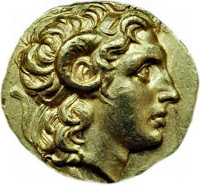
The ram was an important symbol of divine power at the Siwa oasis visited by Alexander the Great in the Libyan desert. He went to the Siwa temple to consult the oracle of Amun-Ra. Alexander's coin shows him with the ram's horns. As a child he was told that he was descended from the gods and it appears that he took this as justification for his vast conquests.

Some speculate that the term Dhul-Qarnayn - "The Two-Horned One" - that appears
in the Qur'an is a reference to Alexander the Great.


At the Amun-Ra Temple at the foot of Jebel Naga/Naqa in Sudan, twelve ram statues set on pedestals line the approach to the temple (see image below). This shrine city was first mentioned in texts of the Meroitic period in the 3rd century B.C. This site was dedicated to Amun-Ra, Horus and Hathor. It is a typical example of a Horite shrine with many pillars like those found at Karnak and Heliopolis (Iunu).


Abraham's people were Horites, a caste of priests that dispersed widely in the ancient world. They served rulers at the high places and at river shrines and temples. In ancient texts they are often known as 'Apiru, Hapiru or Habiru. The word Hebrew is derived from the word Habiru. O'piru refers to a Sun temple.

The Horite religion was messianic in character. It involved the expectation of divine action through the agency of the Creator's son, Horus. It is associated with the descendants of Noah known as Kushites, but not limited to the Kushites. The rulers of Edom (Idumea) were Horites. The region of Edom is also where Abraham ruled between Hebron and Beersheba. He received a ram to sacrifice on the mountain. In Horite religion the Sun rose as a lamb in the east and died as a ram in the West. The solar arc spoke to them of the advance from young innocence to mature strength as a warrior.  Horus was called the Lamb in his weaker (kenotic) state and he was called the Ram in his glorified strength. Both are associated with the death and resurrection symbolism of the vernal equinox

The Horites were devotees of Ra, Horus and Hathor. Horus was regarded as the "Son" of Ra who Hathor conceived when she was overshadowed by the Sun, the Creator's symbol or emblem. Hathor's animal totem was the long-horn cow, and she is shown wearing the horned crown as a sing of her divine appointment. 


Hathor conceived Horus by divine overshadowing of the Sun, the emblem of Ra.

The angel answered, "The Holy Spirit will come on you, and the power of the Most High will overshadow you. So the holy one to be born will be called the Son of God." Luke 1:35


Horite religion prevailed among the Nilo-Saharan rulers who kept cattle and sheep. The long horns of the cattle are often shown as a cradle for the overshadowing sun. Divine overshadowing meant appointment to rule. This is why many of the rulers of the Bible have names that begin with the Y horn symbol: Yitzak, Yishbak, Yaqtan, Yacob, Yeshua, etc.

The curved ram's horns represent the divine warrior defending his flock. The ram's horn, called shofar, was blown at the high places to sound the alarm and to call the warriors to arms. As such, the ram is often spoken of in terms of war, perhaps another reason Alexander, a great warrior, found it a compelling image. This view is supported by the conflict that arises between the ram and the he-goat in Daniel 8.

The Horite priests kept sheep and cattle to offer as sacrifices. These were often kept in a stone sheep cote (naveh) that had a beehive shape. The sheep cotes were sacred places. With the exception of red heifers, rarely were the females sacrificed. The sacrifice of the red heifer was to be a perpetual sacrifice for Israel (Numbers 19:9). The sacrifice of rams and bulls was regarded as more potent, just as the sacrifice of the ram on Mt. Moriah was more potent than that of the lamb about which Isaac inquired as he ascended the mount with Abraham.

The ancient Egyptian word for ram is ba, the same word used to speak of flesh. This may be a reference to the incarnation of Horus, the only deity of the ancient world to be represented as a human male. A sacred ram was kept at the shrine city of Djedet (Mendes) also known as Pr-Banebdjedet. Ba-neb-djedet means "Ram Lord of Djedet" or Ram Lord of the Sacred Pillar (djedet refers to a pillar). Pr refers to a house, shrine or temple, as in O'piru , a Sun temple.

The ram was a symbol of the incarnation of Horus. Once the ram died it was mummified and buried in a necropolis. Mummification was an essential step in preserving the flesh or body (ba) in anticipation of the resurrection. As St. Augustine noted, "the Egyptians alone believe in the resurrection, as they carefully preserved their dead bodies." (Death, Burial, and Rebirth in the Religions of Antiquity, p. 27)

Horus's anthropomorphic form is either as a adult male or as a boy wearing the sidelock typical of royal Egyptian youth. Horus as a boy is often shown on cippi dominating crocodiles and serpents. Consider this in light of the Woman, the Child, and the Dragon in Revelation 12.


The spread of ram imagery in Africa

M. D. W. Jeffreys is an anthropologist who teaches at the University of Pennsylvania. He has written about the spread of the ram-head deity throughout Africa. He maintains that the point of origin was Southern Nigeria. He wrote:
Among the Ibo of Southern Nigeria is a cult object known as Ikeŋga. It is associated with good fortune, success, ability and the strength of the right arm. It is represented by a carved wooden figure of a man with rams horns on his head and a machet in one hand and a human head in the other. Rams are sacrificed to it. The information of previous observers is summarized followed by my own field work. Then other instances in Africa of the ram‐headed god are discussed including that of Egypt whence it is concluded is derived the ram‐god cults of the rest of Africa. (From here.)

Related reading: What Abraham Learned on Mt. MoriahThe Ra-Horus-Hathor Narrative; Who Were the Horites?; The Urheimat of the Canaanite Y; Sheep Cotes as Sacred Spaces; Jesus: From Lamb to Ram; Monuments of the Ancient Kushites; Edom and the Horites; The Edomites and the Color Red; Ram and Bull

Thursday, June 4, 2015

Miners Venerated Hathor


Faynan Copper mine in present-day Jordan, ancient Edom.
This site is the Jordanian counterpart of the copper works at Timna.


Mohammad Najjar and Thomas Levy have been excavating at an ancient copper mine site in the Faynan district of Jordan for more than 20 years. Copper has been mined here for 12,000 years, and the copper smelting here has been done since 4,500 years ago.

This area was part of Edom, a land ruled by the Horites listed in Genesis 36. They are described as having a red skin tone and the ancient Greeks called Edom "Idumea" which means "land of red people." Edom was part of the Nabatean kingdom and the Nabatean warriors resembled the red Nubian warriors with their long wavy hair and the wearing of feathers on their legs.

Nabataean warriors had long wavy hair and wore feathers.
They appear to be related to the red Nubian warriors shown below.


The Horites were devotees of Re, Horus and Hathor. Hathor was venerated as the patroness of miners. Petra reflects Horite beliefs.

Faynan’s twin is the site of Timna in the Negev desert of Israel. In 1934 the area was surveyed by the American archaeologist Nelson Glueck. The area was also surveyed by Beno Rothenberg of Hebrew University between 1959 and 1961. Professor Rothenberg discovered a temple dedicated to Hathor at the southwest edge of Mt. Timna. The smelting works, slag and flints at Timna were found to be identical to those discovered near Beersheba where the elderly Abraham lived with his cousin wife, Keturah. In his book Timna, Rothenberg concluded that the peoples living in the area were "partners not only in the work but in the worship of Hathor." (p. 183)

Beersheba is at the southern boundary of ancient Edom. Both Edomite and Midianite pottery have been discovered at Beersheba. A four-horned brazen altar identical in structural to the altar used later by the Israelites was uncovered in 1973. This discovery was made by a team under the direction of Yohanan Aharoni and Ze'ev Herzog of Tel Aviv University. The team first encountered an ancient storage wall that contained the stones of the altar. Three of the stones still had large horns projecting from them, but the horn of the fourth stone had been broken off. Yet still another stone had the carved image of a serpent, probably indicating Kenite construction. The stones, which had been incorporated into a wall, were reassembled to assume their former shape and dated to the time of the Patriarchs. The altar may have been destroyed during Hezekiah’s attempts to eradicate all shrines outside Jerusalem.

Beersheba had strategic importance because it was the largest settlement in the Negev. It guarded the trade routes between Mesopotamia and Egypt and between the Nile Delta and Southern Arabia. Its fortifications in the late Iron Age were impressive and included a moat that encircled the city and a steeply-sloped earthen rampart. Beyond the rampart the city was surrounded by thick stone walls. The gate was a chambered type, and inside the gate archaeologists found an incense altar at the high place, just as described in II Kings 23:8.