Followers

Showing posts with label priests. Show all posts

Friday, March 8, 2024

Rabbis and Priests


A member of the Facebook group The Bible and Anthropology has asked, "Could a priest be a rabbi and vice versa? Those are always mentioned as two distinct categories, or so it seemed to me."


Dr. Alice C. Linsley

Many rabbis were also priests. The roles are different but could overlap. Rabbis taught and preached in the local synagogues. If their synagogue was in a town with a priestly division such as Nazareth, they also served for a term at the Temple in Jerusalem. 

During the Second Temple period (586 BC-70 AD) the twenty-four priestly divisions or "courses" served in the Temple in rotation. Each course served twice a year for a duration of two weeks. A list of priestly divisions is found in 1 Chronicles 24:7-18.

Nazareth was the home of the eighteenth priestly division, ha·pi·TSETS (Happizzez). In 1962 excavators discovered in the ruins of a synagogue at Caesarea a small piece of a list of the twenty-four priestly divisions. This third to fourth-century marble fragment is inscribed with the names of the places where four of the divisions resided, including Nazareth, the residence of Happizzez.

The priests lived in settlements throughout Israel. When it was "time for the division to go up [to Jerusalem]" (Mishnah, Ta'anit 4:2), the priests went up to Jerusalem to fulfill their obligations. When their appointed time of service in Jerusalem ended, the priests returned to their homes. When not functioning as a priest, these individuals went about their normal routines, tending to their various occupations: stone masons, miners, tomb builders, potters, tent makers, shepherds, goatherds, farmers, merchants, smiths, and carpenters. They also taught and preached in the local synagogues.


Deeper Roots

The point of origin of the Hebrew ruler-priest caste is the Nile Valley long before the time of Abraham. That caste had a moiety system, meaning that it was organized into two ritual groups, the Horite Hebrew and the Sethite Hebrew. Both groups built and maintained shrine and temples along the Nile. The oldest known site of Horite Hebrew worship is at Nekhen on the Nile (4200 BC). 

The Hebrew are probably the oldest known caste. They served at shrines, temples, and mortuary sites at least 1000 years before the caste system of India emerged. Their preserved their ethnic identity by marrying only within their caste (caste endogamy).

During the Old Kingdom (c. 2575-2130 BC) the Hebrew priests were organized in groups called "phyles." Each phyle served a two-week duration at the royal temple before returning home. The later organization of priests in Israel appears to have developed from the earlier Hebrew phyle system.


Sanhedrin Members

The Great Sanhedrin (the highest Jewish court) met in the Hall of Hewn Stones in the Temple in Jerusalem. It convened every day except festivals and Shabbat. Its members included priests, high ranking rabbinical authorities (rabbis), and wealthy Jews whose pure Hebrew ancestral lineages could be verified. The daughters of Sanhedrin members only married priests and rabbis. Only Jewish men belonging to prominent families were members of the Great Sanhedrin (the Beth Din HaGadol). The lesser Sanhedrin courts had members who were priests and rabbis also, but these courts had less authority.

The New Testament reports that many priests became followers of Jesus (Acts 6:7). At least three of Jesus' followers were members of the Sanhedrin: Nicodemus, Joseph Arimathea, and James the Just. The first priests in the service of Christ in southern England were likely ordained by Joseph Arimathea with the written consent of 2 other Sanhedrin members who were followers of the Way.

Members of the Sanhedrin served under the presidency of the high priest much as priests today serve under the presidency of their bishop. The high priest bore the title nasi (ruler, king, prince) and retained this title even after the presidency was transferred to other hands. Similarly, in Anglican and Roman Catholic orders a bishop retains the title "bishop" even after he has stepped down from serving in that office.

Jewish ordination was called semichah and it was necessary for membership in the Great Sanhedrin (The Great Court). Ordination was also required to serve in the lesser courts. Ordination was required to be a member of the Sanhedrin and that was obtained by the imposition of hands by someone who himself had been properly ordained. This is the precedent for the concept of Apostolic Succession in the Church. 

The Sanhedrin members served under the presidency of the high priest much as priests today served under the presidency of their bishop. The high priest bore the title nasi (ruler, king, prince) and retained this even after the presidency was transferred to other hands. Similarly, in Anglican and Roman Catholic orders a bishop retains the title "bishop" even after he has stepped down from serving in that office.

As individuals within the Sanhedrin passed away, or became unfit for service, new members were ordained in what Jews describe as an "unbroken succession" from Moses to Yehoshua the priest of the two crowns (Zec. 6:11), to the elders of Israel, to the prophets (including Haggai, Zechariah and Malachi), to the Anshei Knesses HaGedolah or "Men of the Great Assembly" founded by Ezra c. 520 B.C., to the sages of the Sanhedrin of the Second Temple (c. 520 - A.D. 70).

The second in charge was a ruler-priest who was called ab bet din (father of the court). The role of the ab bet din appears to have been a combination of the roles of the bishop's chaplain and the chancellor of the diocese who serves as the chief legal consultant to the Diocesan bishop. The polity and ordination procedures of the Anglican Church seem to parallel the Sanhedrin. As priestly ordination in Judaism was abolished in 358 AD, Christian priests stand alone as the living succession of priests in the Messianic Faith that we call "Christianity."

The third century Rabbi Johanan enumerates the qualifications for members of the Sanhedrin as follows: they must be tall, of imposing appearance, of advanced age, and scholars. They were also required to be adept in the use of foreign languages. When testimony was given to the Sanhedrin in a foreign language, at least two members who spoke that language were required to examine the witness. There was also a third member who understood the language. These three members constituted a minor court of three, who then reported the testimony to the entire Sanhedrin.

Some High Priests lived in exile among foreign peoples. One example is Hyrcanus who was living among the Parthians. Members of the Sanhedrin did business in foreign parts and visited the local synagogues. Joseph Arimathea would have had Jewish contacts in Cornwall and Devon, places he visited as a mining consultant. Mining in Cornwall and Devon in England began as early as 2150 BC. The Ding Dong mine is one of the oldest mines in Cornwall. An old miner told A. K. Hamilton Jenkin in the early 1940's: "Why, they do say there's only one mine in Cornwall older than Dolcoath, and that's Ding Dong, which was worked before the time of Jesus Christ." (Hamilton Jenkin, A. K. Cornwall and its People. London: J. M. Dent; p. 347) 

Tin ingots from Cornwall dating to 2000 BC have been found in Israel and ingots from Cornwall dating to 1300 BC have been found at archaeological sites in Turkey and Greece. The tin trade brought people together from the Levant, the Nile Valley, Mesopotamia, and parts of Europe.

Local legend holds that the Din Dong mine was one of the places visited by Joseph Arimathea. According to the Sanhedrin rules of ordination Joseph could rightfully ordain the first "Christian" priests while in England. He needed the written consent of only 2 other ruler-priests, and it is inconceivable that he would have neglected to do so.

Tuesday, January 17, 2023

Response to Cory Byrum’s Article on the Unity of Christ’s Body


Dr. Alice C. Linsley


In researching how priests were ordained in the time of Jesus Christ, I found that the rule set down by the Sanhedrin required three ruler-priests to give consent, but only one was required to be physically present for the laying on of hands. The other two could give consent in writing.

As far as we know, none of the Apostles were priests. Therefore, they were not qualified to ordain priests according to the ordination practice that they knew.

Instead, their ministry was evangelistic and pastoral. They bore witness to the long-awaited Son of God, the Messiah. This idea was developed by Cardinal Joseph Ratzinger who wrote: 

“Of great importance for our question is the fact that Jesus gave His power to the Apostles in such a way that He made their ministry, as it were, a continuation of His own mission. 'He who receives you receives me'. He Himself says to the Twelve (Mt 10:40; cf. Lk 10:16; Jn 13:10). Many other texts in which Jesus gives His power to the disciples could here be cited: Mt 9:8: 10:1: 21:23; Mk 0:7: 13:34; Lk 4:6: 9:1; 10:19. The continuity between the mission of Jesus and that of the apostles is once again illustrated with great clarity in the Fourth Gospel: 'As the Father has sent me. even so I send you'. (On the Nature of the Priesthood 20:21)

Certainly, the Apostles commissioned missionaries, elders, and deacons by the imposition of hands. Some of those elders served as Eucharistic ministers. None is described in the New Testament as offering blood sacrifice. We may say that the need for sacrificing priests no longer existed since Christ’s blood sacrifice fulfilled all the Law. That very fact tells us that there is continuity between the Old and the New as much as there is distinction between them.

There certainly is continuity in the requirement of three to consent to ordination. The Apostolic Canons of the Eastern Orthodox require that the consecration of a bishop must be accomplished by at least three. The same applies to episcopal consecrations in the Roman Catholic and Anglican churches. There is a precedent for this in history. In the Sanhedrin ordination was conferred by a court of three.

Members of the Sanhedrin served under the presidency of the high priest much as priests today serve under the presidency of their bishop. The high priest bore the title nasi (ruler, king, prince) and retained this title even after the presidency was transferred to other hands. Similarly, in Anglican orders a bishop remains a bishop even after he has stepped down from serving in that office.

The doctrine of Apostolic Succession received from Rome remains problematic since none of the Apostles were priests. Apostolic succession addresses who has authority over the flock, but it does not shed light on the continuity of the rules for ordination to the priesthood.

However, when we come to ancient Britain, we find a priest among Jesus followers who was qualified to ordain according to the Sanhedrin rule: Joseph of Arimathea. After we remove the embellishments of the Middle Ages we are left with this picture: Joseph was in southern Britain where he consulted as a mining expert. He is said to have visited the Ding Dong mine in Cornwall. (Lodes from that mine were worked well before the time of Abraham.) Mining experts also excavated cave tombs such as the one Joseph provided for our Lord’s repose. It is likely that Joseph saw the need for priests among the Messiah’s followers in Britain and that he ordained a few with the consent of two other members of the Sanhedrin. If this is so, the priesthood in England predates the papacy of Linus which began in A.D. 64.

The Roman narrative has dominated the conversation for so long that the deficiencies of the account are rarely questioned. The empowering of the Apostles cannot be understood as Jesus ordaining these men to the priesthood. This may explain why there is no documentation of the chain of succession during the very earliest days of the Church. There is documentation tracing the chain of consecration from the early 2nd century, but before that none. The Vatican acknowledges this fact. The 1973 International Theological Commission on Catholic Teaching on Apostolic Succession states:

“The absence of documents makes it difficult to say precisely how these transitions came about. By the end of the first century the situation was that the apostles or their closest helpers or eventually their successors directed the local colleges of episkopoi andpresbyteroi. By the beginning of the second century the figure of a single bishop who is the head of the communities appears very clearly in the letters of Saint Ignatius of Antioch, who further claims that this institution is established "unto the ends of the earth".

During the second century and after the Letter of Clement this institution is explicitly acknowledged to carry with it the apostolic succession. Ordination with imposition of hands, already witnessed to in the pastoral Epistles, appears in the process of clarification to be an important step in preserving the apostolic Tradition and guaranteeing succession in the ministry. The documents of the third century (Tradition of Hippolytus) show that this conviction was arrived at peacefully and was considered to be a necessary institution.” (INTERNATIONAL THEOLOGICAL COMMISSION, Catholic Teaching on Apostolic Succession, 1973)

Rome is in error when it claims to have brought Christianity to Britain. Father Louis R. Tarsitano expressed the truth when he wrote, "…it is a simple error of fact to claim that the Anglican Church 'began' in the Reformation, or even with the late 6th century mission of St. Augustine to evangelize the newly arrived Anglo-Saxon pagans. The bishops of a five-centuries-old Christian Church met Augustine on the beach.” (Of Forms and the Anglican Way)

The preamble of a 1421 letter by Abbot Nicholas Frome to Henry V asserted that Joseph of Arimathea and his companions were sent to England in A.D. 63 by St. Philip, who was on mission to Gaul (France). It was copied from materials found in William of Malmesbury’s interpolated De Antiquitate Glastonie Ecclesie, but the date of 63 A.D. for the arrival of Joseph of Arimathea seems too late. Gildas's De Excidio et Conquestu Britanniae claims that Christianity was already in Britain by A.D. 47.

The followers of Jesus Christ are divided into so many groups that it is impossible to name them all. Many yearn for visible unity, at least between the sacramental bodies. Visible unity requires a common commitment to truth regardless the cost to any single institution. In my view, Anglicans should question the Roman conception of Apostolic Succession which has been fashioned for one purpose: to justify Rome's claim to universal authority. Instead, we should claim as a ground for unity the dignity and antiquity of our Anglican patrimony which demonstrates continuity between the priesthood of the Old Covenant and the priesthood of the New Covenant. 

Concerning the validity of Anglican orders, E. J. Bicknell wrote (1919), "The Roman arguments rest upon two great assumptions. First, that Rome is at all times infallible, and therefore her teaching at any time about the meaning of the priesthood must be accepted without question. Secondly, that Rome has a divine right to implicit and universal obedience, and therefore any change in the form of service without her consent shows a contumacious spirit. Neither of these assumptions can be granted, and without them the whole argument collapses."

The only ground for visible unity is power surrendered to Truth.


Related reading: Cory Byrum, "Even As We Are One": On the Unity of Christ's BodyJoseph of ArimatheaWas King Arthur a Descendant of Nilotic Rulers?The Priesthood in England (Part 3); Two Visions of Apostolic Continuity


Wednesday, September 28, 2022

Male and Female are Primary in Hebrew Scriptures


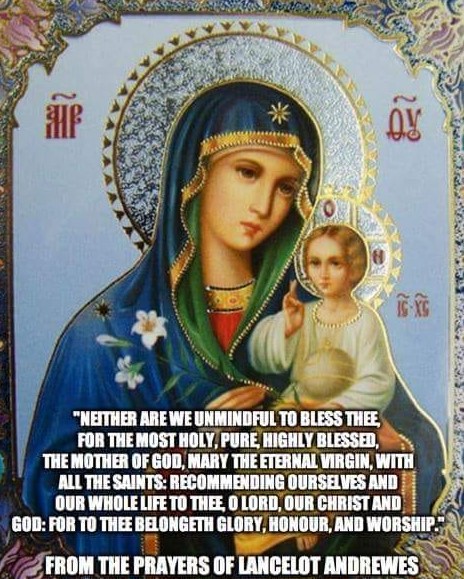
Lancelot Andrewes (1555-1626) was an English bishop who oversaw the translation of the King James Version of the Bible, also known as the Authorized Version.

Dr. Alice C. Linsley

A detailed study of gender in the Hebrew Scriptures reveals that male and female are primary to the Hebrew worldview and to their understanding of God Father and God Son. In recent decades critics of the binary balance of Scripture have falsely claimed that the social structure of the biblical Hebrew was patriarchal. However, anthropological analysis of their social structure reveals that it was characterized by binary balance. This balance is expressed in various biblical narratives. 

There are many examples: the distinct duties/responsibilities of the mother's house versus the father's house; male prophets-female prophets; male rulers-female rulers; inheritance by male heirs-inheritance by female heirs, patrilocal residence-matrilocal residence; Hebrew patronymics-Hebrew matronymics; and in the Hebrew double unilineal descent pattern, both the patrilineage and the matrilineage are recognized and honored, but in different ways. 

The blood symbolism of the Passover associated with Moses has a parallel in the blood symbolism of the scarlet cord associated with Rahab. The abusive behavior of drunken Noah toward his sons has a parallel in the abusive behavior of drunken Lot toward his daughters. 

There is binary balance in the New Testament narratives also. Jesus restored the widow of Nain's deceased son to his mother (Luke 7:11-17). Jesus restored Jairus' deceased daughter to her father (Mark 5:21-43). 

When Jesus was presented in the temple His identity as Messiah was attested by the priest Simeon and the prophetess Anna.

To understand the gender distinctions and binary balance of the early Hebrew, we must dismiss the false narrative that their social structure was patriarchal.

The traits of a strict patriarchy do not apply to the Hebrew from whom we receive the foundation of the Messianic Faith we call "Christianity". There were women chiefs and rulers among them. Women could inherit. Line of descent was traced through high-status wives, especially the cousin brides. Residential arrangements included neolocal, avunculocal, matrilocal, and patrilocal. Assessment of the biblical data reveals that male-female responsibilities and rights were balanced, yet distinct.


Mother’s House versus Father’s House

A very ancient practice is alluded to in Ruth 1:8-9. Here Naomi urges her daughters-in-law to return to their “mother’s house.” This is Naomi’s way of encouraging Orpah and Ruth to remarry. Hoping that they will marry again, Naomi sends them back to their mothers.

The “mother's house” is where women gathered to plan weddings for betrothed girls. The women attended to the practical arrangements for weddings and the items needed to set up a new household. On the other hand, the “father's house” was where the fathers deliberated the terms of the marriage involving dowry, inheritance, and property. The elders of the village were present to witness the deliberations. Sometimes fathers denied marriage to eligible daughters.

A woman who was forbidden to marry (or re-marry) was to return to her father's house. When Judah refused to marry another of his sons to Tamar, as was required by the Levirate marriage law, he told her to return to the father’s house (Gen. 38:11).

Scholars have noted that Rebecca ran to her mother's house to announce the marriage proposal from Isaac (Gen. 24:28). Running to her mother's house expressed Rebecca's willingness to accept Isaac’s proposal. This practice entails more than preparing for a wedding and a new household. It is about building a lineage. Naomi tells both of her widowed daughters-in-law to return to their "mother's house" in the hopes that they would remarry and have families.


Gender and the Priesthood

There are no female priests among the biblical Hebrew. The sacrificing priest would be covered with the blood of the slain animal. Since women were regarded as life-givers, their blood work (menses and childbirth) and the blood work of the priest could never be in the same space.

The male priest is a sign that points to the sacrifice of Jesus Christ. Every Christian priest stands at altar in the person of Christ whose maleness cannot be denied without eviscerating the biblical understanding of His blood sacrifice. By His death comes the forgiveness of sins.

Consistent with the binary balance of Scripture, we find the Virgin Mary is another sign that points to her son. The honor due to her is unique since she alone brought forth the Messiah, the Christ. By her submission and divine overshadowing (Luke 1:35) comes the One who overcomes sin and death.

A male standing at altar is appropriate when we contemplate the blood sacrifice of Jesus Christ. Women priests cause confusion because the sacrament of Christ's giving of Himself is about His Blood, a covering for sin. Female priests overthrow the binary balance.

Were we to contemplate the humble Virgin Mary, would it be appropriate to place before us a male image?

It is no coincidence that the innovation of women priests was first introduced by a denomination that had embraced Feminist thought and had created binary imbalance by promoting erroneous interpretations of Scripture and by dismissing the veneration of the Virgin Mary.


Eve, the Crown of Creation

In the creation stories Eve is the last creature to be given life by the Creator. In this sense she crowns the creation. The biblical Hebrew conceived of the order of creation as a hierarchy, somewhat like the shape of a mountain or a pyramid. The dwelling place of the High God is above the peak and at the peak is the crown of creation. Eve is vulnerable to attack by the Evil One who seeks to invert the hierarchy, placing himself at the head. Eve's submission to the ground-crawling serpent represents a metaphysical reversal of the divine order of creation. 

We live in this reversed state until Christ returns. This is what the Apostle Paul means when he speaks of the whole of Creation groaning and yearning for the day of redemption (Rom. 8:22-23). 

"For we know that the whole creation has been groaning together in the pains of childbirth until now. And not only the creation, but we ourselves, who have the firstfruits of the Spirit, groan inwardly as we wait eagerly for adoption as sons, the redemption of our bodies."


Friday, October 15, 2021

The Male Priesthood Has Deep Roots


Alice C. Linsley


Every tribal society studied by anthropologists regards blood as having power. This "primitive" belief is evident in Genesis 4:10. Shed blood was regarded as potentially dangerous or potentially curative. There were rituals appropriate for women after childbirth and for hunters after the kill. The blood of those killed in combat was to be washed off as soon as possible, and the blood guilt of warriors was to be addressed. Melchizedek, Priest of the Most High God, ministered to Abraham after combat, and the ceremony involved bread and wine (Gen. 14).

Based on evidence of 100,000+ years of red ochre burial, a symbolic blood covering, it is apparent that blood was linked to the hope for life after death, or immortality.

Very early in human history the offices of shaman and priest emerged to address blood anxiety and blood guilt. These are the earliest known religious offices, and both serve as mediators between the natural and supernatural. However, their practices are very different, in that priests are forbidden to engage spirits. 

The blood shed in war and hunting was not taken lightly by early populations. Nor was the blood shed by women in childbirth and their monthly cycle. All blood was to be accounted for by rituals, prayers, and offerings. This was the work of the priest and shaman. 

There were women shamans, but the taboo about mixing male-female bloods or having both present at the same place (as at the altar) meant that there were never any women priests. The so-called "priestesses" of the ancient world were shamans, not sacrificing priests. They served in temples as oracles who delivered messages in trance states, which is characteristic of shamans, not priests.

When early man took life in the hunt, the spiritual leader offered prayers and performed rituals to protect the community from blood guilt. The blood of the hunted animals was accounted for according to sacred law. Shamans rarely offer blood sacrifice. However, as early as 7000 years ago, priests at Catal Huyuk sacrificed animals, and 6000 years Nilotic priests offered blood sacrifice for the most grave offenses. 

Anthropological study of the origins of the priesthood indicate that the male priest stands as a symbol of prayer, sacrifice to cover blood guilt, and sacred law. This observed and documented reality stands behind the Church’s tradition of the male priesthood. It is a central feature of the received Messianic Tradition, and the Church alone has the honor of preserving it.


Sunday, April 19, 2015

The Red Heifer


Alice C. Linsley

The Biblical priesthood appears to have originated among the peoples of the Nile Valley when the green Sahara was able to sustain herds of long horned cattle. Cattle were first domesticated in the Upper Nile Valley about 15,000 years ago. The term for cow nag (Wolog, Fulani), nagge (Hausa), ning (Angas, Ankwe) and ninge (Susu) corresponds to the Egyptian ng.

The words edom, odum and adam are derived from the same root dm and originally referred to the red clay that washed down to the Upper Nile from the Ethiopian highlands. These soils have a cambic B horizon. Chromic cambisols have a strong red brown color. Abraham's Horite people were known to have a distinctive red skin tone. Esau and David are described as red. As a descendant of these red ancestors, Jesus likely had a red skin tone.

Red and black Nubian cattle herders

This is the original context from which the priesthood spread into southern Europe, India, and the ancient Near East. The red Nubians, some of whom were Abraham's ancestors, believed that life is in the blood. In their creation stories, the first man was made from the red soil of the Upper Nile. He is Adam or Ha-dam, meaning "the Blood." Blood was not only the substance of life, it was also the substance by which the people received cleansing through the ministry of their priests. This is why the red calf was the preferred sacrifice for purity.

Aaron created the Golden Calf, a representation of Horus, the divine "son" of the Creator. The image incorporated the sun and would have been a representation of the divine overshadowing or appointment of the Calf of God. Below is picture of what it would have looked like.


The calf is suggestive of Horus as a child. Horus' anthropomorphic form is either as a adult male or more usually as a boy wearing the sidelock typical of royal Egyptian youth. Horus as a boy is often shown on cippi dominating crocodiles and serpents. Consider this in light of the Woman, the Child, and the Dragon in Revelation 12.

Consider the red heifer (Numbers 19:9) that stands as a perpetual sacrifice. The red heifer is sacrificed and burned outside the camp and the ashes used for "water of lustration."  Lustration means to purify by a propitiatory offering or other sacred ceremony. After the completion of the Second Temple, the ashes of the red heifer were available for people who came to the temple. At the entrance to the Women's Court, there was a stone vessel called the kelal which held ashes of the red heifer. The ashes were mixed with water and used for purification ceremonies.


The association of blood and purity

The Hebrew root meaning pure is thr and it corresponds to the Hausa/Hahm word for clean: toro, and to the Tamil word for holy: tiru. All are related to the proto-Dravidian word fro blood: tor. The sacrificing priesthood was found among all these peoples.

The color red represented blood and life among the ancient Nilotes. The Horite priests regarded the red heifer as a representation of Horus, the "son" of the Creator, born miraculously of Hathor. She is shown with cow horns cradling the sun. This indicates overshadowing by the Creator, whose emblem was the Sun. Hathor's totem was the cow and she is shown in Nilotic shrines holding her infant in a stable. Hathor and Horus are expressions of the earliest Messianic expectation among Abraham's Nilo-Saharan ancestors.

The perpetual sacrifice of the red heifer is older than the Levitical priesthood. It pertains to Abraham's Nilo-Saharan cattle-herding ancestors and speaks of the sacrifice of Jesus Christ.

Christ came as High Priest of the good things to come, with the greater and more perfect tabernacle not made with hands, that is, not of this creation. Not with the blood of goats and calves, but with His own blood He entered the Most Holy Place once for all, having obtained eternal redemption. For if the blood of bulls and goats and the ashes of a heifer, sprinkling the unclean, sanctifies for the purifying of the flesh, how much more shall the blood of Christ, who through the eternal Spirit offered Himself without spot to God, cleanse your conscience from dead works to serve the living God? (Hebrews 9:11-14)

Unfortunately, there are Christians who fail to recognize that Jesus' crucifixion and glorious resurrection have fulfilled all the archetypes of the Old Testament. The Reverend Clyde Lott, a Pentecostal cattle breeder from Mississippi, is breeding red heifers to export to Israel to establish a breeding line of red heifers in the hope that this will prepare the way for the construction of the Third Temple and ultimately the Second Coming of Jesus Christ.  

Thursday, February 12, 2015

Blood Guilt and Christ's Priesthood


Alice C. Linsley

Based on their experience and observation, early humans came to think of blood as the substance of life. Life required blood. This is what stands behind Leviticus 17:11: "For the life of a creature is in the blood, and I have given it to you to make atonement for yourselves on the altar; it is the blood that makes atonement for one's life."

The earliest humans noted that animals and humans bled when wounded. If a human bled out, he/she died. The spirit left them. There was anxiety that the one who killed would be haunted by that spirit. This is why humans felt anxiety about shedding blood. They regarded blood as having supernatural power. You will recall that the blood of Abel cried to the Creator from the ground.

There is evidence in Genesis that a very early designation for the human was the word blood. Adam is likely derived from ha-dam, meaning "the blood."

The one who shed the blood of another human carried blood guilt. They knew it deep inside and it troubled them. They needed a mediator to stand between them and the Creator to restore them by ritual absolution of the blood guilt. This is the likely origin of the priesthood. You will recall that after combat, Abraham received the ministry of the ruler-priest Melchizedek. This ritual most certainly involved water purification, but it definitely involved bread and wine. Here we have the signs of the two great sacraments given by Christ to his church: Baptism and Eucharist.

Cain, Nimrod, Abraham, Joseph, Moses, David were men with blood on their hands. Cain killed Abel. Nimrod was a mighty hunter and a kingdom builder who forged his territory through conquest. Abraham killed in combat. Moses took the life of an Egyptian slave driver. David killed Goliath and arranged for the death of Uriah, Bathsheba's husband. The Bible does not sanitize the lives of these men. They bore blood guilt and they acutely felt the necessity of priestly absolution.

Hebrews 10:4 says, "It is impossible for the blood of bulls and goats to take away sins." The Horite ruler priests of Onn and Nekhen would have understood this. They recognized that the blood sacrifice had to be offered again and again. It did not serve once and for all, as does the blood of the Lamb of God. They lived in expectation of the reveling of the Lamb of God, and John the Baptist announced His appearing: "Behold the Lamb of God who takes away the sin of the world!" (John 1:29)

The Horim who lived in Palestine tended sheep because the terrain is less hospitable to cattle that the wide grasslands of the wet Sahara. So the Christ is called "Lamb' of God. However, their Nilo-Saharan ancestors were cattle herders, and for them the image of the divine sacrifice was the "Calf" of God. This is the meaning behind the account of the Golden Horus Calf fabricated by Aaron (Ex. 32).


The calf is suggestive of Horus as a child. Horus' anthropomorphic form is either as a adult male who is the patron of kings, or as a boy wearing the sidelock typical of royal Egyptian youth. As a youth he represents the heir to the kingdom who is innocent of blood guilt. He represents both purity and power to subdue. Horus as a child is often shown on cippi dominating crocodiles and serpents. Consider this in light of the Woman, the Child, and the Dragon in Revelation 12. Consider also the red cow of Numbers 19 that stands as a perpetual symbol of Israel's need for cleansing. The cow is sacrificed and burned outside the camp and the ashes used for "water of lustration." (Num. 19:9) Consider this: Jesus, as with his ancestors Adam, Esau, David, and the Horites of Edom, had a distinctive red skin tone. He was sacrificed outside the camp, and through His blood we are washed clean.

Among Abraham's Nilo-Saharan ancestors, the Calf's mother was called Hathor. Her animal totem was the long-horned cow and she was depicted with a crown of horns in which the sun rests, as a sign of her divine appointment. This is fulfilled in Mary. The angel answered, "The Holy Spirit will come on you, and the power of the Most High will overshadow you. So the holy one to be born will be called the Son of God." (Luke 1:35)

Hathor appears on monument walls at Dendera holding her calf child in a manger.

The Proto-Gospel involves other details that have been specifically fulfilled in Mary and Jesus. One is the ancient Horite belief that Horus would rise on the third day. This was ritualized by the priests blessing grain sowed in the fields on the third day after 2 days of mourning the death of Horus at the hands of his own brother. This is what stand behind Jesus explanation to his disciples about HIS impending death: "Truly, truly, I say to you, unless a grain of wheat falls into the earth and dies, it remains alone; but if it dies, it bears much fruit." (John 12:24)

Related reading: Who is Jesus?; Fundamentalism and Syncretism in Hebrew History; Boats and Cows of the Proto-Saharans; Adam Was a Red Man; The Edomites and the Color Red; Blood and Binary Distinctions; Ethical Concerns of Archaic Communities


Friday, January 23, 2015

The Priesthood in England - Conclusion


This concludes a four-part historical and anthropological study on the priesthood in England. Parts 1-3 are linked at the bottom of this page. Readers are encouraged to begin with Part 1 which compares and contrasts the Anglican, Roman Catholic, and Eastern Orthodox narratives touching on the early presence of priests in England.


Dr. Alice C. Linsley

In this series I have presented information about the two streams of authority in Anglicanism as they came into the British Isles: one via the Sanhedrin authority whereby Jesus' followers in Britain ordained priests, and the other via the Roman Mission which is what most refer to as the "Apostolic Succession".

Apostolic succession pertains to the passage of authority from generation to generation in the Church. It is expressed in 2 Timothy 2:2 where the Apostle Paul directs that “the things you have heard me say in the presence of many witnesses entrust to faithful men who will also be qualified to teach others.”

Apostolic succession does not explain why the Church has a priesthood that is patterned on the priesthood of the early Hebrew. That is best explained by the presence of Hebrew priests in Britain who were disciples of Jesus Christ and authorized to ordain priests according to the ordination rules of the Sanhedrin.

Two Sanhedrin members prepared Jesus' body for burial and saw him buried in the tomb excavated by Joseph Arimathea, a mining expert. John 19 makes it clear that Nicodemus and Joseph Arimathea were well acquainted. Their devotion would have been strengthened by the act of laying Jesus' body in the tomb. The third member of the Sanhedrin who recognized Jesus' identity was James the Just. By the consent of these three ruler-priests, men were ordained priests for the Church in Britain.

These ruler-priests, members of the Sanhedrin, had authority to ordain priests for the church. Joseph Arimathea was a mining expert who also excavated for himself a tomb out of rock. He was a descendant and successor of the early Hebrew ruler-priests, the oldest known priestly caste. If this is so, the validity and the authority of the priesthood in England stands on two feet: that of the Hebrew ruler-priests and that of the succession claimed by the Roman Church. 

Anglicans have held to the Roman account of the priesthood as originating with Jesus' Apostles. This idea was beautifully developed by Cardinal Joseph Ratzinger (Pope Benedict), who wrote:

Of great importance for our question is the fact that Jesus gave His power to the Apostles in such a way that He made their ministry, as it were, a continuation of His own mission. "He who receives you receives me". He Himself says to the Twelve (Mt 10:40; cf. Lk 10:16; Jn 13:10). Many other texts in which Jesus gives His power to the disciples could here be cited: Mt 9:8: 10:1: 21:23; Mk 0:7: 13:34; Lk 4:6: 9:1; 10:19. The continuity between the mission of Jesus and that of the apostles is once again illustrated with great clarity in the Fourth Gospel: "As the Father has sent me. even so I send you" (20:21: cf. 13:20; 17:18).

The weight of this sentence is evident if we recall what we said above concerning the structure of the mission of Jesus. As we saw, Jesus Himself, sent in the totality of His person, is indeed mission and relation from the Father and to the Father. In this light the great importance of the following parallelism appears: "The Son can do nothing of His own accord" (Jn 5:19-30). "Apart from Me you can do nothing" (Jn 15:5).

This "nothing" which the disciples share with Jesus expresses at one and the same time both the power and the infirmity of the apostolic ministry. By themselves, of their own strength, they can do none of those things which apostles must do. How could they of their own accord say, "I forgive you your sins"? How could they say, "This is my body"? How could they perform the imposition of hands and say, "Receive the Holy Spirit"? None of those things which constitute apostolic activity are done by one's own authority. But this expropriation of their very powers constitutes a mode of communion with Jesus, who is wholly from the Father, with Him all things and nothing without Him. Their own "nihil posse", their own inability to do anything, draws them into a community of mission with Jesus. Such a ministry, in which a man does and gives through a divine communication what he could never do and give on his own is called by the tradition of the Church a "sacrament".

If Church usage calls ordination to the ministry of priesthood a "sacrament", the following is meant: This man is in no way performing functions for which he is highly qualified by his own natural ability nor is he doing the things that please him most and that are most profitable. On the contrary, the one who receives the sacrament is sent to give what he cannot give of his own strength; he is sent to act in the person of another, to be his living instrument. For this reason no human being can declare himself a priest; for this reason, too. no community can promote a person to this ministry by its own decree.
(From On The Nature of the Priesthood.)

Catholics and Anglicans traditionally have traced the origins of the office of bishop to the apostles, who it is believed were endowed with a special charism by the Holy Spirit at Pentecost. Catholics and Anglicans believe this special charism is transmitted through the unbroken succession of bishops by the laying on of hands (Numbers 27:22-23).

The evidence which has been presented in this series suggests that this is only part of the story. There appear to have been two streams of priestly consecration or two sources of validity for the Christian priesthood. One is discontinuous with the priesthood established by God among the early Hebrew, and the other appears to be a continuation of that early priesthood. There is evidence of this in England, and a similar study of the priesthood in other regions of the world would likely support this understanding.

The Hebrew ruler-priests were a caste dating back to at least 4000 BC. They married only within their caste (endogamy). Because of caste endogamy, the Messianic priesthood, of which the Christian priesthood is the only living extension, remained within their caste. Jesus is a direct descendant of those early Hebrew ruler-priests. Long before Judaism, they believed in God Father and God Son, and they expected a woman of their ruler-priest caste to conceive the Son of God by divine overshadowing (Luke 1:35, cf. Gen. 3:15).

Jewish ordination was called "semichah" and was necessary for membership in the Great Sanhedrin, and for membership in the smaller courts. A member of the Sanhedrin required a special level of ordination and that was obtained by the imposition of hands by someone who himself had been so ordained. This is the precedent for the concept of Apostolic Succession in the Church. However, as far as we know, none of the Twelve Apostles were ordained. 

The earliest Christian priests in Britain were probably ordained by believing Sanhedrin priests like Joseph of Arimathea, James the Just, and Nicodemus. Acts tells us that there were other priests who believed Jesus Messiah and followed Him. After Pentecost "a great many of the priests were obedient to the faith". It is also likely that some of the seven sons of Sceva, a chief priest, came to faith and they too were qualified to ordain (Acts 19:14). 

The empowering of his disciples to make other disciples cannot be understood as Jesus ordaining these men to the priesthood, and the charisms of the Holy Spirit are granted to all Christians, not just priests. There is nothing in the account of Pentecost to support the idea that the Apostles were priests. As far as we know, none were priests. This is why there is no scholarly documentation of the chain of succession during the very earliest days of the Church. According to this account, the original bishops were consecrated by one or more of the Apostles. These successor bishops later consecrated more bishops. There is documentation tracing the chain of consecration from the early 2nd century, but before that none. The Vatican acknowledges this fact. The 1973 International Theological Commission on Catholic Teaching on Apostolic Succession states:

The absence of documents makes it difficult to say precisely how these transitions came about. By the end of the first century the situation was that the apostles or their closest helpers or eventually their successors directed the local colleges of episkopoi andpresbyteroi. By the beginning of the second century the figure of a single bishop who is the head of the communities appears very clearly in the letters of Saint Ignatius of Antioch, who further claims that this institution is established "unto the ends of the earth" (Ad Epk. 3, 2).

During the second century and after the Letter of Clement this institution is explicitly acknowledged to carry with it the apostolic succession. Ordination with imposition of hands, already witnessed to in the pastoral Epistles, appears in the process of clarification to be an important step in preserving the apostolic Tradition and guaranteeing succession in the ministry. The documents of the third century (Tradition of Hippolytus) show that this conviction was arrived at peacefully and was considered to be a necessary institution. (From here.)

When the best Church scholars fail to find evidence for something, it is probable that the evidence does not exist. Perhaps it is time to look at this from a different perspective.

The Apostolic Canons of the Eastern Orthodox require that the consecration of a bishop must be accomplished by at least three. The same applies to episcopal consecrations in the Roman Catholic and Anglican churches. There is a precedent for this in history. In the Sanhedrin ordination was conferred by a court of three. There were three ruler-priests among Jesus' disciples, and it is through them that the succession of the priesthood continued and has continuity with the priesthood "after the order of Melchizedek." All three of these priests were members of the Sanhedrin, and the law did not require that they all be present to lay on hands. As long as one was present to lay on hands, the other two could consent by messenger or letter.


Only priests belonging to prominent families were members of the Sanhedrin, the Beth Din HaGadol (The Great Court). A "prominent" family was one whose lineages could be traced back to Horite Hebrew ruler-priests (what Jews call their "Horim"). These members of the Sanhedrin served under the presidency of the high priest much as priests today served under the presidency of their bishop. The high priest bore the title nasi (ruler, king, prince) and retained this even after the presidency was transferred to other hands. Similarly, in Anglican orders a bishop remains a bishop even after he has stepped down from serving in that office.

As individuals within the Sanhedrin passed away, or became unfit for service, new members were ordained in what Jews describe as an "unbroken succession" from Moses to Yehoshua the priest of the two crowns (Zec. 6:11), to the elders of Israel, to the prophets (including Haggai, Zechariah and Malachi), to the Anshei Knesses HaGedolah or "Men of the Great Assembly" founded by Ezra c. 520 B.C., to the sages of the Sanhedrin of the Second Temple (c. 520 - A.D. 70).

The second in charge was a ruler-priest who was called ab bet din (father of the court). The role of the ab bet din appears to have been a combination of the roles of the bishop's chaplain and the chancellor of the diocese who serves as the chief legal consultant to the Bishop. The polity and ordination procedures of the Anglican Church seem to parallel the Sanhedrin. As the ordination was abolished in 358 AD, Christian priests alone stand as the living succession of priests in the Messianic Faith that we call "Christianity".

The third century Rabbi Johanan enumerates the qualifications for members of the Sanhedrin as follows: they must be tall, of imposing appearance, of advanced age, and scholars. They were also required to be adept in the use of foreign languages. When testimony was given to the Sanhedrin in a foreign language, at least two members who spoke that language were required to examine the witness. There was also a third member who understood the language. These three members constituted a minor court of three, who then reported the testimony to the entire Sanhedrin.

Many members of the Sanhedrin did business in foreign parts and visited the local synagogues. Some High Priests lived in exile among foreign peoples (Hyrcanus among the Parthians, for example.)

The only followers of Jesus that are known to be members of the Sanhedrin were James the Just, Nicodemus, and Joseph Arimathea who was called "bouleutēs" (honorable counselor). Joseph was "waiting for the kingdom of God" according to Mark 15:43. He is designated Arimathea, that is, of the ruling line of Matthew. This means he was a kinsman of Jesus. Mary’s parents were Yoachim and Anna. Yoachim was a shepherd-priest and his wife Anna was a daughter of a priest. Hippolytus of Thebes records that Mary’s mother was one of three daughters of a priest named Matthan or Mathea (Matthias).

Apparently, Joseph had business and probably family connections in Cornwall. The Cornish say that he once visited the Ding Dong mining operation. Eusebius of Caesarea (260–340 A.D.) may have been referring to this in Demonstratio Evangelica when he reports that some of Jesus' earliest disciples "have crossed the Ocean and reached the Isles of Britain." Since one qualification of membership in the Sanhedrin was facility of multiple languages, Joseph would have been able to communicate with the people of Britain.

As a ruler-priest Joseph would have known men who were qualified to serve as Christian priests in Britain and he would have been able to arrange for their ordination. Being of advanced age, he would have been older than Jesus and most of His Apostles. This means that any ordinations he may have arranged in Cornwall could have taken place within a few years of Jesus' death and resurrection.


Priestly and Commercial Records

The hieroglyphs were priestly writings, and the oldest of these are found in the Upper Nile. The oldest known site of early Hebrew worship (both Horite and Sethite) was at Nekhen

Orly Goldwasser, professor of Egyptology at the Hebrew University of Jerusalem, argues that the first alphabet, from which all other alphabets developed, was invented by Canaanite miners in the turquoise mines of Serabit el-Khadem in the Sinai Peninsula. The pictorial hieroglyphs of the Nile Valley served as the inspiration for the later alphabets.

Other ancient writing forms used by merchants for keeping accounts are found along ancient trade routes; the spice routes, the silk routes, the King's Highway from Egypt through Palestine, the ancient tin route from Spain to Ireland, etc. These involve fewer pictographs and more hatch marks that suggest counting or record keeping. Ogham bears resemblance to these earlier commercial scripts. Some of the elements of the commercial scripts are found in Hebrew and in Ainu, scripts which are clearly related.


A comparison of the Ainu (Kata) and Hebrew scripts reveals a connection that is explained by the fact that the earliest scripts were those used by priests in the service of rulers in many regions, and these priest-scribes kept royal accounts. These ancient rulers are the "mighty men of old" mentioned in Genesis 6. One of them was Nimrod, a Kushite kingdom builder (Gen. 10). Among them were the "red" rulers associated with Abraham and his ancestors Adam and Seth, and his descendants Esau and King David.

The wide dispersion of the early Hebrew priests and scribes is evident in the study of ancient texts and through the presence of both priestly and commercial scripts worldwide. This dispersion began at least 3,000 years before Jesus Christ and included movement in in many directions: Africa, Arabia, Mesopotamia, Anatolia, central Europe, the Western Zagros, Spain, and the British Isles.

There is no reason to doubt the historicity of Joseph Arimathea's connection to Cornwall in spite of the dubious Medieval legends surrounding him. He had business in Cornwall as a metal tradesman and a mining expert. From the time of the earliest pharaohs mining and tomb construction were the work of ruler-priests. Joseph of Arimathea was likely engaged in both, even as he was responsible for the tomb where the Lord Jesus was laid to rest. As a high-ranking priest of the Sanhedrin, he had authority to ordain priests. As a follower of Jesus Messiah, he is an important figure who confirms continuity between the priesthood attached to the promises made to Abraham and his Hebrew ancestors and the priesthood of the Church.

Anglican orders rest on Apostolic succession and the authority of the Sanhedrin to ordain priests. At least 3 Sanhedrin members were followers of Jesus: Joseph Arimathea, Nicodemus, and James the Just. The continuity between the priests of the Old Covenant and the priests of the New Covenant is through the Sanhedrin whose members were verified to be of the Hebrew ruler-priest lineages extending back 6000 years. This means that Anglican orders rest on both Apostolic succession and priestly succession. The Roman Catholic Church claims only Apostolic succession.


Related reading: The Priesthood in England - Part 1; The Priesthood in England - Part 2; The Priesthood in England - Part 3; Why Nekhen is Anthropologically Significant; E.J. Bicknell on Anglican Orders (1919); The Hebrew were a Caste

Thursday, January 22, 2015

The Priesthood in England - Part 3


Alice C. Linsley

Given the evidence set forth in Parts 1 and 2 about the priesthood in England, we must consider the possibility of double validity: 1) succession through the priesthood, and 2) succession through the Apostles.

Among the Seventy, there were Jewish priests. One of them was Ananias of Damascus who laid hands on Paul and Paul received the charism of the Holy Spirit (Acts 9). This is exactly what the Church believes concerning Apostolic Succession, only Ananias was not one of the Twelve Apostles. This suggests greater continuity between the priesthood of old and the priesthood of the Church than is generally recognized.

I would like to expand on that. In the early centuries Christians in the Roman empire tended to stress the Resurrection of Jesus more than Baptism because they were baptized by blood (martyrdom). However, on the edges of the empire, Baptism was stressed more often. For example, in Armenia where icons of Ananias depict him baptizing Paul. This 12th century Italian icon is an example.


The Armeni origins have been traced to Neolithic populations of the Caucasus and to dispersed African populations, largely Sub-Saharan Nilotes (c. 3000 BC). Armenian DNA studies show they have a mixture of these gene flows. Findings in linguistics, DNA studies, migration patterns, routes of tin mining, toponyms, archaeology, and anthropology support the possibility of two streams of authority for the priesthood of the Church.


The Evidence from Cornwall

Oral tradition in Cornwall holds that the ruler-priest Joseph Arimathea came there in connection to mining. Joseph of the venerable (Ar) clan of Matthew (Ar-Mathea) was a mining expert who probably did assessments for the Romans. He may have had relatives and/or Hebrew business associates living in Cornwall and Devon, as evidenced by the many Semitic places names in that region of southern England.

Joseph was a member of the Sanhedrin, a council of ruling priests. In the ancient world, ruler-priests were responsible for metal work, surface and tunnel mining operations, and the construction of royal tombs.

No one knows when surface mining began in Cornwall and Devon, but it was well before 2150 B.C. Tin ore was mined in Cornwall as early as the Bronze age. Dolcoath dates from the late 1500's, but Ding Dong, with its proximity to the Nine maidens stone circle, is considered one of the oldest mines in Cornwall. An old miner told A. K. Hamilton Jenkin in the early 1940's: "Why, they do say there's only one mine in Cornwall older than Dolcoath, and that's Ding Dong, which was worked before the time of Jesus Christ." (Hamilton Jenkin, A. K. Cornwall and its People. London: J. M. Dent; p. 347)

Christopher Hawkins wrote a book titled Observations on the Tin Trade of the Ancients in Cornwall (1811) in which he noted that Cornwall was visited by metal traders from the eastern Mediterranean. One of those metal traders was Joseph of Arimathea, a member of the Sanhedrin.

The legend concerning Joseph of Arimathea's connection to Britain has support from the sciences. Genetic studies have confirmed about 70% of native British men has Y-DNA R1b ancestry, which is the same genetic group as King Tut. 

An early population living in the region of Cornwall were Dam-oni which means red people. Dam-oni is likely a reference to the red skin. They were the builders of the great shrine city of Heliopolis, Biblical On.

A variant spelling is Dumnonii (shown on the map). The Dam-oni may have come from Carnac in Brittany because the stone monoliths in Damnonia are like those in Carnac, though smaller. On the Nile the ancient shrine at Karnak was built with huge stones by skillful craftsmen. 

Jews lived in Cornwall from before the Roman Period. They were as tradesmen, artisans, stone masons, metal workers, and miners. Among them were the priests who performed animal sacrifices, circumcision, and the Sun blessing ceremony (Birkat Hachama). Today rabbis perform the ceremony only every 28 years on a Tuesday at sundown, but in the ancient world this ceremony was probably performed by the Habiru at mid-winter, from which point the days would begin to lengthen, and at mid-summer, from which point the days would begin to shorten. The circle at Stonehenge was designed to help the priests know when to perform such ceremonies. The word Samhain is clearly related to the Arabic word for the Sun - shams. Ha-in is probably of Semitic origin also, and may be a variant of ha-on, referring to the sea-faring Ainu/Oni.

The inhabitants of Cornwall were involved in the manufacture of tin ingots. The area has prehistoric tin mines, stone monoliths, and iron age fortresses. This is the region where Joseph of Ar-Mathea is said to have visited, and the presence of Hebrew is evident in place names like Marazion, meaning "sight of Zion" or Menheniot, which is derived from the Hebrew words min oniyot, meaning "from ships." Menheniot was a center of lead mining.

The smiths of Cornwall also worked gold. This golden lunula from Cornwall dates to between 2400-2000 BC.


The Hebrew living in the British Isles also exhibited great skill in the construction of stone monuments, as did their ancestors who built monuments at Karnak and Heliopolis on the Nile, and stone fortresses like Meroe on the Orontes. Their ancestors probably built Göbekli Tepe and Catalhoyuk. Their mining expertise was evident in the construction of excavated tombs, stone tombs, and tomb mounds such as those found in Bosnia and the Tarum Valley of China. In Orkney the intricate and extraordinary cairn at Maeshowe (shown below) is chambered exactly like that of ancient royal tombs found in Bosnia.


Maeshowe in Orkney


Prehistoric cairns, henges, and brochs are found throughout the British Isles. Chambered cairns have been found in vast areas of Scotland, some dating to 5,000-6,000 B.C. Huge kerbstones have been found at the entrance of some cairns. These are shaped to fit a passageway leading to the burial chambers of high-status individuals. 

Stonework such as this required the skills of a specialized group of men. From ancient times this work was done by priests.

The pyramids, stone monuments, temples, shrine cities, and tombs of the ancient world show a remarkable similarity in their construction. They reveal accurate astronomical observations, as has been demonstrated through studies of Stonehenge. Fred Hoyle (California Institute of Technology) observes in his book on Stonehenge that men living 5000 years ago were "meticulous observers of the night sky" who "calculated with numbers" and "communicated sophisticated astronomical knowledge among themselves from generation to generation." From the earliest times, this was the work of priests and that has been shown time again by research into ancient sacred sites.


Men-an-Tol stone near Penzance in Cornwall


The motifs that appear on the stonework also connect the craftsmen of tombs, monuments and crosses to the ancient 6-prong solar symbol of the dispersed Hebrew. That motif is found on the ossuaries of the ruling families in Jerusalem and on some Celtic crosses. This is the ossuary of Miriam, a granddaughter of the High Priest Caiaphas.


Among the early Hebrew ruler-priests the Sun was the emblem of the High God. It is not surprising that solar symbols appear in Cornwall. St. Piran's Cross (below) is an example. Saint Piran was an early 6th-century Cornish abbot and the patron saint of tin-miners. Isotopic analyses have shown that tin from Cornwall was traded as far away as the Aegean and other eastern Mediterranean regions.


Related reading: The Ar RulersThe Neolithic and Bronze Age Periods in Cornwall, The Priesthood in England - Part 1; The Priesthood in England - Part 2; The Priesthood in England - Conclusion; Was King Arthur a Descendant of Nilotic Rulers?; The Ancient Tumuli of Nobles; Stonework of the Ancient World

The Priesthood in England - Part 2


Alice C. Linsley


In Part 1 we considered the Anglican, Roman Catholic, and Eastern Orthodox accounts of how Christianity came to England. The information provided in Part 1 was taken from official websites of each of these branches of the catholic Faith. 

The one point on which all three accounts agree is that Augustine was the official representative of Rome and was based in Canterbury. As Britain was part of the Roman Empire, it is not surprising that the Roman Catholic narrative should predominate. That narrative has dominated the conversation for so long that the deficiencies of the account are rarely questioned.


These standing stones at Gezer date to around 400 years before the time of Abraham.
Photo: Dennis Cole


None of the narratives explore the evidence of a ruler-priest caste in the British Isles before the Roman Period. These priests served as prophets, scribes, smiths, stone masons, and physicians. They performed circumcisions, a practice that persisted among the royal families of Anglo-Celtic heritage. They offered sacrifices and prayers at sacred shrines, performed ceremonies at circles of standing stones, and they were ordained by ruler-priests in a succession extending back well before the time of Abraham. 

The point of origin of the Hebrew ruler-priest caste is the Nile Valley long before the time of Abraham. That caste has a moiety system, meaning that it was organized into two ritual groups, the Horite Hebrew and the Sethite Hebrew. Both groups built and maintained shrine cities along the Nile. The oldest known site of Horite Hebrew worship is at Nekhen (4000 BC). 

The Nile River was called the Ar and persons with Nilotic ancestry often have names with the Ar prefix. The Ar prefix means "venerable" and applies to rulers, many of whom built their palaces, temples, and treasuries at fortified rock shelters. Indeed, the AR is found in the Irish word Ard Mhacha (Armagh) which was a ceremonial high place. The Ar reference is found in the names of many historical persons, including the Edomite ruler Arêtes, Ar-Shem, Arsames, Artix, Araxes, Artaxerxes, Araunah (Jebusite ruler), Joseph of Arimathea, King Arwium (of Kish), King Arthur, King Arviragus, and King Arishen, a Horite Hebrew ruler whose territory was in the central Zagros. 

The "Ar" is likely a shortened Horus name as is suggested by the Nabataean King Harithath IV who bears the Horus name. In 2 Corinthians 11:32, King Harithath is called King Aretas. Many early Hebrew had Horus names as Horus was the patron of kings and priests in the ancient world.

It is evident that the Ar peoples were highly skilled in the construction of stone tombs and monuments. These were shrine centers attended by priests and were circular with large perimeter stones such as those found at Stonehenge in England, Gezer in Israel, Metsamor in Armenia, and Göbekli Tepe in Turkey (shown below).


The prefix Ar is also found in place names such as Armenia, Arles, Arba, Aram, Arvan, and Arvad. The Arvadites and Arkites are mentioned in Genesis 10:15-18. They are the peoples of Sidon and Het/Heth. They dispersed to the northeast. Some of their Mesopotamian kin are called "Arameans" in the Bible.


Continuity Between the Priesthood of old and the Priesthood of the Church

Some of the Hebrew in Britain would have been living in expectation of the Messiah and would have heard about Jesus' death and resurrection from Jewish kin and Jews with whom they did business. Men like Joseph of Arimathea would have had opportunities to plant a Christian presence among their fellow Jews. As a member of the Sanhedrin, Joseph was qualified to perform ordinations.

In researching how Jewish priests were ordained in the time of Jesus Christ, I found that the rule set down by the Sanhedrin required three ruler-priests to give consent, but only one was required to be physically present for the laying on of hands. The other two could give consent in writing.

This suggests that the priesthood among the natives of Britain has a longer history than has been generally recognized. According to Gildas's De Excidio et Conquestu Britanniae there were already Christians living in Britain in 46 AD. The presence of Christians in Roman Britain predates the episcopacy of Evodius of Antioch (53–69 A.D.) and the episcopacy of James of Jerusalem (d. 69 A.D.), and the episcopacy of Linus of Rome (64-79 A.D.).

Members of the Sanhedrin served under the presidency of the high priest much as priests today serve under the presidency of their bishop. The high priest bore the title nasi (ruler, king, prince) and retained this title even after the presidency was transferred to other hands. Similarly, in Anglican orders a bishop remains a bishop even after he has stepped down from serving in that office. Note the continuity of the tradition concerning the ordination of priests!

The doctrine of Apostolic Succession received from Rome remains problematic since none of the Apostles were priests, as far as we know. Apostolic succession addresses who has authority over the flock, but it does not shed light on the continuity of the priesthood between the Old order and New order. In fact, the best scholars of the Roman Catholic Church have been unable to demonstrate unbroken succession from Jesus to the priesthood of the Church. There is no documentation tracing the chain of consecration from before the Second Century. 

The implications of the priesthood being introduced into England by Messianic Jewish priests are why many will not even consider this angle. My concern is the problem of discontinuity when I do not see that in the Scriptures, or in the immutable way God works. I also suspect that there is more continuity between the priesthood of old and the priesthood of the Church in areas of the world claimed by Eastern Orthodoxy and Roman Catholicism since Messianic priests had dispersed into those areas even before the time of the Incarnation. However, those areas are not the focus of this exploration.

When we come to ancient Britain, we find a priest among Jesus' followers who was qualified to ordain according to the Sanhedrin rule: Joseph of Arimathea. After we remove the embellishments of the Middle Ages we are left with this picture: Joseph was in southern Britain where he consulted as a mining expert. He is said to have visited the Ding Dong mine in Cornwall. (Lodes from that mine were worked well before the time of Abraham.) Mining experts also excavated cave tombs such as the one Joseph provided for our Lord’s repose. It is likely that Joseph saw the need for priests among the Messiah’s followers in Britain and that he ordained a few with the consent of two other members of the Sanhedrin. The two most likely are Nicodemus and James the Just, the first bishop of Jerusalem. If this is so, the priesthood in England clearly predates the papacy of Linus which began in A.D. 64.

The empowering of the Apostles to proclaim the Gospel, to plant churches, and to act as authorities in defense of the Faith cannot be understood as ordination to the priesthood. This is the most logical explanation for why there is no documentation of the chain of succession during the earliest days of the Church. There is documentation tracing the chain of consecration from the early Second Century, but before that none. The Vatican acknowledges this fact. The 1973 International Theological Commission on Catholic Teaching on Apostolic Succession states:

“The absence of documents makes it difficult to say precisely how these transitions came about. By the end of the first century the situation was that the apostles or their closest helpers or eventually their successors directed the local colleges of episkopoi and presbyteroi. By the beginning of the second century the figure of a single bishop who is the head of the communities appears very clearly in the letters of Saint Ignatius of Antioch, who further claims that this institution is established "unto the ends of the earth".

During the second century and after the Letter of Clement this institution is explicitly acknowledged to carry with it the apostolic succession. Ordination with imposition of hands, already witnessed to in the pastoral Epistles, appears in the process of clarification to be an important step in preserving the apostolic Tradition and guaranteeing succession in the ministry. The documents of the third century (Tradition of Hippolytus) show that this conviction was arrived at peacefully and was considered to be a necessary institution.” (INTERNATIONAL THEOLOGICAL COMMISSION, Catholic Teaching on Apostolic Succession, 1973)

Rome is in error when it claims to have brought Christianity to Roman Britain and that there was no Christian priesthood in Britain prior to Augustine. Father Louis R. Tarsitano expressed the truth when he wrote: ... it is a simple error of fact to claim that the Anglican Church “began” in the Reformation, or even with the late 6th century mission of St. Augustine to evangelize the newly arrived Anglo-Saxon pagans. The bishops of a five-centuries-old Christian Church met Augustine on the beach. (Of Forms and the Anglican Way)