Followers

Showing posts with label David. Show all posts

Wednesday, February 1, 2023

The Obed-Edom Connection


These Egyptian winnowing shovels date to 1300-1200 BC (roughly the time of Boaz), making them a good indication of the tools he might have used at his threshing floor in Bethlehem.

Alice C. Linsley


John the Forerunner’s father, Zechariah, was a priest of the division of Abijah (Luke 1:5, 8). Abijah's was the eight division of priests. John’s mother, Elizabeth, was also of the Hebrew ruler-priest caste. Hebrew priests only married the daughters of Hebrew priests (caste endogamy).

There are at least four men named Zechariah or Zecharias among the temple gatekeepers in 1 Chronicles 26 which also mentions that "God had blessed Obed of Edom." These Hebrew men are called "porters" (2 Chron. 23:4) or "keepers of the threshold" of the temple (2 Sam 18:26; 2 Ki 7:10,11). Psalm 84:10 speaks of the preference to be a "doorkeeper in the house of the Lord" rather than to "dwell in the tents of the wicked." Besides opening and closing the doors, they were responsible for the care of the sacred vessels (2 Ki 12:9; 22:4; 23:4). Their clan chiefs drew lots for which gates they would guard.

Ruth was the mother of Obed, a name associated with the early Horite Hebrew of Edom. Details about the clan of Seir the Horite are found in Genesis 36. 

Korah refers to a priest who has ritually shaved before serving in the temple. Korah's descendants are praised in 1 Chronicles 26, where they are grouped with the gatekeepers of Obed-Edom. Obed was the father of Jesse, the father of David. We note that David’s sons are identified as priests in 2 Samuel 8:18.

Naomi and Ruth were the wives of Hebrew priests who were living in Moab. When Ruth returned to Bethlehem with Naomi, she became the wife of Boaz, a ruler of Bethlehem. Boaz fathered Obed, but by levirate marriage law Obed was the heir of Ruth's late husband.

Ruth’s great grandson was David of Bethlehem. He had royal kin in Moab which explains why he sent his parents to the citadel of the king of Moab for protection while he was being pursued by Saul (1 Sam. 22:3).

According to I Chronicles 2:54 and I Chronicles 4:4, Bethlehem was a Hebrew settlement associated with Hur (HR/Hor/Horite). The priests who resided there believed in God Father and made grain offerings to the High God and his son, HR ("Horus" in Greek). Horus names are found among the early Hebrew. In ancient Egyptian HR means "Most High".

After David became king, he brought the Ark "from the house of Abinadab, that was in Gibeah” (Saul's hometown) to Jerusalem (II Sam. 6:1-12). However, for three months the Ark rested in David’s hometown of Bethlehem on the property of Obed-Edom. 

Genesis 36:31 states that there were kings in Edom long before there was a king in Israel. This suggests the antiquity of David's royal lineage. That lineage is traced back to Abraham whose territory was entirely in ancient Edom, and Edom is where Aaron was buried.

Edom was called Idumea by the Greeks, meaning "land of red people". Esau of Edom is described as red (Gen. 25), and David is described as red (1 Sam. 16:12). Given that the Hebrew married only within their caste, we should expect certain physical traits to consistently appear among them.


Thursday, March 31, 2022

The Canonical Texts on Bad Guys


Schottenstein Edition of the Babylonian Talmud (Talmud Bavli).


All my enemies whisper together against me; they imagine the worst for me, saying, “A vile disease has afflicted him; he will never get up from the place where he lies.” Even my close friend, someone I trusted, one who shared my bread, has turned against me. (Psalm 41:7-9)


Gossip and rumors are the work of people who invest in "who's worse than me" thinking. Making someone out as the bad guy gives perverse pleasure to some people. It happens in Bible interpretation also. The Israelites are posed as righteous though they regularly disobeyed and committed evil acts. The Deuteronomist's advocacy of genocide against non-Israelites is reprehensible, yet many attempt to justify it on the basis of the good guy-bad guy fallacy. In reality, both righteous and evil persons are found in every society, community, and population. God's covenant with the Israelites does not permit them to destroy places and images sacred to their Hebrew ancestors, to level settlements of Hebrew clans other than Jacob's, or to commit genocide

Some biblical figures are posed as evil though the biblical data does not support that view. Cain is labeled bad and Abel good. Noah is described as righteous, yet he curses his descendants after falling into a drunken stupor. Ham is labeled bad and Shem good, yet their descendants intermarried (caste endogamy). Esau is the bad guy and Jacob the good guy. The pattern reveals the influence of the rabbis who contributed to the Talmud. Midrash often imposes an interpretation contrary to the data found in the canonical Scriptures.

The Talmud is the source of many "bad guy" portrayals, some of which enter the New Testament writings. We note that the author of Hebrews cast Esau as "immoral" and "irreligious" in Hebrews 12:16, yet Esau, Isaac's proper heir, is said to be the recipient of blessings in Hebrews 11:20.

A comment posted at the Facebook group The Bible and Anthropology is instructive. Dave Anderson wrote: "Jacob acted horribly in this story. Esau has been out hunting for food for the benefit of his family, his brother has food but refuses to give it to him unless he makes an unconscionable contract. A proposal Esau must have taken for a joke. And defrauding his father with a cheap trick to steal the birthright? And after all that Esau forgave his brother. It's clear to me who the good guy in this story was."

Some New Testament writers were influenced by the Talmud in the way they present certain Old Testament characters: Cain, Esau, Korah, and Balaam are examples. Cain is remembered as a murderer, but Moses and David are not. Esau is posed as wicked though he forgives the deception of Jacob and welcomes him back to Edom. Moses’ half-brother Korah is remembered only for his challenge to Moses’ authority and not for his ritual purity, and Balaam becomes the archetype of a foolish false prophet.

Much of the argument developed by the writer of the book of Hebrews relies on rabbinic thought, not on historical realities. In Hebrew 7:14, the writer recognizes that the Messiah is from the tribe of Judah and a descendant of David, but he seems unaware that both Judah and David are descendants of an ancient caste of ruler-priests. He states that the former priests did not take oaths (Heb. 7:20-28) and yet there are historical documents that attest to oaths of office among the Horite and Sethite Hebrew priests. These oaths of office declared their loyalty to the High King who they served, and such oaths were declared before the high priests of the various royal temple complexes. Temples played an important role in resolving legal and personal disputes. 

In an oath taken before a priest of the Temple of Hathor on Dec. 6, 127 BC, a royal servant Petasatet declared his innocence in the case of cloth theft. An oath was taken as a solemn appeal to divine authority represented by the high king. One type asserts a truth and is by nature a declaration such as that of Petasatet. A second type makes a promise pertaining to future actions. (See John A. Widson, “The Oath in Ancient Egypt”.)
 
The writer of Hebrews admits that many of the religious practices of the early priests are not familiar to him. Of the Ark of the Covenant, the mysterious manna, and Aaron’s rod that budded, he explains, “Of these things we cannot now speak in detail.” (Heb. 9:5) The primary influence on his thought appears to be the Talmud, the texts that defined Jewish identity by the time of Jesus. The Talmud encourages Jews to place it above the authority of the Hebrew Scriptures. Consider this: “My son, be more careful in the observance of the words of the Scribes than in the words of the Torah." (Talmud Erubin 21b) "He who transgresses the words of the scribes sins more gravely than the transgressors of the words of the law." (Sanhedrin X, 3, f.88b)

Even Jesus' closest disciples had to be shown that Abraham and their Hebrew ancestors believed in God Father and God Son. John explains, “At first his disciples did not understand all this. Only after Jesus was glorified did they realize that these things had been written about him and that these things had been done to him.” (John 12:16, cf. Luke 18:34) 

The same illumination took place on the road to Emmaus. The disciples said to each other, "Didn't our hearts burn within us as He talked with us on the road and explained the Scriptures to us?" (Luke 24:32)


The Messianic Faith of Abraham is not Judaism

Judaism and the religion of the ancient Hebrews should not be regarded as equivalent since they have different historical contexts. Judaism does not represent the faith of Abraham the Hebrew. Jews recognize that what Abraham believed and what is believed by Jews today are not the same. Rabbi Stephen F. Wise, former Chief Rabbi of the United States, explains: "The return from Babylon and the introduction of the Babylonian Talmud mark the end of Hebrewism and the beginning of Judaism.”

Rabbi Morris Kertzer (American Jewish Committee) has written, “The Talmud is the very foundation of Jewish life. It is taught to Jewish children as soon as they are old enough to read.”

SUNY history professor, Robert Goldberg, writes; “The traditional Jew studies Talmud because it communicates ultimate truth—truth about God, truth about the world, and most important, truth about how God wants the holy community of Israel to live.”

When we set aside the disputations of the rabbis and read the canonical texts objectively, we recognize that all these biblical persons are sinners in need of redemption and forgiveness. In I Samuel 24:4-12 we read that David refused to kill King Saul when he had the opportunity to do so because he would not raise his hand against God's anointed. Yet later, David arranged the death of Uriah, one of his own leading warriors.

David was angry with Saul for hunting him like a criminal because David had served Saul with respect. Though David refused to lay his hand on God's anointed, he saw Saul as his enemy and sought God's aid in bringing about Saul's destruction. David expressed his hatred in Psalm 109. 

C.S. Lewis wrote: "Psalm 109 is as unabashed a hymn of hate as was ever written. The poet has a detailed programme for his enemy which he hopes God will carry out. The enemy is to be placed under a wicked ruler. He is to have 'an accuser' perpetually at his side: whether an evil spirit, a 'Satan', as our Prayer Book version renders it, or merely a human accuser - a spy, an agent provocateur, a member of the secret police (v. 5). If the enemy attempts to have any religious life, this, far from improving his position, must make him even worse: 'let his prayer be turned into sin' (v. 6). And after his death - which had better, please, be early (v. 7) - his widow and children and descendants are to live in unrelieved misery (vv. 8-12).

What makes our blood run cold, even more than the unrestrained vindictiveness, is the writer's untroubled conscience. He has no qualms, scruples, or reservations; no shame. He gives hatred free rein - encourages and spurs it on - in a sort of ghastly innocence. He offers these feelings, just as they are, to God, never doubting that they will be acceptable: turning straight from the maledictions to 'Deal thou with me, O Lord God, according unto thy Name: for sweet is thy mercy' (v. 20)." (C.S. Lewis, Christian Reflections)

When we focus on the canonical texts alone, the good guys do not always seem righteous, and the bad guys often appear righteous. There is no cause for spiritual pride, and no justified claim to moral superiority. Before God's righteousness all are filthy beggars. Two days before he died, Martin Luther wrote, “We are beggars, it is true.”


Thursday, May 18, 2017

Facts and Theories About the Philistines


Alice C. Linsley

The Philistines were the 12th century B.C. peoples whose principal cities were Ashkelon, Ashdod, Ekron, and Gath. A famous citizen of Gath was Goliath, who David defeated in the valley of Elah. Gath sat on the border between Judah and Philistia in Gaza. The people of Gath would have been glad to take possession of the fertile Elah Valley. Philistine control of the valley also would have given them access to the interior of Judah.

Archaeologists call this Iron Age I population "the Sea Peoples" and there is little doubt that they, like the Egyptians, were adept at seafaring. The Philistines dominated the agriculturally rich coastal strip from Gaza in the south to Tell Qasile in the north, near modern Tel Aviv.

According to Genesis 10:14, the Philistines were related to the Nilotic Mizraim clans and the descendants of the Casluchim and the Caphtorim. Deuteronomy 2:23 claims that the Avvim lived in villages of Gaza before the Caphtorim came from Caphtor (Crete?) and displaced them or intermarried with them.

Scholars are uncertain about the original location of Caphtor, but R. A. Stewart Macalister’s excavations at Gezer suggest that they may have come from Crete. The artistic work found by Macalister at Gezer reflects the Minoan style. That peoples from Africa had migrated to Crete thousands of years before has been shown by Thomas Strasser. He and his team found hundreds of tools of African origin on Crete dating to between 100,000 and 130,000 years.

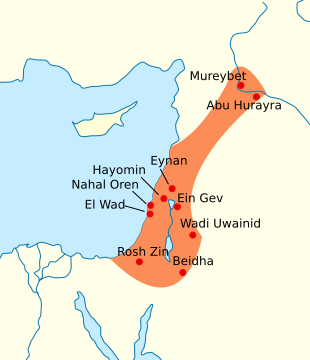
The Avvim of Gaza may be the descendants of the Natufians who inhabited this region between 15,000 and 9,000 years ago. Dorothy Garrod coined the term "Natufian" based on her excavations at Shuqba cave in the western Judean Mountains.The Natufians populated parts of Western Egypt (Fayoum Oasis), the area of Mount Carmel, and parts of Syria. They built the original settlement at Jericho. Confirmed Natufian settlements in Gaza are shown on the map below.

A map of the Levant with Natufian regions across present-day Israel, Palestine, and a long arm extending into Lebanon and Syria


The Natufian physiology indicates a Mediterranean type with some features typical of Nubians. (See Marcellin Boule, Henri Vallois, and René Verneau, Les Grottes Palaeolithiques de Beni Séghoual, pp. 212-214.)

British Archaeologist, Graeme Barker, notes "the similarities in the respective archaeological records of the Natufian culture of the Levant and of contemporary foragers in coastal North Africa across the late Pleistocene and early Holocene boundary."

Harvard Professor of Prehistoric Archaeology, Ofer Bar-Yosef, notes that microlithic forms such as arched backed bladelets and La Mouillah points, as well as the parthenocarpic figs found in Natufian territory, originated in the Sudan.

Distinguished Research Professor at UCLA, Christopher Ehret, notes that the intensive use of plants among the Natufians was first found in Africa, as a precursor to the development of farming in the Fertile Crescent.

Portraits of captured Philistines on the walls of the Madinet Habu temple
A Philistine prisoner is shown with his hands bound. 


The Egyptian-Philistine Connection

At the time of King Saul and David, Gezer was under Egyptian political control and cultural influence. The Philistines had a long standing relationship with the rulers of Egypt. This explains Exodus 13:17, which states: “When Pharaoh let the people go, God did not lead them on the road through the Philistine country, though that was shorter. For God said, “If they face war, they might change their minds and return to Egypt.”

The main coastal route northward from Egypt is called "the road/way through the Philistines' land" in Exodus 13.17. The Egyptians had fortified settlements at many locations along the major trade routes. During the Middle Bronze Age (ca. 2200–1500 BC) as much as 70% of the population of Canaan lived in these fortified towns. Examples include Tell el-‘Ajjul and Gezer with its gate, tower, and protected water system. These high places were under the control of Egypt from about 2000 to 1178 BC. They were stops along the major routes from Egypt to Syria and the Orontes. The Egyptians build one of their most remote fortification at Meroe on the Orontes in Modern Turkey.

One route, the Horus Way, was the southern section of the Way of the Sea (derek hayyam) mentioned in Isaiah 9:1. This road joined the Nile Valley to the area that came to be occupied by the Philistines. There were numerous Egyptian fortifications along the Horus Way and it appears that Philistines served in the garrisons of these fortifications. The American archaeologist William F. Albright believed that "The Philistines were evidently settled in the Coastal Plain by permission of the Pharaoh, as becomes clear from his [Ramesses III's] inscriptions [at Medinet Habu]." (William F. Albright, The Excavation of Tell Beir Mirsim in Palestine, vol. 1: The Pottery of the First Three Campaigns, Annual of the American Schools of Oriental Research (ASOR) 12 (New Haven, CT: ASOR, 1932), p. 58.)

After about 1000 BC, Israel's power and status had increased, overshadowing the power of the Philistines. The new king of Israel was Solomon, David's son. He married the daughter of the king of Egypt. The pharaoh took Gezer and gave it as a wedding dowry to King Solomon (1 Kings 9:16).

Saul had been chosen in hopes that he would strengthen Israel against the Philistines, but that did not happen. When the young man David proved to be the greater warrior, Saul turned against David. David fled for his life and grew strong in his reliance on the LORD.


Israel and Philistia meet for battle

I Samuel 17:19-51 tells the story of the confrontation between the forces of King Saul and the Philistines in the valley of Elah. The Philistine champion in this encounter was Goliath. According to the Biblical account, Goliath cursed the true God and made fun of David and his Hebrew people.

Elah refers to the Valley of the Terebinth (Emek HaElah in Hebrew: עמק האלה‎). Terebinth trees (Pistacia atlantica) and oaks grew in the place where the Israelite army camped.

To enter the territory of Judah, the Philistines had to come through the Elah Valley. It is likely that they had in their sights the fortified city at Khirbet Qeiyafa in the Elah Valley, discovered by Yosef Garfinkel, and excavated under his direction from 2007 to 2013. The city is dated between 1050 and 915 BC and sat on the summit of a hill that borders the Elah Valley on the north. This is on the main road from the coastal plain of Philistia to Jerusalem.

Another city in the area is Adullam. It was on an elevated site and near the well-traveled route which later became a Roman road through the Elah Valley. Judah’s friend, Hirah, was from Adullam. While Judah was visiting Hiram, arrangements were made for Judah to take his second wife. If Judah followed the marriage pattern of his Horim, this bride would have been Judah’s patrilineal cousin. The Hebrew text shows evidence of emendation. This bride is said to be a daughter of Shua, but it is more likely that Shua was one of Hirah's daughters because Shua is a woman's name. An earlier Shua is mentioned in 1 Chronicles 7:32 as the daughter of Eber. She lived seven generations before Judah.

King David sought refuge in the area of Adullam after being expelled from Gath by King Achish. David hid from Saul in a cave near Adullam (1 Sam. 22:1). David’s father, Jesse, came to him there. Jesse was in danger also, so David sought refuge for his family in Moab. “David brought them before the king of Moab; and they dwelt with him all the while that David was in the stronghold.” (1 Sam. 22:4). This appears to be a case of calling on the aid of kin. Jesse was a descendant of Boaz and his Moabite wife, Ruth.

Tuesday, May 3, 2016

Seated with Christ


The LORD sits enthroned over the flood; the LORD is enthroned as King forever.
Psalm 29:10

Alice C. Linsley

Many years of anthropological investigation using Biblical data has convinced me that Messianic expectation is one of the earliest religious beliefs. It is expressed in the burial practices of Abraham's archaic ancestors who believed in bodily resurrection and anticipated the coming of a Righteous Ruler who would overcome death and lead His people to immortality.

Through Biblical Anthropology some principles have been established to identify and authenticate material of great antiquity. On such principle states: "The more broadly dispersed throughout the canonical books a verse, quotation, or allusion is, the older it is." That means that Psalm 110:1 is one of the oldest Messianic references in the Bible. It appears in various forms in the Old Testament [Ps. 145:13; Isaiah 9; Daniel 4:34 and 7:27]  and at least 20 references are made to this in the New Testament.

Psalm 110: 1 reads, The Lord says to my Lord: "Sit at My right hand until I make Your enemies a footstool for Your feet."

It is generally assumed that David wrote these words under the inspiration of the Holy Spirit. However, that is not the case.  David received these words from his Horite Hebrew/Habiru ancestors. This belief was stated in these exact words at least 1000 years before David in the Coffin Texts. Consider how Horus, the archetype of Christ, describes himself in the Coffin texts (Passage 148):

"I am Horus, the great Falcon upon the ramparts of the house of him of the hidden name. My flight has reached the horizon. I have passed by the gods of Nut. I have gone further than the gods of old. Even the most ancient bird could not equal my very first flight. I have removed my place beyond the powers of Set, the foe of my father Osiris. No other god could do what I have done. I have brought the ways of eternity to the twilight of the morning. I am unique in my flight. My wrath will be turned against the enemy of my father Osiris and I will put him beneath my feet in my name of 'Red Cloak'."

Here we find the words of Psalm 110:1, a Messianic reference, and the context for Paul's words: "And God raised us up with Christ and seated us with him in the heavenly realms in Christ Jesus." (Ephesians 2:6)

Therefore, let us live and pray as ones seated with Christ! Let us take hold of the promise of Christ: "To the one who is victorious, I will give the right to sit with me on my throne, just as I was victorious and sat down with my Father on his throne." (Revelation 3:21)


Horus and the Proto-Gospel

Horus, the Seed or "Son" of the Creator, was the embodiment of divine kingship and the protector of the reigning pharaoh. Ra and Horus shared the same emblem, the Sun, and were regarded as one, as Jesus confirmed when he said, "I and my Father are one." (John 10:30; John 17)

In Utterance 699 of the Pyramid Texts, Horus ascends aloft like a heron and is exalted at his Father's side. The prayer reads: "Be young, be young beside your Father."

Horus was conceived when Hathor was overshadowed by the Sun. Likewise, the angel told the Virgin Mary, "The Holy Spirit will come on you, and the power of the Most High will overshadow you. So the holy one to be born will be called the Son of God." (Luke 1:35)

Hathor is shown wearing the sun within the horns of the cow. The Y image came to designate divinely appointed rulers among Abraham's people: Yitzak, Yacob, Yaqtan, Yishmael, Yeshua, Yishbak, etc. One of the signs of divine kingship was that the new born child was swaddled in a red cloak.


The Nilotic Rulers and Messianic Expectation

Saint Augustine wrote, "that the Egyptians alone believe in the resurrection, as they carefully preserved their dead bodies." (Jon Davies, "Death, burial, and rebirth in the religions of antiquity", Routledge, 1999, p. 27) However, the peoples of the Upper and Lower Nile shared this belief which they received from their Proto-Saharan ancestors. Royal tombs were built at the Horite Hebrew/Habiru shrine city of Nekhen before the first Egyptian Dynasty. The oldest section of Nekhen dates to 3800 BC. At Nekhen, Proto-Saharan nobles were buried with red ocher as early as 3500 BC.

One intriguing discovery at Nekhen was the recovery of an almost complete beard in association with the redheaded man in Burial 79. Consider how the descendants of these ruler-priests are often described in Genesis as red an hairy. Esau and David are examples, and the people who live in Abraham's territory of Edom was known to have a distinctive red tone. Edom or "Idumea" means land of red people.

Embalming of royal mummies was already a science by 2800 BC. Reference to a Righteous Ruler-Priest who would overcome death and lead his people to immortality is found in the Pyramid Texts (2400 BC) and in the Coffin Texts (2100 BC). These texts express the desire of the Kushites and Egyptians for immortality. The offices of ruler and priest were connected. They believed they would receive eternal life through the agency of their ruler-priest and they yearned for his appearing.

They ancient Kushites and Egyptians made a great ceremony of the burial of their dead kings. The construction of the royal tomb took many years. Upon completion of the tomb, there was as consecration ceremony. When the ruler died, the embalmer priests carefully prepared the body. There was a procession to the tomb, lead by the priests and royal family, the people in their train.  After prayers and animal sacrifice, the tomb was sealed. The grieving people returned to their homes. It was believed that the Righteous Ruler would rise on the third day just as the sun broke on the eastern horizon. At his rising the Righteous Ruler would gather his people to himself and lead them to immortality.

This is pictured in Psalm 68:18:  "You ascended on high, leading a host of captives in your train and receiving gifts among men, even among the rebellious, that the Lord God may dwell there."

This is what the Apostle Paul refers to when he wrote, "This is why it says: 'When he ascended on high, he took many captives and gave gifts to his people.'" (Ephesians 4:8)


Related reading: Who Were the Horites?; Who Were the Kushites?; The Christ in Nilotic Mythology; Mining Blood; The Edomites and the Color Red; The Urheimat of the Canaanite Y; The Solar Imagery of the Proto-Gospel


Sunday, May 11, 2014

David's Zion Found


Massive fortification of five-ton stones stacked 20 feet (6 meters) wide


The Israeli archaeologist Eli Shukron believes he has found the legendary citadel captured by King David. Shukron, who excavated at the City of David archaeological site for nearly two decades, says he believes strong evidence supports his theory.

"This is the citadel of King David, this is the Citadel of Zion, and this is what King David took from the Jebusites," said Shukron, who said he recently left Israel's Antiquities Authority to work as a lecturer and tour guide. "The whole site we can compare to the Bible perfectly."

There is no doubt that King David was a historical figure.  A written reference to the "House of David" was found in an archaeological site in northern Israel. However, archaeologists are divided on which sites in Jerusalem are identified with David.

Shukron's dig, which began in 1995, uncovered a massive fortification of five-ton stones stacked almost 20 feet wide. Pottery shards helped date the fortification walls to be 3,800 years old. They are the largest walls found in the region from before the time of King Herod, the ambitious builder who expanded the Second Jewish Temple complex in Jerusalem almost 2,100 years ago. The fortification surrounded a water spring and is thought to have protected the ancient city's water source.

The fortification was built 800 years before King David would have captured it from its Jebusite rulers. Shukron says the biblical story of David's conquest of Jerusalem provides clues that point to this particular fortification as David's entry point into the city.

Mount Zion today
I believe that Eli Shukron has found the citadel of David (Zion), but these things are difficult to prove definitively. Watch this video.

One of the impressive finds is a small golden bell, such as might have been worn on the hem of a priest's garment. This was recovered from the ancient sewer system. The bell's owner likely "walked in the street, and somehow the golden bell fell from his garment into the drainage channel," Shukron said.

The golden bell dates from the Second Temple period, and is an important relic. The Second Temple stood from about 515 B.C. until A.D. 70 when it was destroyed by the Romans. Herod, the builder of the Second temple, was of Edomite ancestry.


Zion or Sion?

Zi-on or Si-On means "Son of On." Joseph married the daughter of the priest of On. On was the premier Horite temple city of the ancient world. The royal pyramids of Giza, Abusir, and Saqqara were aligned to the obelisk of On (Heliopolis) in Egypt. Recently a 10,000 year obelisk was found in Judah. It also was east-facing.


The Edomites and the Jebusites built their "high places" where there were natural springs or permanent sources of fresh water. They were masters at building with large stones and creating underground water channels. Petra is an example of Edomite workmanship. The architecture there reflects Horite Hebrew (Akkadian "Abrutu") architecture.

The Edomites, like King David, are described in the Bible as having a red skin tone. This suggests that their ancestry is of exceptional antiquity. Melchizedek was the ruler-priest of Yerusalem (Yebu) in Abraham's time, and a kinsman of Abraham. Abraham ruled in the territory of Edom. Some of the rulers of Edom are listed in Genesis 36.

Wednesday, October 23, 2013

Which Bethlehem is Jesus' Birthplace?


Alice C. Linsley


Bethlehem (Bēt Lahm) means "house of meat" and indicates a settlement known for sheep and cattle. There are two places called Bethlehem, one in Galilee and the other near Jerusalem. The name indicates a place where shepherd-priests took animals from their flocks to sacrifice. The meat was distributed to the needy.

In Christian belief, Jesus is the Lamb of God who gave his flesh for the life of the world. He is the Lamb of God who takes away the sin of the world. His nativity was announced first to the shepherds of Bethlehem, the very descendants of the people in Eden to whom the promise of Messiah's appearing was first given (Gen. 3:15).

David came from Bethlehem. He tended the sheep of his father, just as Moses tended the sheep of his priest father-in-law, Jethro. Jesus comes from a long line of shepherd-priests. His maternal grandfather was Yoakim (Joachim), a priest who kept flocks.

Bethlehem was a Horite settlement according to I Chronicles 4:4 which names Hur (Hor) as the "father of Bethlehem."  I Chronicles 2:54 gives Salmon as "the father of Bethlehem," but there is no contradiction here since Salmon was also a Horite. The names Salmon, Salma and Solomon were common names among the Horites, also know as Habiru (Hebrew). A leader named Salmon married Rahab of Jericho. He is listed as the son of Hur, another common Horite name.

The Horites were a caste of ruler-priests whose origins can be traced back to the Nile Valley.  The oldest know Horite shrine city was Nekhen in Sudan (4500 BC). The temple there was dedicated to Horus, the son of Ra. He was said to be born of Hathor-Meri by the overshadowing of the sun, the emblem of the Creator Ra. She is shown in ancient images with a crown of horns - Y - a solar symbol. 

From the Nile Valley, the Horites moved into Arabia, Canaan, and Mesopotamia, taking their religious beliefs and practices with them. Abraham, Jacob, Moses, Samuel, David and the Virgin Mary were of the Horite lines. David was from Bethlehem and Joseph went to Bethlehem to register for the census (Luke 1:26) because he and Mary were descendants of Horite ancestors who lived in Bethlehem. One of those ancestors was the righteous Boaz who married Ruth.

The Bethlehem of Boaz was an agricultural area where grain was grown in extensive fields. This describes Galilee, not the hill country around Jerusalem.

Bethlehem is where Ruth gave birth to Obed, King David's grandfather. Ruth is praised by the women of Bethlehem (the chorus) as being worth seven sons, and she is likened to Tamar who “built up” Judah by giving him twin sons Perez and Zerah. Judah gained these righteous sons after losing unrighteous sons.

Throughout the book of Ruth there is a subtle play on the theme of replacement. Naomi is the female counterpart of Job. Both lost everything and came to despair, but the Lord restored their fortunes and made them great in Israel.


Textual clues as to Jesse’s high standing in Israel

David was anointed first in Bethlehem and later he was anointed in Hebron (II Samuel 2:1-4). It is possible that these two settlements marked the northern and the southern boundaries of Jesse’s territory. Jesse would have had a wife in Bethlehem and another in Hebron, following the practice of his Horite shepherd-priests ancestors who maintained two wives in separate households on a north-south axis. If David's Bethlehem was in Galilee, Jesse's territory would have extended about 118 miles (190 kilometers) from Bethlehem in Galilee to Hebron in the south, and all would have been regarded as a holding of Judah.

Another possibility is that Jesse's two wives were located in Bethlehem of Galilee and Ramah in the hill country to the south. These are linked in Matthew's Gospel (Matt. 2:13-23); suggesting that Jesse's territory extended from Bethlehem "Ephratha" to Ramah. Throughout much of the Bible, Ephratha is a reference to Judah. This north-south extension would have been called "Judah" in Jesse's time. If David's city was the Bethlehem in Galilee, Jesse ruled over a territory extending from Galilee to Ramah of Judah.

Though it is clear that the ruler's wives lived in separate settlements on a north-south axis, it is difficult to determine the extent of the ruler's territory because of multiple located with the same name. There several settlements named Ramah and at least two named Bethlehem. Regardless, it is evident that Jesse of Bethlehem was a great ruler of Judah.


Jesse's solar designation

Jesse’s name in Hebrew is Yesai and designates a great ruler. The initial Y is a solar cradle which indicates someone who has been overshadowed by the Creator. This overshadowing means the person is appointed for some special purpose. Remember that the Angel Gabriel announced to Mary that she would conceive by the overshadowing of the Spirit and bring forth the Holy One who would rule and save his people.

Many other Biblical rulers are indicated by the Y symbol: Yitzak (Issac); Yishmael (Ishmael), Yaqtan (Joktan); Yisbak; Yacob (Jacob); Yosef (Joseph); Yetro (Jethro) and Yeshua (Joshua/Jesus). The men listed in Ruth 4 are royal persons and descendants of Abraham and his Horite ruler-priest ancestors. David was born into a family of very high standing and this prepared him for the years when he would serve King Saul and rule over Israel.

It is evident that David was born into a family of very high standing and this prepared him for the years ahead when he would serve King Saul and rule over Israel.


Connections to Egypt and Tyre

Rachel was buried at Bethlehem. She gave birth to Joseph who married the daughter of the priest of Heliopolis in Egypt. Heliopolis (called Onn in Genesis 41:45) was a Horite shrine city of great prominence in the ancient world. The great pyramids of Giza, Saqqara and Abusir were aligned to the obelisk at this Ainu shrine city.


If we draw a line from Heliopolis in Egypt to the shrine at Baalbek ("God of Beka") in Lebanon, we have a fairly straight diagonal line that extends from Abusir in Sudan to Baalbek.  Tyre was the main shrine city between Heliopolis and Baalbek. The earliest structure at Baalbek dates to at least 2900-2300 BC, corresponding to the Old Kingdom in Egypt. The builders were great stone masons and builders of temples and monuments.

The kings of Tyre were Horites and kin to David.  Bethlehem of Galilee was part of ancient Tyre. In Mark’s Gospel, Jesus' true identity is recognized in the ancient island city of Tyre, not in Jerusalem.

Tyre was the home of Hiram I, the father of the Tyrian king who helped to build Solomon’s temple. Hiram I was kin to David and sent skilled artisans to help David build a palace in Jerusalem, “the city of the Great King” (Matt. 5:35). Hiram is also known as "Huram" and "Horam", variations of the names Hur, Hor and Harun (Aaron). According to Midrash, Hur was Moses’ brother-in-law. Hur’s grandson was one of the builders of the Tabernacle.

In other words, the common ancestors of Hiram I and David were Horites who anticipated the fulfillment of Genesis 3:15. They believed that the promised Seed of the Woman (the Son of God) would be born of their blood lines and they expected Him to visit them. Mark 7:24 gives an account of when the Son of God visited Tyre, and here we are told that Jesus “could not pass unrecognized.”


Caste-based Industries of Bethlehem

Beside keeping sheep and priestly duties, another occupation in ancient Bethlehem was leather work. Leather workers were called Tahash. One of Nahor's sons was Tahash (Gen. 22:24). Tahash refers to a tanner of animal skins. Exodus 25:5 links "five ram skins dyed red" with "tahash skins" and "acacia wood." The Tahash appear to be those who ritually prepared the skins of sacrificed animals for use in solemn oath, such as the passing of leather sandals.

Now in earlier times in Israel, for the redemption and transfer of property to become final, one party took off his sandal and gave it to the other. This was the method of legalizing transactions in Israel. (Ruth 4:7)

The exchange of the leather sandal was a blood oath since it involved taking the life of an animal The practice was to confirm the exchange property after a death. Aben Ezra says that the giving of the leather shoe was "to confirm all things" whether by sale or barter.

The exchange of a leather shoe represents a solemn oath like that signaled by the exchange of a linen cloth, called "sudar." According to the Medieval rabbi Rashi, a linen cloth was used to make purchases and the cloth was called "sudar." 

Rashi is speaking of a related custom. The term "sudar" pertains to "Sudra" which is a reference to the peoples of Sudan. Linen originated in the Nile Valley and was carried from there to India. Among Abraham's Nilo-Saharan ancestors wounds were treated with raw meat and bandaged with linen. Dead domesticated animals, such as dogs and donkeys, were wrapped in white linen and buried outside the towns.

In Genesis 3:21, God acts as the first tahash when He sacrifices animals to make coverings for the man and the woman. In doing so, God covers them by a blood oath, wraps the newly dead, and sends them out of the Garden.

Sudar is also a reference to the Dravidians. Dravidian leather workers are called "Madigas" and they are recognized as one of the world's oldest castes. The Madiga have nucleotide diversity levels as high as those of HapMap African populations. The Tahash and Madigas represent a very ancient practice of leather work associated with animal sacrifice and solemn oaths.

The Tahash were also known as "sarki" in Africa and parts of Asia. The sarki sacrificed animals and tanned the hides. Today Sarki live in the Orissa province of India and in Orisha, Nigeria. They also live in the Tarai region of Nepal. Sometimes they are called “Harwa” which is the ancient Egyptian word for priest.


Archaeology of Bethlehem

Speaking about the discovery of a clay seal dating to the First Temple period, Eli Shukron of the Israel Antiquities Authority said, "This is the first time the name Bethlehem appears outside the Bible, in an inscription from the First Temple period (1006-586 B.C.), which proves that Bethlehem was indeed a city in the Kingdom of Judah, and possibly also in earlier periods."

2700 year seal bears the name of Bethlehem

The coin-sized artifact was found during archaeological excavations in the oldest part of Jerusalem. The seal (called a "bulla") bears the name of the city of Bethlehem in ancient Hebrew script. A bulla is a piece of clay used as an official seal on a document or object. The seal was impressed with the mark of the sender, and an intact bulla was proof that a document had been delivered unopened.

The seal indicates that a shipment was sent from Bethlehem to Jerusalem in the seventh year of a king's reign. Possibly the king was Hezekiah or Josiah.

The bulla makes it clear that a town called Bethlehem was inhabited by Hebrews in the time of Solomon's temple, but it doesn't specify which Bethlehem. There are two; one in Judah near Jerusalem, and the other in Galilee near Nazareth. Today there is growing consensus that Jesus' birthplace was the Bethlehem near Nazareth because the Bethlehem near Jerusalem was not inhabited during the first century when Jesus would have been born.

When the Magi appeared before Herod they were told that the Messiah was to be born in Bethlehem. Herod’s wise men found this in the book of Micah: "But thou, Bethlehem Ephratah, though thou be little among the thousands of Judah, yet out of thee shall he come forth unto me that is to be ruler in Israel; whose goings forth have been from of old, from everlasting."  This indicates two things about Jesus's birthplace: it belongs to the tribe of Judah and it was also associated with Caleb's wife Ephrath. There is no contradiction here, as Bethlehem belonged to Caleb, whose son was Salma. Salma is called the father of Bethlehem in Chronicles 2:54.

Bethlehem is mentioned in Matthew 2:16-18 as the place where Herod ordered all the baby boys to be slaughtered, and Jesus would have been among "the Innocents" had Joseph not been warned by an angel to take the child and his mother and flee to Egypt. From Bethlehem in Galilee and nearby Nazareth the road to Egypt was a direct one.  From Bethlehem on the West bank there was no direct route into Egypt.

As Jews traced their blood lines through their mothers, it was necessary for Joseph to register both he and Mary in Bethlehem. So they left Nazareth and went to Bethlehem, a distance of about 5.5 miles (9 kilometers). The distance from Nazareth to Bethlehem near Jerusalem is 93 miles (150 kilometers). Would Joseph have taken Mary, in the last stage of pregnancy, on a journey of 93 miles on a donkey?

Mary’s full name was "Miriam Daughter of Joachim Son of Pntjr (Panther) Priest of Nathan of Bethlehem." Long before the time of the Pharaohs the Horites designated the king ntjr. The name p-ntjr means "God is King."

Nathan is the name of the prophet who called King David to repentance and saved his kingdom. Likely this Nathan was one of David's kinsmen from Bethlehem in Galilee.


Bethlehem of the West Bank

The Church of the Nativity in the Bethlehem near Jerusalem was commissioned in 327 AD by Constantine and his mother Helena and was built over the site that was believed to be the cave where Jesus was born. There are caves under the church and one was used by St. Jerome for about 30 years. This is where he translated the Bible into Latin (Vulgate). Some of the caves were used for burial.

Such a cave tomb was discovered in "Bethlehem South" in 2009. It contained burial items such as pottery, plates and beads, along with the remains of two individuals. The tomb dates to the Middle Bronze period (2200-1550 BC) when there was no permanent settlement in that place. Many tombs from this period have been found throughout Israel. In fact, this period is primarily known from the study of its cemeteries, with relatively few settlements discovered in the region of Judah.

A 3100 year arrowhead found near Bethlehem South bears the inscription bn 'nt, meaning "son of Anat." In ancient Egyptian mythology, Anat and Ashtart were daughters of the Creator Ra. They became the wives of Set/Seth, the deified ruler on earth.


The great antiquity of Bethlehem

Evidence of human habitation in the area of Bethlehem between 100,000-10,000 BC is well-attested along the north side of Wadi Khareitun where there are three caves: Iraq al-Ahmar, Umm Qal’a, and Umm Qatafa. These caves were homes in a wooded landscape overlooking a river. At Umm Qatafa archaeologists have found the earliest evidence of the domestic use of fire in Palestine. There are 40 Paleolithic sites in the hills surrounding Jerusalem, many of them near Bethlehem.


Saturday, April 27, 2013

Royal Prayers


Alice C. Linsley


Royal prayers are found in extra-Biblical documents and throughout the Bible. The prayers of rulers reflect the burden of their responsibility. Rulers in the ancient world were responsible for the welfare of their people, the protection of their resources, and devotion to the Deity under whose authority they ruled. An aspect of this royal devotion was the building and maintenance of temples and shrines.


Prayers of Kushite rulers

Kushite rulers held a theology that Biblical Anthropologists recognize. This can be determined from artifacts such as the Sheba-qo Stone which describes the theology that held sway at Heliopolis (Biblical On) and Memphis. The Stone dates to the Nubian Dynasty or the Kushite Empire, but the theology is much older. According to this theology the Creator is the great Craftsman who gives wisdom and skill to the King and his craftsmen. This is expressed in Proverbs 25:2 - "It is the glory of God to conceal a thing: but the honor of kings is to search out a matter."

The royal craftsmen worked with visible things such as tools of stone and metal. The Creator, on the other hand, works with what is concealed and mysterious like the wind or breath (ruach). The breath of the Creator went forth at the beginning of creation and things were created out of His mouth/word, and not from a pre-existing substance. He crafted the heavens above and the earth below, and separated the light from darkness. This theology is expressed in Genesis 1 and in the Wisdom Tradition that regards God as the architect whose wisdom is evident in the order of creation.

This prayer of the Kushite King Taharqa, dated to 675 BC., ascribes to God the necessity of the fulfillment of the Divine will.

“O, the one who will not abandon his work when it has only been half realized” (col. 5).

It appears that Taharqa had lost control of holdings in Syria-Palestine (Khor) which had paid him tribute. In his prayer he laments the loss of tribute (inw) from those lands.

“Let me do it with your tribute of Khor which has been turned aside from you” (col. 16).


Dan'el Kahn in his Taharqa, King of Kush and the Assyrians, writes, "This sort of personal prayer by the king during a setback in battle is known from Ramesses II’s 27 accounts of the battle of Kadesh. However in Ramesses’ case the god Amun heard his prayer and came to his aid. Cf. K. A. Kitchen, Ramesside Inscriptions: Historical and Biographical II (Oxford 1979) 34-42. For convenience see the translation in M. Lichtheim, Ancient Egyptian Literature, vol. II (Berkeley 1976) 65. For prayers in Ancient Egypt see H. Brunner, Gebet” LdÄ II, 452-9. This category of personal prayer is, however, better known from the Bible. The basic (although not always mandatory) components of the personal prayer are: Addressing god repeatedly, usually using epithets of the god as well. The worshiper expresses his relationship with god and his humility towards the greatness of his god. A complaint or a description of the distress is forwarded. Then, a request is made in the interrogative or in the imperative mode.The reason for the request is expressed as an identity of cause between the worshiper’s needs and god’s affairs. Sometimes a promise by god or earlier actions in favor of the worshiper are recalled. A request from god to show his true nature and potency is also very common. The supplicant then reminds god of a previous favor bestowed on him by god. A promise to continue worshiping god is mentioned at the end. See: M. Greenberg, “Prayer”, in: Encyclopaedia Biblica, vol. 8 (Jerusalem 1982) 898-904 (Hebrew). All these components of the personal prayer can be found in Taharqa’s prayer."


Abraham's prayers

In Genesis, Abraham complains to God about not having a proper heir. This was an extremely grave matter for a Horite ruler-priest.

"O Lord God, what can you give me seeing that I shall die accursed, and the steward of my household is Dam-Mesek Eliezer?" (Genesis 15:2)

Horite priest sacrificing a ram
He also intercedes for Sodom where his nephew Lot was living. The element that is most characteristic of ancient royal prayers is found in verse 25: "Far be it from you to do such a thing—to kill the righteous with the wicked, treating the righteous and the wicked alike. Far be it from you! Will not the Judge of all the earth do right?”

We see a similar expression of the necessity to fulfill the divine will as appears in Taharqa's words: “O, the one who will not abandon his work when it has only been half realized.”


David's prayers

David was of Kushite ancestry and a descendant of Abraham the Horite. He was the eighth and youngest son of Jesse of Bethlehem, a Horite shepherd-priest. The settlement had a shrine and was known for the sacrifice of sheep and rams. The meat was distributed to the poor, which is why the Bethlehem was called "House of Meat" as in the tradition still preserved by the Arabic: Bet Lahm.

The prayer of King David in 2 Samuel 7:18-29

Then King David went in and sat before the Lord and prayed, "Who am I, O Sovereign Lord, and what is my family, that you have brought me this far? And now, Sovereign Lord, in addition to everything else, you speak of giving me a lasting dynasty! Do you deal with everyone this way, O Sovereign Lord? What more can I say? You know what I am really like, Sovereign Lord. For the sake of your promise and according to your will, you have done all these great things and have shown them to me.

"How great you are, O Sovereign Lord! There is no one like you--there is no other God. We have never even heard of another god like you! What other nation on earth is like Israel? What other nation, O God, have you redeemed from slavery to be your own people? You made a great name for yourself when you rescued your people from Egypt. You performed awesome miracles and drove out the nations and gods that stood in their way. You made Israel your people forever, and you, O Lord, became their God.

"And now, O Lord God, do as you have promised concerning me and my family. Confirm it as a promise that will last forever. And may your name be honored forever so that all the world will say, 'The Lord Almighty is God over Israel!' And may the dynasty of your servant David be established in your presence.

"O Lord Almighty, God of Israel, I have been bold enough to pray this prayer because you have revealed that you will build a house for me--an eternal dynasty! For you are God, O Sovereign Lord. Your words are truth, and you have promised these good things to me, your servant. And now, may it please you to bless me and my family so that our dynasty may continue forever before you. For when you grant a blessing to your servant, O Sovereign Lord, it is an eternal blessing!"


Solomon's prayer

1 Kings 8:22-30

Then Solomon stood before the altar of the Lord in the presence of all the assembly of Israel, and spread out his hands toward heaven; and he said: “Lord God of Israel, there is no God in heaven above or on earth below like You, who keep Your covenant and mercy with Your servants who walk before You with all their hearts. You have kept what You promised Your servant David my father; You have both spoken with Your mouth and fulfilled it with Your hand, as it is this day. Therefore, Lord God of Israel, now keep what You promised Your servant David my father, saying, 'You shall not fail to have a man sit before Me on the throne of Israel, only if your sons take heed to their way, that they walk before Me as you have walked before Me.' And now I pray, O God of Israel, let Your word come true, which You have spoken to Your servant David my father.

"But will God indeed dwell on the earth? Behold, heaven and the heaven of heavens cannot contain You. How much less this temple which I have built! Yet regard the prayer of Your servant and his supplication, O Lord my God, and listen to the cry and the prayer which Your servant is praying before You today: that Your eyes may be open toward this temple night and day, toward the place of which You said, 'My name shall be there,' that You may hear the prayer which Your servant makes toward this place. And may You hear the supplication of Your servant and of Your people Israel, when they pray toward this place. Hear in heaven Your dwelling place; and when You hear, forgive.


Hezekiah's prayers

King Hezekiah was a man of prayer. Two of his prayers are recorded in the Bible.

Isaiah 38:2-8

Hezekiah turned his face to the wall and prayed to the Lord, "Remember, O Lord, how I have walked before you faithfully and with wholehearted devotion and have done what is good in your eyes." And Hezekiah wept bitterly.


2 Kings 19:15-19

And Hezekiah prayed to the Lord : "O Lord, God of Israel, enthroned between the cherubim, you alone are God over all the kingdoms of the earth. You have made heaven and earth. Give ear, O Lord, and hear; open your eyes, O Lord, and see; listen to the words Sennacherib has sent to insult the living God.

"It is true, O Lord, that the Assyrian kings have laid waste these nations and their lands. They have thrown their gods into the fire and destroyed them, for they were not gods but only wood and stone, fashioned by men's hands. Now, O Lord our God, deliver us from his hand, so that all kingdoms on earth may know that you alone, O Lord, are God."
 

Note the common themes of these royal prayers. There is acknowledgement of the Deity's universal sovereignty and past favors to the king. There is a request that the ruler perceives to be aligned with the will of the Deity for his kingdom based on past experiences. Having been promised a kingdom, Abraham petitions God for a proper heir because without a son from Sarah, that kingdom cannot be realized.


Related reading: Kushite Kingdom BuildingThe Calling of Abraham; Kushite Kings and the Kingdom of God; No Kingdom by Deception; The Horite Ancestry of Jesus Christ