Followers

Showing posts with label Kushites. Show all posts

Wednesday, March 11, 2020

Moses and the "Kushite" Bride


Alice C. Linsley

If Moses married according to the pattern of his Horim, he would have had two wives. Other Hebrew rulers with two wives include Lamech, Terah, Abraham, Esau, Jacob, Amram, Elkanah (Samuel's father), Ashur (1 Chron. 4:5), Mered (1 Chron. 4); Joash (2 Chron. 24:1–3), and Shaharaim of Moab (1 Chron. 8:8). Caleb fathered children by his wives Azubah and Jerioth (1 Chron. 2:18).

Moses' first wife would have been a half-sister, a daughter of Amram. She is described as his "Kushite" bride in Numbers 12:1. It seems probable that this wife remained in Egypt with Amram because we have very little information about her. In Exodus, the focus shifts to Zipporah, Moses' Midianite cousin.

Ishara (Ušḫara) is a Hittite word said to mean "promise" or "binding oath." The Hittites are related to Heth of Kiriath Arba (Hebron) where Sarah lived. Though a place rather than a person, Hebron is listed as a "son" of Kohath in 1 Chronicles 23:12.

Ishara is a woman's name and is related to the name Ishtar. According to Stol and Wiggermann, although Ishtar was a goddess of love, Ishara was the figure to whom women turned to bare sons (Birth in Babylonia and the Bible: Its Mediterranean Setting, p. 79).

In 1 Chronicles 23:18, Ishar is named as a chief, as is the woman Anah in Genesis 36. (See diagram below.) Among the Horite Hebrew, women served as chiefs. The right to rule depended on one’s rank and authority more than one’s gender. Rank and authority were determined by the antiquity of the clan and its reputation. According to Genesis 36:31, the Horites “are the kings who reigned in the land of Edom, before any king reigned over the children of Israel.” Jeremiah notes that the rulers of Edom and Teman of Edom were renowned for their wisdom (Jer. 49:7).

Genesis 36 mentions that Esau the Elder married a Hittite woman. Her name is Adah, the daughter of Elon. In this same diagram, we see Anah, daughter of Zibeon, listed as a Horite chief. Anah's daughter Oholibamah married Esau the Younger.


1 Chronicles 23:18 says that Ishara's son was Shelomith. The name is problematic because there are eight people by that name in the Old Testament, 5 men and 3 women. If Shelomith is the name of another son born to Amram (and Ishara?), his name identifies him as a member of a ruling family. In the ancient Akkadian language, shal means rule or reign, and mit refers to a mace. 

The names Shelomith and Shulamit share the same consonants: Sh-l-m-t. The name Shulamit appears in the Song of Songs where she is described as "dark as the tents of Kedar."

The dispute that arose over Moses' Kushite wife appears to be connected to the ruling house in Egypt which was served by Horite and Sethite priests. Though marriage to a half-sister was customary among the biblical Hebrew, it is likely that the Kushite bride was viewed as compromising Moses' authority among the clans of Jacob who were leaving Egypt.


Friday, January 24, 2020

Samuel's Horite Hebrew Family


Alice C. Linsley

Samuel's father was a Horite Hebrew priest with two wives. His name means "God's provision" and the name Elkanah appears in different generations of Horite Hebrew ruler-priests (1 Chron. 6:23-34; 1 Chron. 9:16; 2 Chron. 28:7). In Exodus 6:24 we find that a man named Elkanah is the grandson of Korah, the half-brother of Moses and Aaron. This diagram shows that Korah is a descendant of Seir the Horite ruler of Edom (Gen. 36).


In the narrative of Samuel's birth we read that his father Elkanah was a Zuphite, meaning he was a descendant of Zuph and lived in Ramathaim-zophim, "the land of Zuph." Ramathaim-zophim is described as "hill country" and it is known that the Horites preferred the high country. Ramathaim is simply Ramah elsewhere in the story of Samuel's family.


Hill country of Edom, ruled by the Horites (Gen. 36)

Ramah has a long association with prophets; Samuel being one of the greatest. Deborah, “the wife of Lappidoth, was a prophet” who judged from her palm tree between “Ramah and Bethel in the hill country of Ephraim." (Judges 4:4-6) Ephraim refers to the region around Bethlehem.

The Horite Hebrew were a caste of rulers who served as priests, prophets, scribes, warriors and metal workers. They were ethnically Kushite. Ramah was a son of Kush according to Genesis 10:7.

In the Masoretic Text the name of Samuel's city is hara-matatyim zophim. (See The Anchor Bible Commentary on I Samuel by P. Kyle McCarter, Jr., p. 51) This means that Samuel's father was a priest of the line of Matthew (or Mattai/Mattan). Hara-matatyim is the priestly line of Joseph of Arimathea, one of Jesus' relatives, and the member of the Sanhedrin who buried the Lord's body in a tomb he has excavated for himself. Samuel's father and Jesus had common Horite Hebrew ancestors.

David and his father Jesse were of this Horite lineage also. Matthew's Gospel links Bethlehem and Ramah (Matt. 2:13-23); suggesting that Jesse's territory extended from Bethlehem to Ramah. All of this would have been called "Judah" in Jesse's time. If David's city was the Bethlehem in Galilee, Jesse was indeed a great ruler. This is further supported by the Y solar cradle in his name - Yishai. Many of the great Horite rulers are designated by this symbol of divine appointment: Yismael, Yitzak, Yacob/Yisrael, Yetro, Yisbak, Yaqtan, and Yeshua.

Samuel's Horite ancestry, and his kinship to Jesse, is further supported by the distinctive Horite marriage and ascendancy pattern that they shared. Samuel's father was a priest with two wives, Hannah and Peninnah. It was the custom for Horite Hebrew ruler-priests to have two wives. One was a half-sister (as was Sarah to Abraham) and the other was a patrilineal cousin or niece (as was Keturah to Abraham).

The first wife was the sister bride, married at a fairly young age. She was the wife of the man's youth. The second wife was taken close to the time of the heir's coming to the throne. The two wives lived in separate households, usually on a north-south axis.

The firstborn son of the sister wife ascended to the throne of his biological father. So Isaac ruled over Abraham's territory. The firstborn son of the cousin/niece wife ascended to the throne of his maternal grandfather, after whom he was named. Abraham's cousin wife was Keturah. Her firstborn son was Joktan (Yaqtan). Joktan the Younger ascended to the throne of his maternal grandfather, Joktan the elder, the progenitor of the Joktanite clans of Arabia. This pattern of two wives and the cousin bride's naming prerogative, makes it possible to trace the Horite line of descent from Genesis 4 to Jesus, the Son of God.

Samuel dwelt in Ramah. This suggests that he ascended to the throne of his father. This means that his mother Hannah was Elkanah's half-sister wife, as the rabbis attest. Peninnah was Elkanah's cousin wife. Her first born son ascended to the throne of his maternal grandfather, not as the high priest but as a vassal to the high priest with a land holding in the territory of his maternal grandfather.

I Sam.1:4 states that when Elkanah offered a sacrifice, it was his custom to give portions to Peninnah and to all her sons and daughters. We do not know how many children Peninnah had, but we are told that after Hannah gave birth to Samuel, she had two more sons and two daughters.

If Samuel followed the marriage and ascendancy pattern of his Horim, he married one of Peninnah's daughters at a fairly early age. Nazirites did marry, as is evident from the story of Samson.

Here is a diagram showing Samuel's Horite family.


Related reading: The Judges Samuel, Deborah and Huldah; The Chiefs of Edom; The Antiquity of the Edomite Rulers; The Extent of Edomite Territory; Aaron Was Buried in Edom; The Horite Hebrew Wisdom of Elihu; The Horite High Places


Friday, July 31, 2015

Meroe on the Orontes


Alice C. Linsley


The ancient capital of the Kushite kingdom was Meroe in modern Sudan. It had a later sister city, Meroe on the Orontes, established around 2000 BC. The Kushite Meroe was situated on the craggy ascent of Mount Silpius. Antioch was built at the bend in the river to the north of Mount Silpius which rose abruptly on the south. 

Meroe on the Orontes was a high place before Antioch (Antakya, Hatay) became a major Greek settlement in 307 BC under Antigonus, one of Alexander the Great's generals. Antioch became the more important of the twin cities, with 500,000 inhabitants by the Second Century AD.

Meroe and Antioch were twin settlements when this region was under Egyptian control. Meroe, a fortress on the spur of Mount Silpius, was named IO, which means “pillared place of the Sun.” The I represents a pillar and the O is a solar symbol of the Creator. On ancient maps, Antioch, across from Meroe (p. 25), is called Anti-Meroe (p. 2). Likewise, the city of Anti-O/Antioch is across from Meroe, called IO.

In ancient times, the Orontes (the Draco, the Asi) was the chief river of the Levant and had sufficient depth for sail boats to come up the river from the Mediterranean near modern Beirut in Lebanon. This was aided by the north-flowing currents. Thus Meroe and Anti-Meroe (Antioch) had ports. The fortress on the spur of Mount Silpius was named IO. Many shrine cities were called Ianna or Iunu. Heliopolis (biblical On) was called “Iunu” (iunu) which means "place of pillars" because it had a temple. This is the hieroglyph for the shrine city of On/Heliopolis on the Nile:


Ancient Meroe on the Orontes appears to predate modern Antioch by about 1600 years. For the Egyptians, the Orontes marked the northern boundary of Amurru, east of Phoenicia. They found it easy to navigate because, like the Nile River, the Orontes flows from south to north. The river was first known as the Asi. The word asi in Aramaic means "east." 

Asi is found attached to names in the Bible. The priest Elkanah had a son named Am-asi (I Chron. 2:25, 35). An obscure figure in ancient history was Amasi-appa. The word appa means father. 

The north-flowing Orontes was also called Draco, and was identified with the northern polar star. When the fortress at Meroe was build, about 4000 years ago, the north pole star was seen near Alpha Draconis in the constellation of Draco. A relatively inconspicuous star in the night sky of the Northern Hemisphere, it is significant as having been the north pole star from the 4th to 2nd millennium BC.

It appears that around 2000 B.C. the fortress on Mount Silpius was considered the “Meroe of the East.” It had a shrine dedicated to Anat, a Horite Hebrew name found in the Nile Valley. Joseph married Asenath, the daughter of a priest of On (Heliopolis) on the Nile. The name Anat appears among several ancient Nilotic rulers. Anat-Hor name means "Anat of Horus.” Most Nilotic rulers had Horus names, as Horus was regarded as the protector of righteous rulers. Anat-Har was succeeded by ‘Aper-Anat, which mean “Priest of Anat.” In ancient Egyptian records a ruler named Anat-Har (or Anat-Hor or Anather), was the first ruler of the Sixteenth dynasty of Egypt, who reigned over part of Lower Egypt as a vassal of the Hyksos kings of the 15th Dynasty. The Egyptians called the chiefs of the Upper Nile settlements "Hyk Khase" which appears to be the origin of the term "Hyksos."

Anat-Hor’s seal


It was possible to sail to Antioch from the Mediterranean through the city of Samandağ, founded in 300 BC by Seleucus Nicator, another general of Alexander the Great. It was called “Seleucia Pieria” but it was subject to silting and the port was finally ruined by an earthquake in 586 A.D. Thus, the preferred way to Antioch was via Cyprus to Beirut and up the Orontes. Before Abraham's time, this would have taken the traveler near the archaic megalithic shrine of Baalbek. Baalbek was inhabited since 9000 B.C.

The Orontes River has been the site of many famous battles in ancient history. Around 1274 BC, the major Battle of Kadesh was fought here between the Egyptian army of Ramesses II and the Hittite army of Muwatalli II. The river was also the site of the Battle of Karkar (Qarqar) fought in 853 BC, when the Assyrian army, under Shalmaneser III, encountered an allied army of twelve kings led by Hadadezer of Damascus. Hamath on the Orontes fell to Sargon II in 720 B.C. Hebrew (Habiru/Abru) were living in the region of Antioch and Hamath according to Isaiah 11:11:

On that day,
The Lord shall again take it in hand
to reclaim the remnant of his people
that is left from Assyria and Egypt,
Pathros, Ethiopia, and Elam,
Shinar, Hamath, and the isles of the sea.


Antioch played a great role in the early development of Christianity. The oldest known church was in a cave on the outskirts of the city. It was visited by Pope Paul VI in 1962. Both St. Peter and St. Paul lived at Antioch for many years. The elders of the Antioch church commissioned Paul and Barnabas to be missionaries to the Gentiles of Asia Minor. The early Christians were first called followers of “the Way” and then for the first time they were called “Christians” at Antioch. Acts 11:26 tells us that it was the Cypriot-born Barnabas (Bar-Nabas, son of Nabas/Prophet) who brought Paul before the elders at Antioch. “So for a whole year Barnabas and Saul met with the church and taught great numbers of people. The disciples were called Christians first at Antioch.”

St. Ignatius was chosen to serve as Bishop of Antioch after St. Evodius, who died around AD 67. Antioch was the birth place of John Chrysostom, who died in 407 A.D.

Nicolas the deacon of the Seven Deacons was a proselyte of Antioch. Christians who dispersed after Stephen's martyrdom preached at Antioch. From Antioch the church sent charity by the hands of Barnabas and Saul to the brethren at Jerusalem who were suffering during a time of famine.


Related reading: Twin Cities of the Ancient WorldWas King Arthur a Horite Ruler?; Does Genesis 10 Describe the Ainu Dispersion?; Stone Work of the Ancient World; Gobekli-Tepe's T-shaped Pillars; The High Places

Tuesday, March 10, 2015

Kushite Burial Practices


Alice C. Linsley

Biblical Kush was a vast region that included Egypt, Sudan, Nubia, the coastal areas of the Horn of Africa, and the Afro-Arabian populations living in Ramah, Sheba and Dedan.

DNA studies show "genetic unity and linkage" between the Sudanic, Egyptian, Nubian and other Nilotic peoples, as well as some populations of the Horn of Africa. (Yurco (1996), Keita (1993, 2004, 2005) Lovell (1999), Zakrewski (2003, 2007). The Copts are one of the oldest Egyptian populations. This is based on the relatively high frequency of the B-M60 marker (c.60,000 BP), indicating early pre-dynastic colonization of Egypt by Upper Nilotes.

These are the peoples among whom the themes of Genesis 1-3 are found. 

The Nilotic Kushites were expert pyramid builders, as were their European kinsmen the Kushan. They build thousands of pyramids across the ancient world. Some have been located in Niger and other parts of the Sahara. Many along the Nile Valley. Pyramids have also been found in Bosnia, and Southern China.

In addition to building pyramids, the Kushites buried their dead in underground tombs. Here is a report on excavations at this Nile cemetery near the modern-day village of Dangeil.

Several of the tombs have been excavated and archaeologists have found artifacts such as a silver ring, engraved with an image of a horned deity. They also discovered a faience box, decorated with large eyes, called "udjat" and generally recognized as the eyes of Horus.

One of the more intriguing discoveries at the Dangeil tombs is seven blessing bowls. The seven bowls are attached; six of the bowls surround a central bowl. Ancient Nilotic and Mesopotamian priests used bowls to bless and to curse. These are called "incantation bowls" and the blessings or curses are inscribed inside the bowls.

This cursing bowl, found in Egypt, dates to c. 3000 BC.


The construction of such tombs required skills in mining engineering. The Kushites were known to have sophisticated mining operations in the Nuba Hills where they mined gold and in Edom where they mined copper.

Wednesday, December 11, 2013

The African Cultural Context of Genesis 1-12


Alice C. Linsley

In assessing the literature that pertains to the Genesis Prehistory, it is evident that most scholars have missed the African cultural context of this material. Lacking this perspective, it is difficult to resolve some questions consistent with findings in archaeology, linguistics, migration studies, climate studies and molecular genetics. However, when we place the Genesis "prehistory" in its proper Nilo-Saharan context, textual questions can be resolved quite satisfactorily. This is my field of expertise and why I have labeled my work "Biblical Anthropology."

My disclaimers say that the cultural context of Abraham's people is Mesopotamian and therefore Near Eastern. These people clearly do not understand my 35 years of research. Africa is not the Near East.

The cultural context of Abraham's Mesopotamian ancestors is Nilo-Saharan and usually referred to as "Kushite." Analysis of the kinship and ascendancy pattern of the Genesis kings reveals that Abraham is a direct descendant of Nimrod, a Kushite ruler. Genesis 10 explicitly states that Nimrod was the son of Kush. The language of Nimrod's kingdom was Akkadian, and Akkadian cuneiform is essentially a Nilo-Saharan script/language.

Genesis 4 and 5 tell us about Abraham's Nilo-Saharan ancestors who are the "mighty men of old." They were the rulers of the ancient Afro-Asiatic Dominion. They were city builders, and the archaeological evidence indicates that their cities were shrine centers with sophisticated Neolithic technologies. They were not the first people of earth.

When we place this material in the Nilo-Saharan context we are able to resolve a key question concerning Kain. Eve represents the first Mother, but there is a huge gap of time between the historical Eve and Kain of Gen. 4.

The text does not say that Eve gave birth to Kain. Here is what it states:

Now Adam knew Eve his wife, and she conceived and bore Cain, and said, "I have gotten/gained (qa-nithi) a man with the help of the Lord."  Gen. 4:1, The Hebrew Study Bible

The human knew Havva his wife, she became pregnant and bore Kayin. She said: Kaniti (Qanithi)/ I have gotten a man, as has YHWH.  Gen. 4:1, The Schocken Bible, Vol. 1

Qany(ty) or Qan-itti comes from Nilo-Saharan languages similar to Oromo and ancient Egyptian. These languages share many phonemes with ancient Akkadian. The Akkadian itti, as in itti šarrim, means "with the king" or "for the king." It is attached to the names of royalty. Even today the Oromo of Ethiopia and Somalia attach itti to names: Kaartuumitti, Finfinneetti and Dimashqitti. That itti is associated with Nilotic rulers is evident in the name of the great Egyptian queen Nefertitti.

Based on this information, the best interpretation of Gen. 4:1 is that the first mother knew that she was the founder of a line of rulers. This suggests a very early belief among Abraham's African ancestors that humans are uniquely equipped to "have dominion" over the earth and other creatures, a belief expressed in Gen. 1:28.

This idea is linked to another belief of Abraham's African ancestors: the idea that humans reflect the image of the Creator, the Ruler of the Cosmos. We are meant to be rulers. Abraham's ancestors took this seriously and dispersed along the ancient water systems. The Nilo-Saharan or "Kushite" dispersion out of Africa has been confirmed by DNA studies.

They also believed that there would come a ruler whose kingdom would be eternal because he would defeat death. That is why the ancient Nilo-Saharan rulers were buried with extreme care. This is the origin of Messianic expectation.


Related reading: The African Context of Biblical Material; Recovering the African Background of GenesisAdam and Eve: The Blood and the Birther; Horite Temples; The Kushite Marriage Pattern Drove the Kushite Expansion Out of Africa; DNA Research Confirms the Kushite Migration; Righteous Rulers and the Resurrection; On Gaps and Overlaps


Friday, June 28, 2013

Ethics and Religious Practices of the Afro-Asiatics


Alice C. Linsley


"Afro-Asiatic" is a general yet useful term in speaking about some of the oldest human populations whose related languages are classified under this term. It identifies a diversity of peoples, castes, societies and territories that have linguistic affinity. Beyond this, there appear to be shared values, common moral laws, and a similar epistemology.

The peoples under consideration lived between 4500 and 1500 BC, although Vedic sources state that the "Saka" ruled several thousands of years longer. The Matsya Purana claims that the world belonged to Kushite Saka for 7000 years. If this is true, we must extend the range of their influence to about 8000 BC.

While the Saka are identified as "Kushites" that term is perhaps less useful than the term Afro-Asiatics. "Kushite" encompasses many Nilo-Saharan peoples and castes, including Biblical figures such as the kings listed in Genesis 4, 5, 10 and 11. A more accurate historical designation is "Nilo-Saharan."

Archaeology, linguistics, molecular genetics, and anthropology have begun to construct a cohesive picture of the Afro-Asiatics. It is generally agreed that their point of origin is the Upper Nile Valley and that they were masterful navigators of the great water systems of the Late Holocene. Using these water systems, sent-away royal sons dispersed and established new territories from the Horn of Africa to India. The earliest "kingdoms" of southern Arabia were ruled by Saka. These are recognized as the ancient seats of wisdom by Biblical writers.

The rulers and sent-away sons built cities on high places with natural water sources and maintained water shrines along great rivers. The shrines were under the direction of a caste of ruler-priests who have been variously called Opiru, Hapiru, and Habiru (Hebrew) in ancient texts. In Genesis these are the Horite ruler-priests whose lineage is presented in Genesis 36 and they are described as having a red skin tone. Likely they are the descendants of Red Nubians.

Red and black Nubians
Detail from a Champollion drawing

Solar symbolism of Horites
In the Mahabharata, Saka-dvipa is identified as the land of the Sakas whose religious practices and cosmology were centered on the solar arc. O-piru in fact refers to attendants or priests at sun temples. The O here is a solar symbol rather than a letter. Not surprisingly, the oldest Afro-Asiatic monuments reveal alignments that express reverence for the sun.

The diffusion of common religious practices and ethical views is most logically explained by the dispersion of Kushite peoples out of Africa. This dispersion, described in Genesis 10, has been scientifically verified.


Bloodshed: The first moral law

Among the ancient Afro-Asiatics there was anxiety about the shedding of blood. They regarded the shedding of blood to be a moral issue of the first magnitude. Blood was conceived as the substance of life, with the power to bring blessings or curses upon those who were responsible for the shedding of blood. Such blood anxiety required the ministrations of mediators such as priests and shamans.

Before the hunting party departed, the priest or shaman offered sacrifice to the spirits of the hunted animals. When someone killed another human by accident, the killer was to provide an animal to be sacrificed in his place and was to pay satisfaction to the victim’s family. If he killed on purpose, he would forfeit his life. All of these decisions were governed by laws that were passed from generation to generation and upheld by the rulers and their advisors.

There was anxiety about the blood shed by women in their monthly cycle and in childbirth. For this reason it was common for women to remain in structures outside the village during menstruation and childbirth. Female family members brought them food and other necessary provisions. After ritual purification, the women returned to their regular routines in the village. Women of the noble classes remained in their chambers where female servants provided all their needs.

Among ancient peoples religious laws governed every aspect of the community’s life. The laws found in Leviticus and in the ancient Vedic Brahmanas are examples. Here we read instructions for how lepers are to be put outside the community and restored to the community after they are healed. Many of the laws govern family relations, forbidding incest and adultery. Others establish rules for the proper treatment of slaves, foreigners, widows and orphans.

The clay tablet of the code of Ur-Nammu from the reign of King Shulgi is dated to 2095-2047 BC It originally held 57 laws which covered family and inheritance law, rights of slaves and laborers, and agricultural and commercial tariffs. This code prescribes compensation for wrongs, as in this example: "If a man knocks out the eye of another man, he shall weigh out one-half a mina of silver." (Biblical Archaeology Review, Vol. 28, Sep/Oct 2002, p. 30.)


Ethics in the Afro-Asiatic Dominion

The Code of Hammurabi dates to about 1750 B.C. Hammurabi was an Amorite (Semite) who became King of Babylon about the time that Abraham left his father’s house in Harran and settled in the land of Canaan. The ancient capital of Babylon was about 55 miles south of modern Baghdad and it was large city of the Fertile Crescent. Although the city states of the Fertile Crescent shared common ideas and practices, these cities were not unified under a single ruler. Instead they were governed by independent rulers who were often related by marriage. Marriage was a way to form political alliances, and contribute to the preservation of the people’s cultural heritage.

Rulers of the Afro-Asiatic Dominion governed territories extending from the Atlantic coast of modern Nigeria to the Indus River valley of India. They spoke languages in the Afro-Asiatic language family and controlled commerce on the waterways. The Afro-Asiatic world was a river civilization that disappeared when earth’s climate changed. Today central Africa, Palestine, Mesopotamia and India are dry, but 10,000 to 12,000 years ago these areas were wet and fed by rivers many miles wide. The basins of these now extinct or much diminished rivers have been identified by satellite photos. Many of the laws of the Afro-Asiatic Dominion pertain to commerce and water rights.

Rulers controlled the major water systems of the ancient world at a time when Africa and Asia were much wetter. These rulers were owed tribute for maintaining order on the rivers. Royal priests maintained shrines on the rivers where the tribute was collected, a portion being offered to the shrine deity. As the climate changed the landscape of the ancient world, some of the laws changed also. For example, strangers who came to wells or watering holes in now arid lands were no to be harmed or taxed. Wells and public watering holes became, by law, places of immunity. This was all the more necessary since they were frequented by women and children, whose job it was to draw water.


A binary versus a dualistic worldview

The ancient Afro-Asiatics had a binary worldview based on their acute observation of the patterns in nature. The binary worldview hinges on binary sets that are observed by all people at all times and in all places (universal structure/pattern). Binary sets are objective, not subjective.

The French anthropologist Claude Lévi-Strauss believed that the primitive mind and the modern mind are shaped by the same structures. Lévi-Strauss is the central figure in Structuralism. He described structuralism as “the search for unsuspected harmonies” across cultures. He showed that qualities experienced binary opposites, like raw and cooked, reveal a network of abstract relations which form a coherent system of thought or a worldview.

Another example of a binary set is male/female. All humans are born either male or female. The number of incidents of genitally-confused births is very rare and those born with such conditions know their gender. Often their condition can be corrected through surgery and hormone therapy.

Binary sets require that we make distinctions between two seemingly opposite entities. This does not mean that every set of opposites is a binary set, however. Only sets which are universal and objective are binary sets. Tall-short and talent-untalented are subjective and therefore do not represent binary sets.

Among the ancient Afro-Asiatics the key binary sets were: male-female; sun/day-moon/night, heaven-earth, God-Man; and the directional poles east-west and north-south. The ruler was associated with the sun and his skin was sun darkened. His queen was associated with the moon and appeared in public with her skin covered in white power.

In a binary worldview one of the entities in the set is regarded as superior in some way to the other. The entities of the binary have a relationship of dominance and subservience. The sun is greater than the moon because the sun gives light whereas the moon merely reflects the sun’s light. Males are larger and stronger than females. Heaven is more glorious than earth, and God is far greater than Man. This view is different from the dualism that characterizes most Asian religions. Dualism is the belief that reality is comprised of two different yet equal principles: material and non-material, light and dark, good and evil, female and male, etc. The ying-yang symbol does not represent the oldest worldview.

Sometimes the language of a binary set is used to speak of a greater whole. Male and female can refer to all humanity. In Genesis 1:1 we read that God created "the heavens and the earth." This is called a “merism” and it means that God created the whole universe. In Psalm 139, the psalmist declares that God knows "my sitting down and my rising up.” This is to say that God knows all the psalmist's actions. The phrase “good and evil” – as in “the tree of the knowledge of good and evil” - is a merism whereby a metaphysical binary set refers to all that can be known. Eve is tempted to eat of this tree so that she might become like God, knowing all things.

In a binary system meaning also is derived from reversals such as switching directional poles or gender associations. Reversal is when the subordinate entity is granted a place of dominance. In ancient mysticism, the reversal of north and south, that is, moving south to the north position, meant that the feminine principle is set in motion. This spoke of fertility, conception, birth and new life.

In Genesis 12:6 we read that Abraham sought guidance from the “moreh” or prophet when he pitched his tent at the Moreh’s Oak. Male prophets sat under firm upright trees such as oaks. These represent the masculine principle. Female prophets sat under soft trees with more fluid motion such as date nut palms. These trees are called "tamars" and they represent the feminine principle. Judges 4:4-6 says, “Deborah, the wife of Lappidoth, was a prophet who was judging Israel at that time. She would sit under the Palm of Deborah, between Ramah and Bethel in the hill country of Ephraim, and the Israelites would go to her for judgment."

Genesis 12 places the Moreh’s Oak at the sacred center between Bethel and Ai, on an east-west axis. Deborah's Palm was between Ramah and Bethel, on a north-south axis. Note the reversal of cardinal points and gender associations. This is typical of the binary system of the ancient Afro-Asiatics.

The Tree of Life was said to be in the middle of the garden. If the sacred center is the place where the east-west axis and the north-south axis intersect, we have the image of the Cross.


Afro-Asiatics and the role of morehs or prophets

The evidence of archaeology and anthropology suggests that the water shrine was the place were wisdom and council was sought by Afro-Asiatics and Indo-Europeans. The seers or prophets included female. Themistoclea and Deborah are an examples. They served similar functions in their communities, but their practices and worldviews were different. Themistoclea represents the shamanistic approach and Deborah represents an approach in which consultation of spirits and trace states was forbidden.

The Biblical prophet was forbidden from consulting spirits. Indeed Saul's rejection as king over Israel was due in part to his consulting a medium. The Biblical prophets knew what shamans worldwide know - that the spirits sometimes lie. Therefore they were to consult only the Spirit of God (Ruach) who moved over the waters at the beginning and know all things, and cannot lie.

The Wisdom Tradition of the Bible represents a very ancient approach to epistemology. This is evident is such books as Job, Proverbs, Sirach and Baruch. Wisdom as a feminine principle is sometimes called the “Sophia” tradition. Sophia is the Greek word for wisdom and it is based on objective observation of the order of creation.

Likewise, Themistoclea represents an epistemology that wedded experience, reason and the observation of order in Nature. As the prophetess of Apollo at Delphi she would have been a source of much ancient wisdom, including knowledge of the natural world, astronomy, medicine, music, mathematics, animal husbandry and philosophy. She would have offered advice pertaining to the time for sowing and harvests, whether to go to war, and who and when to marry.

Shrine prophets were often deified, either posthumously or during their lifetimes. The Hebrew (habiru) righteous ones were regarded as deified (elohiym). The plural form for deity appears in Genesis 1: In the beginning elohiym created the heavens and the earth. The word also appears in Genesis 6:2, which speaks of the "sons of the elohiym" who took wives from the daughters of men. The plural form relates to the ancient Horites from whom we receive the material in Genesis. They are the origin of Israel's priesthood and why Jews call their ancestors horim.

The Horite ruler-priests were regarded as deified "sons" of God. They served as the wise ones and advised the great kingdom builders of old. As such, they are considered gods, as in Exodus 22:28: "Thou shalt not revile the gods (elohiym), nor curse the ruler of thy people."


Related reading: Ethics and Binary Oppositions; Moral Obligation; Women Prophets and Shamans; Righteous Rulers and the Resurrection; Levi-Strauss and Derrida on Binary Oppositions; The Genesis King Lists; The Kushite Marriage Pattern Drove Kushite Expansion


Saturday, April 27, 2013

Royal Prayers


Alice C. Linsley


Royal prayers are found in extra-Biblical documents and throughout the Bible. The prayers of rulers reflect the burden of their responsibility. Rulers in the ancient world were responsible for the welfare of their people, the protection of their resources, and devotion to the Deity under whose authority they ruled. An aspect of this royal devotion was the building and maintenance of temples and shrines.


Prayers of Kushite rulers

Kushite rulers held a theology that Biblical Anthropologists recognize. This can be determined from artifacts such as the Sheba-qo Stone which describes the theology that held sway at Heliopolis (Biblical On) and Memphis. The Stone dates to the Nubian Dynasty or the Kushite Empire, but the theology is much older. According to this theology the Creator is the great Craftsman who gives wisdom and skill to the King and his craftsmen. This is expressed in Proverbs 25:2 - "It is the glory of God to conceal a thing: but the honor of kings is to search out a matter."

The royal craftsmen worked with visible things such as tools of stone and metal. The Creator, on the other hand, works with what is concealed and mysterious like the wind or breath (ruach). The breath of the Creator went forth at the beginning of creation and things were created out of His mouth/word, and not from a pre-existing substance. He crafted the heavens above and the earth below, and separated the light from darkness. This theology is expressed in Genesis 1 and in the Wisdom Tradition that regards God as the architect whose wisdom is evident in the order of creation.

This prayer of the Kushite King Taharqa, dated to 675 BC., ascribes to God the necessity of the fulfillment of the Divine will.

“O, the one who will not abandon his work when it has only been half realized” (col. 5).

It appears that Taharqa had lost control of holdings in Syria-Palestine (Khor) which had paid him tribute. In his prayer he laments the loss of tribute (inw) from those lands.

“Let me do it with your tribute of Khor which has been turned aside from you” (col. 16).


Dan'el Kahn in his Taharqa, King of Kush and the Assyrians, writes, "This sort of personal prayer by the king during a setback in battle is known from Ramesses II’s 27 accounts of the battle of Kadesh. However in Ramesses’ case the god Amun heard his prayer and came to his aid. Cf. K. A. Kitchen, Ramesside Inscriptions: Historical and Biographical II (Oxford 1979) 34-42. For convenience see the translation in M. Lichtheim, Ancient Egyptian Literature, vol. II (Berkeley 1976) 65. For prayers in Ancient Egypt see H. Brunner, Gebet” LdÄ II, 452-9. This category of personal prayer is, however, better known from the Bible. The basic (although not always mandatory) components of the personal prayer are: Addressing god repeatedly, usually using epithets of the god as well. The worshiper expresses his relationship with god and his humility towards the greatness of his god. A complaint or a description of the distress is forwarded. Then, a request is made in the interrogative or in the imperative mode.The reason for the request is expressed as an identity of cause between the worshiper’s needs and god’s affairs. Sometimes a promise by god or earlier actions in favor of the worshiper are recalled. A request from god to show his true nature and potency is also very common. The supplicant then reminds god of a previous favor bestowed on him by god. A promise to continue worshiping god is mentioned at the end. See: M. Greenberg, “Prayer”, in: Encyclopaedia Biblica, vol. 8 (Jerusalem 1982) 898-904 (Hebrew). All these components of the personal prayer can be found in Taharqa’s prayer."


Abraham's prayers

In Genesis, Abraham complains to God about not having a proper heir. This was an extremely grave matter for a Horite ruler-priest.

"O Lord God, what can you give me seeing that I shall die accursed, and the steward of my household is Dam-Mesek Eliezer?" (Genesis 15:2)

Horite priest sacrificing a ram
He also intercedes for Sodom where his nephew Lot was living. The element that is most characteristic of ancient royal prayers is found in verse 25: "Far be it from you to do such a thing—to kill the righteous with the wicked, treating the righteous and the wicked alike. Far be it from you! Will not the Judge of all the earth do right?”

We see a similar expression of the necessity to fulfill the divine will as appears in Taharqa's words: “O, the one who will not abandon his work when it has only been half realized.”


David's prayers

David was of Kushite ancestry and a descendant of Abraham the Horite. He was the eighth and youngest son of Jesse of Bethlehem, a Horite shepherd-priest. The settlement had a shrine and was known for the sacrifice of sheep and rams. The meat was distributed to the poor, which is why the Bethlehem was called "House of Meat" as in the tradition still preserved by the Arabic: Bet Lahm.

The prayer of King David in 2 Samuel 7:18-29

Then King David went in and sat before the Lord and prayed, "Who am I, O Sovereign Lord, and what is my family, that you have brought me this far? And now, Sovereign Lord, in addition to everything else, you speak of giving me a lasting dynasty! Do you deal with everyone this way, O Sovereign Lord? What more can I say? You know what I am really like, Sovereign Lord. For the sake of your promise and according to your will, you have done all these great things and have shown them to me.

"How great you are, O Sovereign Lord! There is no one like you--there is no other God. We have never even heard of another god like you! What other nation on earth is like Israel? What other nation, O God, have you redeemed from slavery to be your own people? You made a great name for yourself when you rescued your people from Egypt. You performed awesome miracles and drove out the nations and gods that stood in their way. You made Israel your people forever, and you, O Lord, became their God.

"And now, O Lord God, do as you have promised concerning me and my family. Confirm it as a promise that will last forever. And may your name be honored forever so that all the world will say, 'The Lord Almighty is God over Israel!' And may the dynasty of your servant David be established in your presence.

"O Lord Almighty, God of Israel, I have been bold enough to pray this prayer because you have revealed that you will build a house for me--an eternal dynasty! For you are God, O Sovereign Lord. Your words are truth, and you have promised these good things to me, your servant. And now, may it please you to bless me and my family so that our dynasty may continue forever before you. For when you grant a blessing to your servant, O Sovereign Lord, it is an eternal blessing!"


Solomon's prayer

1 Kings 8:22-30

Then Solomon stood before the altar of the Lord in the presence of all the assembly of Israel, and spread out his hands toward heaven; and he said: “Lord God of Israel, there is no God in heaven above or on earth below like You, who keep Your covenant and mercy with Your servants who walk before You with all their hearts. You have kept what You promised Your servant David my father; You have both spoken with Your mouth and fulfilled it with Your hand, as it is this day. Therefore, Lord God of Israel, now keep what You promised Your servant David my father, saying, 'You shall not fail to have a man sit before Me on the throne of Israel, only if your sons take heed to their way, that they walk before Me as you have walked before Me.' And now I pray, O God of Israel, let Your word come true, which You have spoken to Your servant David my father.

"But will God indeed dwell on the earth? Behold, heaven and the heaven of heavens cannot contain You. How much less this temple which I have built! Yet regard the prayer of Your servant and his supplication, O Lord my God, and listen to the cry and the prayer which Your servant is praying before You today: that Your eyes may be open toward this temple night and day, toward the place of which You said, 'My name shall be there,' that You may hear the prayer which Your servant makes toward this place. And may You hear the supplication of Your servant and of Your people Israel, when they pray toward this place. Hear in heaven Your dwelling place; and when You hear, forgive.


Hezekiah's prayers

King Hezekiah was a man of prayer. Two of his prayers are recorded in the Bible.

Isaiah 38:2-8

Hezekiah turned his face to the wall and prayed to the Lord, "Remember, O Lord, how I have walked before you faithfully and with wholehearted devotion and have done what is good in your eyes." And Hezekiah wept bitterly.


2 Kings 19:15-19

And Hezekiah prayed to the Lord : "O Lord, God of Israel, enthroned between the cherubim, you alone are God over all the kingdoms of the earth. You have made heaven and earth. Give ear, O Lord, and hear; open your eyes, O Lord, and see; listen to the words Sennacherib has sent to insult the living God.

"It is true, O Lord, that the Assyrian kings have laid waste these nations and their lands. They have thrown their gods into the fire and destroyed them, for they were not gods but only wood and stone, fashioned by men's hands. Now, O Lord our God, deliver us from his hand, so that all kingdoms on earth may know that you alone, O Lord, are God."
 

Note the common themes of these royal prayers. There is acknowledgement of the Deity's universal sovereignty and past favors to the king. There is a request that the ruler perceives to be aligned with the will of the Deity for his kingdom based on past experiences. Having been promised a kingdom, Abraham petitions God for a proper heir because without a son from Sarah, that kingdom cannot be realized.


Related reading: Kushite Kingdom BuildingThe Calling of Abraham; Kushite Kings and the Kingdom of God; No Kingdom by Deception; The Horite Ancestry of Jesus Christ


Thursday, January 3, 2013

Number Symbolism in Revelation


“Numbers are the universal language offered by the Deity to humans as confirmation of the truth.”--St. Augustine (A.D. 354-430)


Alice C. Linsley


The Apocalypse of Saint John is rich in number symbolism. The symbolism is rooted in ancient cosmological perceptions of seven stars/planets as celestial messengers or angels. One of these is the "morning star" or Venus (Rev. 2:28). The other "stars" of the ancient world were Jupiter, Mercury, Mars, Saturn, and the Sun and the Moon. All can be seen by the naked eye near the ecliptic.

In the ancient world these seven celestial bodies were referred to as bowls. They were perceived to hold both blessings and curses. In Revelation 16:1-21 the bowls pour out curses that resemble the plagues of Egypt.

5000 year Egyptian cursing bowl

The Sun was recognized to be at the sacred center of the cosmos, just as the Tree of Life was at the sacred center of the Garden in Genesis, and Christ is at the sacred center of the churches (Rev. 1:12), represented by the seven lampstands (Rev. 1: 20). The Tree of Life motif is taken up again in conjunction with the number 12 in Revelation 22:2: “In the midst of the street of it, and on either side of the river, was there the tree of life, which bear twelve manner of fruits, and yielded her fruit every month; and the leaves of the tree were for the healing of the nations.”

Besides the symbolism of numbers there are other signs and symbols that spoke to the people to whom the oracles were directed. These include sacred mountains, the two-edged sword, the open door, the dragon-like beast, blood, fire and sacred scrolls. The scroll with the seven seals that none can open expresses the ancient three-tier cosmology. "But no one in heaven or on earth or under the earth could open the scroll or even look inside it." (Rev. 5:3)

The purpose of this apocalyptic work is to encourage followers of Jesus Christ at a time of great trial and persecution. The oracles to the churches center on the ultimate victory of Christ and the eternal nature of his Kingdom.

In the opening of the Apocalypse, Christ stands at the sacred center of seven golden lampstands holding seven stars in his right hand. He explains, “The seven stars are the angels of the seven churches, and the seven lampstands which you saw are the seven churches” (Rev.1:20).

The seven churches are Ephesus, Smyrna, Pergamos, Thyatira, Sardis, Philadelphia, and Laodicea. All were located on a commercial highway and Hebrews (ha-biru) had lived in these towns for many generations.

There are seven stars (celestial messengers), seven churches (lampstands), seven oracles and seven bowls. The number seven speaks of perfection in the sense of cosmic wholeness and parallels the seven days of creation in Genesis. Here the number symbolizes a new creation.

The churches of Smyrna and Philadelphia most reflect the Divine image, as did the first Man and Woman. These are declared good while the other churches are declared lacking or deficient.

The blessed Polycarp, the bishop of Smyrna, testified, “He will raise us from the dead … we shall … reign with Him.” When brought before the Roman governor and commanded to curse Christ's name, he replied: “Eighty and six years have I served him, and he has done me nothing but good; and how could I curse him, my Lord and Savior?” He was burned alive in 155 A.D.

The Lord says of Smyrna: “I know your affliction and your poverty, even though you are rich. I know the slander on the part of those who say they are Jews and are not, but are a synagogue of Satan. Do not fear what you are about to suffer. Beware, the devil is about to throw some of you into prison so that you may be tested, and for ten days you will have affliction. Be faithful until death, and I will give you the crown of life” (Rev.2:9-10).

Notice that it is Jews who persecuted the faithful Hebrews in Smyrna. They apparently used the same strategy against Messianic Jews that the Sanhedrin had used against Jesus in Jerusalem. They turned them over to the Roman authorities on false charges.

To the church at Philadelphia the Lord says: “Because you have kept my word of patient endurance, I will keep you from the hour of trial that is coming on the whole world to test the inhabitants of the earth. I am coming soon; hold fast to what you have, so that no one may seize your crown. If you conquer, I will make you a pillar in the temple of my God; you will never go out of it. I will write on you the name of my God, and the name of the city of my God, the new Jerusalem that comes down from my God out of heaven, and my own new name” (Rev.3:10-13).

This church is to the Kingdom of God what Heliopolis was to the ancient Horites. It is the place of true worship, characterized by many pillars (iunu) in the temple. Iunu refers to the pillared temple of Heliopolis (Biblical On). The pillars represented the righteous ones in the temple of God. Exodus 24:4 explains that the twelve pillars in God's house represent the twelve tribes upon which God has inscribed the holy Name.

Philadelphia is the site of the modern city of Amman in Jordan. It was originally built on seven hills. It received its named from Ptolemy II Philadelphus, the Macedonian ruler of Egypt. The city was culturally Nabataean until 106 AD when it came under Roman control and joined the Decapolis. Petra was the principal city of Edom and it rivaled Jerusalem in grandeur. Petra reflects Horite beliefs.


The Nilotic Context of the Number Symbolism

The Nilotic context of Revelation is evident in the use of the papyrus reed to measure (Rev. 21:15). These reeds grew with great uniformity, the segments being the exact distance apart. The golden reed was a symbol of the ruler's authority. The crook and flail of the Kushite and Egyptian rulers were segmented like Nile reeds and represented their authority to determine weights and measurements. They alone had the authority of Horus to determine boundaries of time, measurements and direction (horologion/horimos/horizon).

The 24 Elders (Rev. 19:4) represent the whole community of the redeemed, both those who lived in expectation of the Incarnation and those who believe in the Son of God after his appearing in the flesh. This is suggested by the number 24 or 2 groups of 12. The number 12 can be traced to the oldest counting devices and corresponds to the 12 lunar cycles.

John's number departs from Jewish and Quranic tradition in which there are 70 or 72 elders who rule as judges. In the Quran they are called "Houris" and the Arabic word means "beings of distinction" or deified rulers. Horite ruler-priests were regarded as deified “sons” of God. They are often called “gods” (elohiym), as in Exodus 22:28: “Thou shalt not revile the gods (elohiym), nor curse the ruler of thy people.”

The 12 foundations of the New Jerusalem represent the 12 elders who are like the precious gems in the breastplate of Harun (Aaron). "And the foundations of the wall of the city [were] garnished with all manner of precious stones. The first foundation [was] jasper; the second, sapphire; the third, a chalcedony; the fourth, an emerald; the fifth, sardonyx; the sixth, sardius; the seventh, chrysolite; the eighth, beryl; the ninth, a topaz; the tenth, a chrysoprasus; the eleventh, a jacinth; the twelfth, an amethyst." (Rev. 21:19-20)

The Egyptians marked time by 36 ten-day increments (half of 72) and each increment was ruled by a different righteous ruler or rising star. This is based on the number of "decan" stars which were seen to rise during summer nights in Ancient Egypt. A "decan" star was a star that rose just before sunrise at the beginning of a 10-day "decade" in Ancient Egypt. The Egyptian year was marked by 36 decan stars or 36 ten-day periods. During summer nights, 12 decan stars rose; one for each hour. This is the apparent basis for the appointment of the 12 Apostles as rulers. Jesus said to them, "I tell you the truth, at the renewal of all things, when the Son of Man sits on his glorious throne, you who have followed me will also sit on twelve thrones, judging the twelve tribes of Israel." (Matt.19:28)

The numbers 12 and 72 both represents councils to whom authority has been given by God. The number 72 is 3 sets of 12. Luke 10:1-20 which speaks of 72 appointed to proclaim the Kingdom.

Those to whom Christ gives authority in the Kingdom are our spiritual Horim (Fathers). The English equivalent of the word Horim is Horites. St. Paul explains that those who are not of Abraham's blood have been grafted into Abraham's Horite Hebrew line through Jesus Christ. Jesus is a blood descendant of the Horite ruler-priest lines through Mary, Joseph's cousin bride. Mary is the "Woman" of Genesis 3:15. The Son of God came into the world to save sinners, to crush the head of the serpent, and to restore Paradise, according to this Edenic Promise.

The righteous who have died can expect to escape the second death (Rev.2:11). The ancient Egyptian priests taught that the dead person continues as a shadow and they considered the blessed dead “the living ones.” The word Sheol is derived from the Egyptian word Sheut (šwt), meaning shadow. Statues or ancestor figurines of deified rulers were painted black to convey their continued existence as shadows. On the final day, some in shadow land will be granted eternal life and others will die the second death.

The Apostle Paul explains that those who die with Christ in baptism will rise in Him on the Last Day. These will not die the "second death" of which John speaks in Revelation 2:11 - "The one who is victorious will not be hurt at all by the second death."

The Apocalypse of St. John recapitulates the ancient expectation of the Kingdom being delivered to the Son by the Father and reassures those who suffer that their righteous suffering will be rewarded. The work is as timely today as when it was first written.


Sunday, December 9, 2012

Seats of Wisdom


Alice C. Linsley


Jeremiah refers to Edom and Teman of Edom as seats of wisdom. The prophet writes: Concerning Edom: This is what the LORD Almighty says: 'Is there no longer wisdom in Teman? Has counsel perished from the prudent? Has their wisdom decayed? (Jeremiah 49:7)

The wisdom to which Jeremiah refers is that of the Horite ruler-priests who were renown in the ancient world for their wisdom. Edom was Horite territory. Seir the Horite is listed in Genesis as one of the Edomite kings. He is a contemporary of Esau the Elder.


Reference: Genesis 36

Note that there are 2 named Esau
Esau the Younger is the grandson of Esau the Elder.


The wisdom of the Horites extended to medicine, astronomy, writing, commerce, navigation, natural sciences, and architecture. The 400-acre Edomite complex at Petra reflects Horite beliefs.

The Horites were the inventors of the earliest known writing systems. They were the early scribes and wise men or prophets. Naba-tean refers to Naba or Nabu, the guardian of scribes and prophets. The cult of Nabu was introduced into Mesopotamia and Babylon by the Kushites. Kushite kings sometimes bore the name Nabu, as with Nabu-shum-libur, an early Kushite king in Babylon and Nabu-aplu-iddina. This is the origin of the Hebrew word nabi, meaning prophet. 

The worldview of the Horites is essentially Kushite. As the Kushites spread across the ancient world, they took their wisdom with them. This wisdom is expressed in proverbs, poetry, descriptions of battles, travels, astronomical observations, commercial accounts and medical texts. It is represented in the huge collection of ancient Arabic texts found at the oases of Teman and Dedan. Teman and Dedan were caravan stops along the trade route from Sheba to Babylon. Genesis 10:7 designates Sheba and Dedan as Kushites.

Approximately 11,000 Thamudic inscriptions have been found scattered from the regions of Dedan and Teman to Syria. These represent the proto-scripts of the Biblical Afro-Asiatics. Similar inscriptions have been identified along the Nile in Sudan. These are accompanied by petroglyphs showing humans, oxen, cattle, circles and spirals. Abraham's Proto-Saharan ancestors venerated cattle.

The wisdom of the Horites was so extensive that it was unrivaled in the ancient world before the rise of Greece and much of the wisdom ascribed to the ancient Greeks was borrowed from the Horites. Iamblichus wrote that Thales of Miletus insisted that Pythagoras go to Memphis to study because the priests there were esteemed for their knowledge and wisdom. Plato studied for 13 years in Egypt under the priest Sechnuphis and his conception of the eternal Forms was based on Horite metaphysics.

The Greek word for boundaries in creation is oros or horos, a reference to the celestial archetype of Horus who was said to be the marker of boundaries. Horus was born of Ra by the Virgin Queen Hathor-Meri who became pregnant when overshadowed by the Sun, the emblem of the Creator. Hathor's totem was a cow and temple images show her holding her son in a manger. This is an early expression of Messianic expectation and it is based upon the Edenic promise that a Woman of the Horite lines would bring forth the "Seed" who would crush the serpent's head and restore Paradise (Gen. 3:15). Jesus identified Himself as that Seed in John 12:24 when he told his disciples, "Truly, truly, I say to you, unless a grain of wheat falls into the earth and dies, it remains alone; but if it dies, it bears much fruit."

In the works of Plato and Aristotle horos or horismos refers to landmarks, boundaries and categorical limits. From Horus come the words hour, horoscope, horologion, horotely and horizon. The association of Horus with the horizon is evident in Har-ma-khet, meaning "Horus of the Horizon". Horus was said to control the winds and to establish the cardinal points. The stars, planets and constellations were fixed in place by Horus, and as Ben Sira reminds us, not one of the heavenly bodies "has ever got in the way of another, and they will never disobey his word." (Ecclesiaticus 16:24)

Horus shrines and temples were located at major water systems and Horus ruled the waters. This is why the Horus name appears in the word for river in Hebrew and Arabic (nahar/nahr) and in Aramaic (nehar). Abraham’s older brother controlled commerce on the Tigris River between Ur and Haran. His Horus name is Na-Hor (Gen. 22:20).


Ancient Tyre

Another seat of wisdom was ancient Tyre. This island city was a Horite shrine as ancient as Jerusalem and Bethlehem. The artisans who served the temple at Tyre lent their architectural and metal-working expertise to the construction of David's palace and Solomon's temple.

The wisdom of Tyre is associated with the Edenic Promise, as is the wisdom of Edom. "Son of Man, raise a lament over the king of Tyre and say to him: Thus says the Lord God: You were the seal of perfection, full of wisdom and flawless beauty. You were in Eden, in the Garden of God; every precious stone was your adornment... and gold beautifully wrought for you, mined for you, prepared the day you were created." (Ezekiel 28:11-18)

Tyre was the home of Hiram I, the father of the Tyrian king who helped to build Solomon’s temple. Hiram I was kin to David and sent skilled artisans to help David build a palace in Jerusalem, “the city of the Great King” (Matt. 5:35). Hiram is also known as "Huram" and "Horam", which are versions of the names Hur, Hor and Harun (Aaron), as in Jabal Harun, the Mountain of Aaron.

According to Midrash, Hur was Moses’ brother-in-law, Miriam’s husband. Hur’s grandson was one of the builders of the Tabernacle. I Chronicles 4:4 lists Hur as the "father of Bethlehem". Bethlehem was in the heartland of Horite Hebrew territory. David was born about B.C. 1040, the eighth and youngest son of Jesse, a Horite shepherd-priest. The settlement was originally known for the sacrifice of sheep and rams. The meat was distributed to the poor, which is why the settlement was originally called "House of Meat." This meaning is retained in the Arabic name for the town: "bêt lahm".

When Jesus went to Tyre His true identity was recognized, according to Mark's Gospel (cf. Matt. 15:21). Hiram I, David and Jesus share a common Horite ancestry. Their Horite lineage extends back to Eden. The Horites believed that the promised Seed of the Woman would be born of their ruler-priest lines and they expected Him to visit them. In Mark 7:24, this expectation was fulfilled when the Son of God visited Tyre. Mark explains that there Jesus “could not pass unrecognized.”

Saturday, March 24, 2012

The Bible and the Question of Race


Women of East Africa


Alice C. Linsley

The word "race" does not appear in the Bible because that word represents a conception of human diversity which is untrue. All humans living today have ancestry that can be traced using molecular genetics back to Africa and from the beginning of human existence there was great diversity of appearance.

It is not so much that "our genes have been mixing since we evolved" as that all the genetic variables have existed in humans from the beginning. This is evident from studies of archaic human fossils and ancient mummies found in Africa, our common point of origin. Blue-eyes, red hair, and red beards are as African as black skin and heliotrichous hair.

There is great variation in physical attributes among peoples who are identified with Africa. One of the more intriguing discoveries at Nekhen on the Nile (4000 BC) was the discovery of an almost complete beard in association with the redheaded man in Burial no. 79. The Nekhen News (p. 7) reports, "The vast majority of hair samples discovered at Nekhen were cynotrichous (Caucasian) in type as opposed to heliotrichous (Negroid)."

The Nubians are one people, yet organized into two ritual groups (moiety): red Nubians and black Nubians. Both appear on many ancient monuments. They preserved their distinctive skin tones by marrying within their own group (endogamy).

A moiety refers to each of two social or ritual groups into which a people is divided, especially among Australian Aborigines, some American Indians, and the ancient Nubians.

Red and black Nubian cattle herders

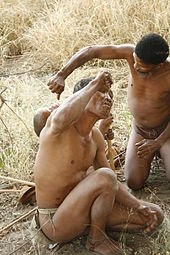
The San Bushman are one of the oldest known people groups and they have a distinctive yellow skin tone.
San of Botswana

The "father" of genetic mapping, Luigi Cavalli-Sforza, believes, "The most important difference in the human gene pool is clearly that between Africans and non-Africans…" This is because the farther archaic peoples dispersed from their point of origin in Africa the less diverse their genetic makeup. This is also true for world languages.

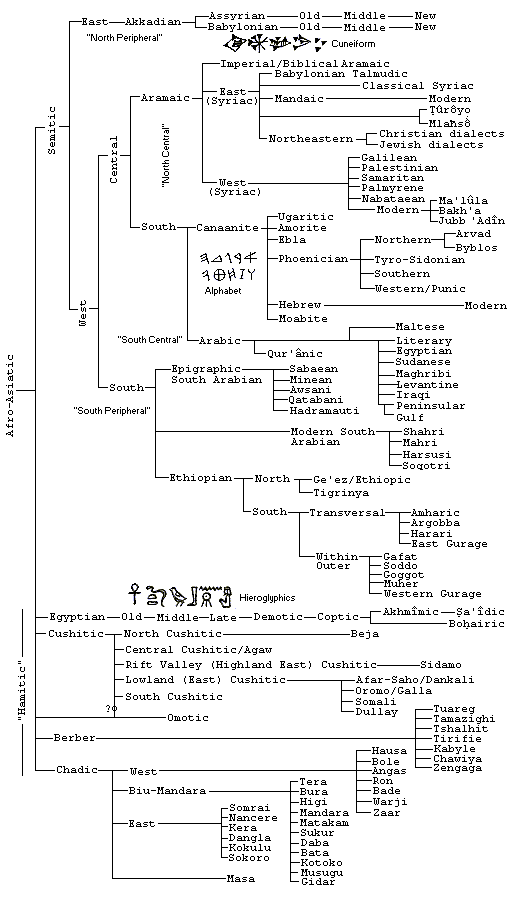
The oldest phonemes and roots are found in the Afro-Asiatic language family shown below. Hebrew is in this family and many Hebrew words are of African origin or derived from ancient Akkadian which also has affinity to African words.


Among archaic peoples of the Afro-Asiatic Dominion there was no concept of race. People were identified by their clan and caste. Castes were a major feature of archaic societies. The word "race" does not appear in the Bible because it is not a biblical concept.

In the New Testament, the Greek word ethnos is used for peoples or nations. The Hebrew goy or goyim is used to distinguish non-Jews from Jews. Both Goy and Ethnos refer to "peoples" or "nations" and not to races.

For both Y-chromosome and Mitochondrial DNA, a couple of hundred haplogroups have been identified. On the molecular level, human diversity is much greater than generally recognized. That diversity and the existence of humans on earth for more than 3 million years pose insurmountable problems for those who believe that three races come from Noah's sons, Shem, Japheth and Ham.

In this view, Japheth is the father of the Caucasian or white race; Shem of the Mongoloid or yellow race; and Ham of the Negroid or black race. This is contrary to what Genesis reveals.  Analysis of the King Lists in Genesis 4 and 5 makes it clear that the lines of Ham and Shem intermarried. Abraham was a descendant of both Ham and Shem.

Noah and his sons were Nilotic rulers whose lines intermarried. The idea that Noah cursed black people when he cursed Ham/Canaan is false and despicable. Since Ham and Shem's lines intermarried, Noah’s curse would have fallen upon all his descendants by Ham and Shem. There is no ground here for assuming that Noah's curse involves black people as was taught by those seeking to justify enslavement of Africans in the 19th Century.

Noah lived approximately 2490-2415 B and was not the only ruler on Earth. This is the period of the Old Kingdom, a time of great cultural and technological achievement in Egypt.

Ethnic and genetic diversity existed long before Noah's time. Human populations mined red ocher in the Lebombo Mountains more than 50,000 years before Noah. River peoples (Pengtoushan culture) thrived along the Yangtze River between B.C. 7500–6100, and the Yangshao culture flourished along the central Yellow River between B.C. 5000 and 3000. Yangshao nobles wore silk garments. During Noah's time, the Baodun culture was established in numerous settlements along the Min River in China. The Qafzeh population made tools about 125,000 years ago at Jebel Faya in the Arabian Peninsula.  There is no evidence that any of these peoples were wiped out by a worldwide flood.

Young Earth Creationists insist on imposing their simplistic view of race on Genesis despite the overwhelming evidence that Genesis is not so much about human origins and the age of the Earth as it is about the origins of Messianic expectation among Abraham's Nilotic ancestors.  In their Affirmation VI which appear at the back of their books, we read:  We affirm that the genealogies in Genesis 5 and 11 are chronological, enabling us to arrive at an approximate date of creation of the whole universe.

They clearly have no understanding of the nature of the King Lists because they never mention Genesis 4 which must be read with Genesis 5, as the lines of Cain and Seth intermarried. The intermarriage is evident in the cousin bride's naming prerogative as in the case of Lamech's daughter Namaah (Gen. 4: 22) who married her cousin Methusaleh and named their first-born son Lamech (Gen 5: 25) after her father, to whose throne Lamech the Younger ascended.

The fact that the Hamites and Semities cannot be separated linguistically or genetically in Genesis or in molecular genealogy underscores that the text is speaking of one people in different ruling houses, not of different races.

Young Earth Creationism promotes racism in Affirmation XII: We affirm that all people living and dead are descended from Adam and Eve...and that the various people groups (with their various languages, cultures, and distinctive physical characteristics, including skin color) arose as a result of God's supernatural judgment at the Tower of Babel..."

What astonishing ignorance about Genesis! All of the rulers named in Genesis are Afro-Asiatics and their skin color and other physical features varied greatly long before the Akkadian 7-tiered temples were built in Babylon. It is ignorant and racist to insist that genetic diversity or black skin color is the result of God's judgment.

Dr. Joshua Zorn, a former Young Earth Creationist, is right in saying, "The worst aspect of YECS teaching is that it creates a nearly insurmountable barrier between the educated world and the church."

Further, in their untenable scheme Young Earth Creationists make no mention of a red people, the oldest genetic group to which Abraham's Ainu father belonged. Abraham's ancestors originated in the Upper Nile. From the Nile his ancestors moved into Mesopotamia. They have been identified as Edomites (meaning red) and Horite Habiru (Hebrew devotees of Horus).

If Abraham's Ainu ancestors spread far and wide as Genesis 10 reports, we would expect them to be an early stock from which many other peoples come.  This has been confirmed by Luigi Cavalli-Sforza's genetic distance studies which places the Ainu at the center.

Cavalli-Sforza's Genetic Distance Chart


Molecular Genealogy Confirms Genesis

Molecular genealogy has forever changed our understanding of race. Classifications based on outward appearance are misleading. There is a range of physical characteristics within a single haplogroup. So Luigi Luca Cavalli-Sforza was correct when he wrote in 1994, "The classification into races has proved to be a futile exercise for reasons that were already clear to Darwin."

Darwin's discovery of the diversity, complexity and isolation of species in Galapagos has application for understanding human diversity, genetic complexity and the effects of isolation on populations. When it comes to the rulers listed in the "begats" the tools of kinship analysis enable us to discover the marriage and ascendancy structure.  This information helps us to understand how these early ancestors of Christ became the founders of the Afro-Asiatic Dominion. Analysis of the "begats" also reveals that these rulers were not the founders of the human race, but great kingdom builders of the archaic world.

Archaeological and anthropological research has demonstrated that there was a wide range of physical appearance among those Nilotic peoples. Some were light brown with blue eyes, other had a reddish skin tone and green eyes, and others were black with dark brown to amber-colored eyes.

Abraham means “burnt father” and refers to his reddish skin color. In Arabic, the word ham means burnt. The Nilotic peoples were referred to burnt because they had a reddish skin tone.  Abraham was a descendant of these ancestors, who the Bible designates as Kushites. Their skin color ranged from the black Nubians to the reddish brown Egyptians.

The Ainu originated in the Nile Valley by migrated as far as Japan and North America. They have a red skin tone.  David is described as having a reddish skin tone like that of Egyptians who work in the sun (I Sam. 16:12; 17:42). The Hebrew word for red or ruddy is edom. The Hebrew root is DM, as there are no vowels. Edom is equivalent to the Hamitic/Hausa odum, meaning red-brown and to the word Adam, the first man whom God formed from the red clay which washed down to the Upper Nile Valley from the Ethiopian highlands.

Recent DNA studies indicate that the lighter skin gene of Europeans is a relatively recent development. For images of how the Ainu probably looked before the lighter skin gene, go here.


Related reading: The Genesis 10 EthnographyThe Edomites and the Color Red; Answers to High Schoolers' Questions About Noah's FloodWho Were the Kushites?; The Christ in Nilotic Mythology; A Kindling of Ancient Memory; Getting the Facts About Human Origins; The Annu/Ainu of On (Iunu)