Followers

Showing posts with label Nekhen. Show all posts

Monday, November 24, 2025

Royal Hebrew High Places


The winged sun was a symbol of the High God.


Dr. Alice C. Linsley

The early Hebrew lords such as Cain and Nimrod are remembered for their city building efforts. They established settlements at high elevations near permanent water sources. These are what the Bible calls “the high places”. High places were fortified settlements on hills or mountains. The higher elevations made defense of these settlements easier. Built by rulers, the fortifications protected their palaces, royal temples, treasuries, and garrisons.

There were many high places in the ancient world. They were identified by the words "kar" (rock shelter) and "tamana" (great place). The term kar is associated with burnt offerings, charcoal and soot. The Turkish word kara means "black". In Magyar, korom refers to soot, as does the Korean word kurim. In the Sumerian language, Ekur (É.KUR) refers to a mountain house, pyramid, or elevated temple. The place name tamama has been found in over 188 countries and five continents. Votive offerings made at the tamama high places were called tama or tamata. The words are related to the ancient Akkadian word tamitu, meaning oath or pledge.

Some fortified settlements and temples were served by Hebrew royal priests. This is especially evident along the Nile River. Nekhen, the oldest known site of Horite Hebrew worship (4000 B.C.), had a temple with a large oval courtyard surrounded by a mud-plastered reed fence. The courtyard was paved with multiple layers of compressed mud. This temple appears to be the pattern for later temples as depicted on seals from the First Dynasty of Egypt (3100 – 2686 B.C.).

Nekhen was an established settlement at the time that some place Adam and Eve. in history. However, priestly some texts found in the Nile Valley have been dated to 4200 BC. Archaeology and anthropology provide some of the backstory to Adam and Eve, the parents of the Hebrew rulers Cain and Seth. These are historical people, but clearly, they were not the only Hebrew lords and ladies 6000 years ago.

The Hebrew ruler-priests living along the Nile were organized into two ritual groups or moieties: the Horite Hebrew and the Sethite Hebrew. The two groups helped each other but were often in competition. Descriptions of the Horites and Sethites are plentiful in ancient texts such as the Pyramid Texts (2400-2200 BC). These descriptions make it clear that the Horites and the Sethites maintained separate settlements. Utterance 308 addresses them as separate entities: "Hail to you, Horus in the Horite Mounds! Hail to you, Horus in the Sethite Mounds!" The more prestigious Horite Hebrew settlements were usually at a higher elevation that those of the Sethite Hebrew. Utterance 470 contrasts the Horite mounds with the Sethite mounds, designating the Horite Mounds "the High Mounds".

Multiple high places attracted pilgrims and generated revenue even as pilgrims and tourists are drawn today to shrines in the British Isles, France, Iran, Italy, Spain, and Jerusalem. The greater the fame and prestige of the shrine or temple, the larger the crowds. Naturally, competition arose between the sacred sites. That competition is evident in the Deuteronomist Historian’s antagonism toward all "high places" other than Jerusalem. A late source (800-400 BC), the Deuteronomist sought to centralize worship at the Jerusalem temple, and to shape national observances such as the Passover and Tabernacles.

Competition between the sacred high places of the Jews and Samaritans is mentioned in the New Testament. When Jesus was going to Samaria, the Samaritans who believed that he might be the Messiah hoped that he would establish Mt. Gerizim as the center of his kingdom. However, they no longer welcomed him once they learned that Jesus had "set his face to Jerusalem" (Lk. 9:51).

Thursday, March 20, 2025

The Religious Symbolism of Gold


This crescent-shaped gold collar (lunula) was found in Cornwall, England. The Penwith Lunula is dated to the Early Bronze Age (2500-1550 BC). It was worn by a ruler in England around the same time Abraham became established as a ruler in ancient Edom.

From ancient times, gold has been a highly prized commodity. Gold is mentioned over 400 times in the Bible. The word for gold is similar in these Afro-Asiatic languages: Ancient Egyptian - nub (nwb); Akkadian - dahh-ubu; Arabic - dha-hab; and Hebrew - za-hab.

There is evidence that the finest gold was named for Horus, "the Golden One." The HR root is found in the Assyrian word for gold hur-asu and in the Hebrew words for refined or purified gold - haruz. 

Gold was highly valued among the Nilotic Hebrew for whom it represented the sun, the symbol of the High God and his son HR (Horus in Greek). In the ancient world, kings and judges were believed to be appointed by the High God, and Horus was their patron.

The Egyptian word HR means "the One on high." The Turin Canon, which provides important information on Egypt's early history, describes the predynastic rulers as "Followers of Horus" and many had Horus names. The Horus name (HR, Hor, Hur, Har) is the oldest known among the Nilotic rulers, even before Egypt emerged as a political entity. 

Many early Hebrew rulers had Horus names. Hur is an example. According to Midrash, Hur was Moses’ brother-in-law, the husband of Miriam. Hur’s grandson was one of the builders of the Tabernacle. 1 Chronicles 4:4 lists Hur as the "father of Bethlehem," an early Horite Hebrew settlement.

A chief of the tribe of Asher holds the Horus name Harnepher (1 Chron. 7:36).

Another Horus name is Na-Hor, the name of Abraham's older brother. Nahor ruled over his father's territory in Paddan Aram when Terah died. In ancient Akkadian, Na is a modal prefix indicating service to, affirmation, or affiliation. Na-Hor indicates that this man was a devotee of HR, which in ancient Egyptian refers to the Most High God.

A prayer addressed to Horus says, "For you are he who oversees the gods, there is no god who oversees you!" (Ancient Pyramid Texts, Utterance 573)

One of the most famous images related to Horus was found at Nekhen. This is a gold artifact of Horus under the sign of his totem, the falcon. This great gold plumed falcon represents the son of the Father (Re in Ancient Egyptian). Nekhen was named for Horus of the Falcon: Nekheny.


Horus of Nekhen, the oldest known site of Horite Hebrew worship (c.4000 BC).


The Hebrew Lived in Regions Rich in Gold

Abraham was a very wealthy Hebrew. This is attested by Genesis 13:2 which states that Abraham was very rich in livestock, in silver and in gold. Genesis 24:22 says that Abraham's servant delivered a gold ring and two gold bracelets to Rebekah as a gift from her future husband, Isaac.

Some of Abraham's ancestors lived in regions where gold was found both on the surface and in tunnels. Genesis 2:11 designates Ha'vilah as a gold rich area. It was where the waters of the Upper Nile form a V, suggesting the branching of the White and Blue Nile. The land was later known as Nubia, which means "land of gold." Genesis 2 also mentions that the region has Bdellium, a semi-transparent oleo-gum resin extracted from Commiphora wightii and from Commiphora africana. These trees grow in Ethiopia, Eritrea and other parts of East Africa.

In 2007, archaeologists from the Oriental Institute discovered a 4000-year gold-processing center along Nile. The site is called Hosh el-Guruf and is located about 225 miles north of Khartoum. More than 55 grinding stones made of granite-like gneiss were found at the site. The ore was ground to recover the gold, and water was used to separate the flakes from the particle residue. Similar grinding stones have been found at Timnah in southern Israel.

A temple dedicated to Hathor, the mother of Horus, was discovered at the southwestern edge of Mt. Timnah by Professor Beno Rothenberg of Hebrew University. In his book Timna, Rothenberg concluded that the peoples living in the area were "partners not only in the work but in the worship of Hathor." (Timna, p. 183)

Another area described in the Bible as being rich in gold is Ophir. Ophir was in southwest Arabia. This is the territory of Sheba and Ramah (see map below). Every three years Solomon received tribute of gold, silver, sandalwood, precious stones, ivory, apes and peacocks from Ophir. Solomon's navy traveled to Ophir, taking "four hundred and twenty talents of gold from there" (1 Kgs. 9:26-28; 22:48; 2 Chron. 8:17-18; 9:10).

This gold of Ophir was mined heavily and became scarce. This is attested in Isaiah13:12, which says, "I will make mortal man scarcer than pure gold and mankind than the gold of Ophir."


The Religious Symbolism of Gold

In ancient times high kings, rulers, and judges were noted by some association with the sun. Many rulers among Abraham's ancestors were believed to be appointed by God as the Creator's representatives of earth. The sun symbol appears as the initial Y (a solar cradle) in the names of these Hebrew chiefs and priests: Yaqtan (Joktan); Yishmael (Ishmael); Yishbak; Yitzak (Isaac); Yacob (Jacob); Yosef (Joseph); Yetro (Jethro); Yeshai (Jesse) and Yeshua (Joshua/Jesus).

The letter Y in Ancient Egyptian is represented by two upright feathers. That symbol also designated one with authority to judge.

The Y-solar cradle also appears as bull horns. The mother of Horus is the only woman in ancient history to be shown wearing the horns to indicate her appointment by divine overshadowing.


Hathor the Overshadowed

Hathor was appointed to bear the "son"of God, Horus. In this image she is shown overshadowed by the sun, the emblem or symbol of the Creator. Hathor foreshadows the Virgin Mary, the mother of Jesus Messiah. When Mary asked the angel how she would conceive a child, seeing that she "knew" no man, Gabriel explained, “The Holy Spirit will come on you, and the power of the Most High will overshadow you. So the holy one to be born will be called the Son of God." (Lk. 1:25)


Hathor's is often associated with cattle, so it is not surprising that her offspring, Horus, was sometimes portrayed as the golden calf.


Exodus 32:2 says that Aaron fashioned the golden calf from the gold rings worn by the Israelites. We note that Aaron is never criticized or chastened by God for fabricating this Messianic image.


Related reading: The Gold of Ophir; Minoan Golden BeeKushite Gold; Nubia in Biblical HistoryThe Golden Calf in Anthropological Context


Friday, December 27, 2024

Get to Know the Biblical Hebrew!


Dr. Alice C. Linsley


An important feature of the Hebrew social organization was their moiety structure. They were organized into two separate ritual groups (moieties), and it is clear from the biblical data that the moieties associated with one of the Hebrew ancestors more than the other. 

The Kenite and Midianite metalworkers associated with Cain/Kain whose descendant Tubal-Cain is described as a metal worker in Genesis 4.

The Sethite Hebrew associated with Seth who appears to have been a deified Nilotic ancestor, as is suggested by the discovery of Seth images at Nekhen on the Nile, the earliest known Hebrew site.

The two moieties helped each other but were often in competition. Descriptions of the Horites and Sethites are plentiful in ancient texts such as the Ancient Pyramid Texts (2400-2200 BC). These descriptions indicate that the Horites and the Sethites maintained separate settlements. Utterance 308 addresses them: "Hail to you, Horus in the Horite Mounds! Hail to you, Horus in the Sethite Mounds!"

The more prestigious Hebrew settlements were those of the Horites. These were at a higher elevation that those of the Sethite Hebrew. Utterance 470 of the Ancient Pyramid Texts contrasts the Horite mounds with the mounds of Seth, designating the Horite Mounds "the High Mounds."

The Hebrew married only members of their royal priest caste. Marriage between members of the moieties strengthened the Hebrew identity. and preserved the caste's wealth. For example, the lineages of Cain and Seth are linked by a pattern of recurrent marriage between the numerous Horite and Sethite clans.


Bride exchange between the descendants of two brothers such as Cain and Seth, or Ham and Shem, was a common practice among the Hebrew. The diagram above shows that Naamah, a descendant of Cain, married her cousin Methuselah, a descendant of Seth. The Horite and the Sethite moieties were bound together by the exchange of high-status women between the Hebrew clans.


Cousin brides were especially important links between the Horite and Sethite Hebrew clans. The Hebrew men who ruled over territories maintained two wives in separate settlements. The firstborn son of the first wife ruled over the territory after his father died. The firstborn son of the cousin wife was sent to serve the household of his maternal uncle. Jacob was sent to serve his maternal uncle Laban. Likewise, Joseph went to serve his maternal uncle Potiphar in Egypt.

Other sons who were sent away include Cain whose descendants the Kenites were living in Canaan, which is כנען, pronounced kena'an. Moses served his maternal uncle Jethro in Midian (avunculocal residence). The practice of sending away non-ascendant sons is mentioned in Genesis 26. Abraham gave gifts to his sons and sent them away from his proper heir Isaac. 

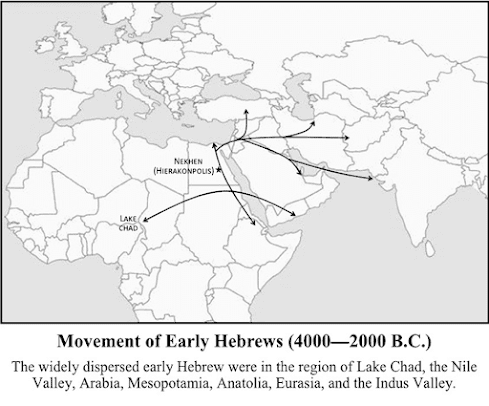
The custom of sending away non-ascendant sons drove the Hebrew dispersion out of the Nile Valley well before the time of Abraham (c. 2000 BC).


Applying kinship analysis to the biblical texts makes it possible to detect the historical realities behind Jewish midrash. Certain literary devices are used to develop the Jewish narrative. One is the device is jealousy among brothers. Though the Genesis story does not explain why Cain killed Abel, midrash supplies the explanation that he was jealous. Likewise, Joseph’s treatment by his brothers is explained as an act motivated by jealousy.

Midrashim often employ the device of slavery to explain why a prominent Hebrew is not living in Judah, Israel, or the land of Canaan. It is used to explain why Joseph was in Egypt, why Daniel was in Babylon, and why Mordecai and Esther were in Persia. In the sixth century BC, many Judean noblemen were taken to Babylon, and Babylon was conquered by the Persians who took captives to Susa. These events have been historically verified. Midrash often embroiders historical events to convey a theological message.


Tuesday, November 26, 2024

Competition Between the Horites and the Sethites


Egyptian artifact dating to c. 1970-1878 BC. 


Dr. Alice C. Linsley

This Egyptian hippopotamus statuette can be seen in Gallery 111 at the Metropolitan Museum of Art in New York City. Museum workers regard "William the Hippo" as a mascot. The artifact was found in a shaft associated with the funerary chapel of Senbi the Steward. This 8 in (20 cm) figurine in faience, a clay-less material, illustrates the high level of Egyptian faience work during the Middle Kingdom.

According to the Museum, this hippo figure is a "particularly fine example of a type found, in common with various other animal forms, among the funerary furnishings of tombs of the Middle Kingdom."

William seems a benign creature, almost whimsical. However, hippos can be aggressive and are known to attack. In Job 40:15-24, the hippo is called the "behemoth" and is described as one of God's most dangerous creatures. On ancient Nilotic murals and royal vessels, the early kings are often shown spearing fearsome hippos. Such scenes depict the kings as courageous and able to impose order on chaos. The hippo was the animal totem of Seth and sometimes represented the chaos that could arise when Seth, a deified ruler, asserted equality with Horus, the son of the High God.

The competition between Seth and Horus is found in many Egyptian tales. These tales reflect the competitive relationship between the Sethite and the Horite Hebrew who maintained separate settlements (mounds) along the Nile River before the time of Abraham (2000 BC). 

It is clear in the Ancient Pyramid Texts (2400-2000 BC) that the Horites and the Sethites maintained separate settlements. Utterance 308 addresses them as separate entities: "Hail to you, Horus in the Horite Mounds! Hail to you, Horus in the Sethite Mounds!" 

Though separate groups or moieties, the Horite and Sethite Hebrew shared common religious practices and beliefs, and they worshiped the same God and served the same king. However, the Horite temples and shrines were the more prestigious. Utterance 470 contrasts the Horite and Sethite mounds and designates the Horite mounds as "the High Mounds."


Golden Horus falcon found at Nekhen.


The animal totem of Horus was the falcon, symbolizing flight through the heavenly regions. The falcon was also the totem of the Horite Hebrew who were devotees of Horus (HR). HR in ancient Egyptian means the Most High One. 

The hippopotamus, on the other hand, is a creature of the mud, dust, and clay, suggesting that the mounds of the Sethites were the lower mounds. The elevation of the mounds appears to relate to a hierarchy of authority.

Figures relating to both Seth and Horus have been found at Nekhen on the Nile, the oldest known site of Horite Hebrew worship (4000 BC). This figurine of Seth as a red man with the head of a hippo was found at Nekhen. 


Votive offerings at the Nekhen temple were ten times larger than the normal mace heads and bowls found elsewhere, suggesting that this was a very prestigious shrine.


Friday, November 8, 2024

The Earliest Known Site of Horite Hebrew Worship


Dr. Alice C. Linsley


The Hebrew regarded the mountain top as the spatial sacred center between heaven and earth, and high noon as the temporal sacred center, a time without shifting shadows. This belief is expressed in James 1:17 – “Every good and perfect gift is from above, coming down from the Father of the heavenly lights, who does not change like shifting shadows.” There were many Hebrew “high places” and the one that became associated with Judaism is Jerusalem.

High places served by Hebrew priests include Uruk (alt: Erech), Jericho, Heliopolis on the Nile, Nekhen and Karnak. Burnt offerings were made at the high places. This is reflected in the association of the term kar with charcoal and soot. The Turkish kara means "black." In Magyar, korom refers to soot, as does the Korean word kurim. In Dravidian, car means "sheltered together" and kari refers to a river. In Manding, kara means "to assemble." Among the Nilotic Luo, kar specifies a place with boundaries. In ancient Sumerian, é-kur refers to a mountain house, a pyramid, or an elevated temple. It is evident that kar refers to a rock sheltered or fortified site with a temple or shrine tended by priests.

High places are described as “mounds” in the Ancient Pyramid Texts (2400-2000 BC). One of those mounds was Nekhen, the oldest known site of Horite Hebrew worship. Archaeological discoveries there have confirmed the presence of Horite and Sethite Hebrew at Nekhen as early as 5100 years ago. The citizens brewed beer, made pottery, and built homes and public buildings using bundled reeds and large logs. They fashioned sacred objects of flint, gold, and malachite. Green malachite held special significance for the early Horite Hebrew. It was associated with Horus. The Egyptian Book of the Dead speaks of how the deceased will become a falcon "whose wings are of green stone" (chapter 77). The Pyramid Texts speak of Horus as the "Lord of the green stone" (Utterance 301). A leather pouch containing chunks of malachite was found among the grave goods at Tomb 39 in Nekhen, a city dedicated to Horus whose totem was the falcon.


Golden Horus as a falcon found at Nekhen.
 

Early hieroglyphic writing appears on some of the artifacts found at Nekhen. Archaeologists also found the earliest funerary complex in the land that would become known as Egypt, and the exquisite burial goods leave no doubt that this tomb belonged to one of the Upper Nile’s earliest kings.

Nekhen was a center for the worship of the High God and his Son HR. Votive offerings found at Nekhen were ten times larger than the mace heads and bowls found elsewhere, indicating the prestige of the Horus Temple. Royal priests at the Temple of Horus honored the High God, the High God’s son HR, and HR’s mother, Hathor.

An ivory Hathor comb with carved cow horns at the top was found in grave 66F at Nekhen. It dates to between 3650 and 3300 BC.


Thursday, July 25, 2024

Seth, Son of Adam


Dr. Alice C. Linsley

The historical Adam was the father of three sons: Cain, Abel, and Seth. The Bible does not name any descendants of Abel. Some of Cain's descendants are listed in Genesis 4 and some of Seth's descendants are listed in Genesis 5. The lines of Cain and Seth intermarried (endogamy). That is shown in the diagram.


Lamech the Elder (Gen. 4) had a daughter named Naamah. She married her cousin Methuselah and named their firstborn son Lamech, after her father. This is an example of the cousin bride's naming prerogative, a distinctive feature of the marriage and ascendancy pattern of the early Hebrew (5000-2000 BC).

The rulers listed in Genesis chapters 4, 5, 10, 11, 25 and 36 were members of the Hebrew ruler-priest caste. As is common with castes, they practiced endogamy. By marrying only members of their caste, certain genetic traits were passed to their descendants. Apparently, a red to red-brown skin tone was one of those traits. 

The Sethite Hebrew were a well-established moiety of the Hebrew caste by 2400 BC because their sacred sites are mentioned in texts that date to 2400 BC. This means that the historical Adam probably lived between c.5000-4800 BC. 

The Sethites served at the sacred high places (mounds) along the Nile and are mentioned many times in the Ancient Pyramid Texts (2400-2200 BC). One place where figurines of Seth were found is Nekhen on the Nile. The city was dedicated to the son of the High God, HR (Horus in Greek). HR in ancient Egyptian means "Most High One."

The vast majority of hair samples discovered at the predynastic cemetery site HK43 at Nekhen were cynotrichous (Caucasian) as opposed to heliotrichous (Negroid), according to The Nekhen News (p. 7). Samples ranged from a single hair to a complete headful, with the largest number originating from the disturbed Burial no. 16 of a female of around 35+ years of age.

Another fascinating find at Nekhen was the recovery of an almost complete beard in association with the redheaded man in Burial no. 79. The man had long wavy natural red hair and a full beard. 

The shrine city of Nekhen is the oldest known site of Horite Hebrew worship and there were Sethite Hebrew living there. This figurine of Seth as a red man with the head of a hippo. was found at Nekhen. Perhaps the hippo was the totem of the Sethite Hebrew, and the falcon was the totem of the Horite Hebrew. Note the red-brown tone of the figurine.


Seth is often portrayed in ancient images as a red hippo. Seth’s homeland is the land of Seti, at the northern edge of the Upper Nile. This region is sometimes referred to as the land of red earth. 

According to Genesis 5:3, Seth was a son in the image of his father Adam. This likely means that he had a red skin tone. The word “Adam” refers to blood (dam in Hebrew, dammu in Ancient Akkadian) and the color red. Adam is derived from the root אדם (A.D.M), meaning "to be red or ruddy" (Strong’s #119). Jeff A. Benner explains, Dam is the "red" blood, adamah is the "red" ground, edom is the color "red" and adam is the "red" man.

The connection between the terms adam (red man) and adamah (red soil) is evident in Genesis 2:7 which states that "the adam" was formed out of the "adamah." The region of the Nile under consideration has a cambic B horizon. Chromic cambisols have a strong red brown color. 


Related reading: Horite and Sethite MoundsAdam and Estrangement from GodFunerary Rites and the Hope of ResurrectionAfrican = Black is a Modern Equation

Thursday, August 1, 2019

Who Were the Sumerians?


Alice C. Linsley


The evidence of anthropology, linguistics, DNA studies, and archaeology indicates that the Sumerians were likely dispersed cattle-herding Proto-Saharans who moved into the northern regions of Eden where the climate conditions in this riverine terrain during the African Aqualithic made the land ideal for grazing. The Proto-Saharans moved into Mesopotamia before 7000 BC. They developed a way of life that centered around the ancient water systems.

In Genesis, Eden is described as a vast well-watered world that extended from the source of the Nile in Ethiopia to the Tigris and Euphrates Rivers.

This Eden belt has an arc shape that corresponds roughly with the drought zone of the early 1970s when Lake Chad began to shrink rather dramatically and the smaller lakes of Egypt's desert virtually disappeared. The arc extends in three directions from the southern Sahara near the Benue Trough in Nigeria to the Nile and there bends up-river (south) to the equatorial East African rift valleys, and northeast toward present day Jordan, Israel, Syria, and Iraq.

The height of this ‘aquatic civilization’ came in the seventh millennium BC, when higher rainfall made rivers longer and wider, and caused lakes to burst their basins (Butzer et al., 1972; Zinderen Bakker, 1972).

Around 7000 BC, Lake Chad expanded enormously and overflowed via the Benue and Lower Niger rivers into the Atlantic. In East Africa the small lakes in the Kenya rift valley and in Egypt's desert rose and many of the water systems became connected. This was a time of flooding and probably when Noah lived (c.4200 BC) in the region of Lake Chad. The region is called Borno or Benue, both mean "land of Noah."


The Dispersal of the Sumerians

The Sumerians established settlements between the Tigris and Euphrates Rivers. The rivers and their tributaries provided abundant water for sheep and cattle. The Sumerian herding of sheep and cattle is a recurrent theme in early Sumerian art and literature.


Sumerian relief from Ur showing sheep and cattle (c. 2600 BC).


Some of the settlements became royal cities from which the surrounding region was governed by the king or the vassal of a high king. The Sumerian city-states included Eridu, Nippur, Lagash, Kish, Ur and Uruk (Erech). These became shrine cities similar to those found along the Nile at Heliopolis, Nekhen and Nekheb.

Among the Sumerians and Akkadians there resided a royal caste of priests who served the kings in their daily worship and also in funeral rituals. This practice was well established in ancient Egypt. Matthew J. Adams' comprehensive study (2003) addresses ancient Egyptian references to “royal mortuary complex attendants” designated by the non-compounded hntjw-š. He notes that land for plowing was set aside for the priest attendants of the "dual pyramid town" by royal decree (p. 27).

The ancient priests also served as royal advisors, scribes, physicians, astronomers, and temple architects. Beginning around 2000 BC, they supervised the construction of ziggurats in Mesopotamia. These were stepped temples, usually with seven tiers. The number seven was a sacred number for the ancient priests. The connection between the words for priest (Akkadian: abru) and the number seven is evident in the Nilotic (Luo) word for the number seven, which is abiriyo.

The word "Hebrew" is derived from the Akkadian word abru, meaning priest. Variants spellings include 'Apiru, Ha-biru and Ha-piru. The word refers to priests who served at the temples of the ancient Sun cities. The Sun temple was called O-piru, meaning "house of the Sun." The Habiru were already widely dispersed in the 14th-13th centuries B.C. Their dispersion was driven by a marriage and ascendancy pattern in which some sons were sent away to establish their own territories.

The Sumerians borrowed words from the Akkadians as early at 4000 BC. Some Sumerian words came into Hebrew through Aramaic. Abraham's brother Na-hor (meaning a devotee of Horus) ruled over the territory of their deceased father between the rivers of Mesopotamia. Three of the Egyptian Armana tablets identify this region as "Naharin" which means "Land of Horites." Genesis 25:20 and 28:2 call this region Paddan-Aram, meaning "field" or "land of Aram." The link between Aram (Land of Arameans) and Naharaim (Land of Horites) is evident in the description of the region as Aram-Naharaim in Gen 24:10Judg 3:8; and Ps 60:21.

NImrod was one of the Hebrew rulers who dispersed into Mesopotamia . He was the son of Kush (Gen. 10:8). The language of Nimrod's territory was likely Sumero-Akkadian. Nimrod's cultural context is more Nilotic than Mesopotamian. He is associated with Calah on the Tigris River, known today as the city of Nimrud. Calah (Akkadian 'Kalhu') appears to have been the northernmost point of his territory in Mesopotamia. Nimrod's territory extended along the Tigris between Calah and Ashur. Likewise, Terah's territory extended between Ur and Haran. In the Bible, we first meet Abraham in Ur because he was a descendant of Nimrod the Kushite kingdom builder (Gen. 10). Both Abraham and Nimrod were Hebrew rulers whose ancestors served as ruler-priests along the Nile.


The shrine city of Urkesh (Tell Mozan) was between the Tigris and Euphrates rivers. It was inhabited before the time of the Hurrians. The artifacts there suggest that the Horite Hebrew priests influenced the religious symbolism. The Temple of the Lion is an example (2200 BC).


This bronze foundation peg in the form of a snarling lion comes from Urkesh. Pegs like this were placed in foundation deposits under temple walls. Their appearance in northern Mesopotamia represents the adoption of a practice from the Horite Hebrew. The earliest lion imagery dates to Naqada IIC, circa 3200 BC. (See Nekhen News, p. 8.) Nekhen is the oldest known site of Horite Hebrew worship (4200 BC). 


Wednesday, March 16, 2016

The Annu of On (Iunu)


This image of a Annu/Ainu priest shows him holding the staff and wearing a cap with a frontal piece typical of Ainu chiefs in Japan and Eastern Canada. Tera (Terah) means priest and neter (ntr/ntjr)refers to God. Het is a reference to the front of the temple which was east-facing. Akhet is the ancient Egyptian word for horizon.


The Nilotic Annu/Ainu priests were associated with the most prestigious shrine and temples of the ancient world, including Nekhen and Biblical On (Heliopolis). The shrine at Heliopolis was known as Iunu, place of pillars. Heliopolis was one of the places were the Habiru (Hebrew) Horites served as priests. Joseph married a daughter of the priest of Heliopolis.

Plato wrote "Tell me of the God of On, which was, is and shall be." Plato studied under a Horite priest of Heliopolis for thirteen years. Heliopolis was the geodetic center of Egypt. The pyramid triads at Giza, Abusir and Saqqara are aligned to the obelisk at On. Baalbek (Heliopolis) in Lebanon, also aligns to On as well.

The Nilotic origin of the Ainu has been well established. None is surprised that the Ainu can be traced genetically to the Nile Valley. Africa is the point of origin of humans. The Ainu dispersed along water ways and mountain ridges. They took with them their religion, rituals and expertize with metal work and stone work. It was their custom to build shrines near water and at high elevations near ancient rock shelters. Their priests performed rituals at these shrines. They also built circular monuments of standing stones called kar. Kar-nak along the Nile means stone monument where rituals are performed. In Exodus 25:11 Ki-kar refers to a circle; ki-kar za-hav ta-hork, means "circle of pure gold."

Haplogroup C-M217, also known as C2 (and previously as C3), is a Y-chromosome DNA haplogroup. It is the most frequently occurring branch of the wider Haplogroup C (M130). M217 is found at high frequencies among Central Asian peoples, indigenous Siberians, and some Native peoples of North America.

Haplogroup C-M217 comprises more than ten percent of the total Y-chromosome diversity among the Manchus, Koreans, and the Ainu of Hokkaido and Okinawa. Recent DNA studies reveal that the Ainu of Hokkaido and the Ryukyuans of Okinawa have a closer genetic affinity than either group has to the Japanese. It is likely that these populations which practiced clan endogamy retain cultural and physical characteristics of the earlier Jomon who had dispersed throughout the various islands of Japan 14,000 years ago.

Traditional Ryukyuan family tomb called kamekōbaka.
These resemble the stone tombs of Horites living in other regions.

There are Ainu in Eastern Canada also. The grandson of an Ainu elder living in Eastern Canada reports that not all the native people of North America came via the land bridge from Siberia. His Miqmaq people came to North America via Scandinavia, a fact that has been confirmed by DNA studies (Haplogroup X2b5).


Haplogroup X is one of the five haplogroups found in the indigenous peoples of the Americas. It occurs at a frequency of about 3% for the total current indigenous population of the Americas. However, among the Algonquian peoples it comprises up to 25% of mtDNA types.

Y-SNP lineages C-M217 have been identified in South American populations. The study suggests a late introduction of C3 into South America no more than 6,000 years ago via coastal or ocean routes.
 
Related reading: The Nile-Japan Ainu Connection; Horned Altars and Horned Sacred Vessels; A Kindling of Ancient Memory; Solving the Ainu Mystery


Saturday, December 12, 2015

The Gourd in Biblical Symbolism


A despondent Jonah facing east under a gourd plant.


Alice C. Linsley


Gourds were a sacred symbol among Abraham's Hebrew people. They represented fertility, new life, the arousal of the High God, the rising Sun and, as with the pomegranate, the hope for bodily resurrection. Gourd images decorated the Temple built by Solomon.

Cedar gourds decorated the inner sanctuary of the temple.
The house, that is, the nave in front of the inner sanctuary, was forty cubits long. There was cedar on the house within, carved in the shape of gourds and open flowers; all was cedar, there was no stone seen. 1 Kings 6:18
Gourds also decorated the bronze sea, a circular basin which held a supply of water for ritual use.
Now he made the sea of cast metal ten cubits from brim to brim, circular in form, and its height was five cubits, and thirty cubits in circumference. Under its brim gourds went around encircling it ten to a cubit, completely surrounding the sea; the gourds were in two rows, cast with the rest. It stood on twelve oxen, three facing north, three facing west, three facing south, and three facing east; and the sea was set on top of them... 1 Kings 7:24

In the story of Jonah, the LORD prepares a gourd plant to shelter Jonah. This pleases Jonah, but a worm destroys the plant. The gourd represents the new life to be enjoyed by the people of Ninevah after repentance and deliverance from destruction. The worm is Jonah's bitterness that his enemies should be saved, just as he feared, knowing that the LORD is gracious and merciful.
The LORD said, "Do you have good reason to be angry?" Then Jonah went out from the city and sat east of it. There he made a shelter for himself and sat under it in the shade until he could see what would happen in the city. So the LORD God appointed a plant and it grew up over Jonah to be a shade over his head to deliver him from his discomfort. And Jonah was extremely happy about the plant.… Jonah 4:4-6

The gourd is a solar symbol and therefore spoke of the High God among the early Hebrew (4000-2000 BC). As it matures, the gourd swells. Likewise, the sun swells as it rises in the morning. The Sun was the symbol of the High God among the Hebrew. There is a connection to the ancient Egyptian root bn, meaning to swell or enlarge. The Egyptian word for the rising sun is wbn, and that which is enlarged or swollen to its limits is designated by the reduplication bnbn.


This appears to be a benben used to mark a sacred Celtic site.


In his book, Mountains of the Pharaohs, Dr. Zahi Hawass states that the benben was the "solar symbol par excellence, thought to have existed in reality as an object, perhaps a stone with a rounded top..." (p. 34)


Benben in Nigeria.


Benben pillars have been found in the Middle East and parts of Africa. They represent the arousal of the High God, the sole source of all life. Tombs of officials from the 4th Dynasty (2613-2494 BC) were surmounted by conical mounds or benben. These tombs, along with the east-facing royal tombs at Giza, indicate that the ancient Nilotic rulers hoped to rise from death, even as the Sun rises. The Prophet alluded to this belief when he wrote, “But for you who revere my name, the sun of righteousness will rise [swell/be magnified] with healing in its wings.” (Malachi 4:2)

The Old Arabic word for the swelling of the sun is yakburu, meaning “he is getting big” and with the intensive active prefix: yukabbiru, it means "he is enlarging." This it is related to the word O-piru, a reference to an east-facing Sun temple. The Hebrew ruler-priests who served in the sun temples were called Hapiru, Habiru, 'Apiru or Abru, from which the English word "Hebrew" is derived. In Ancient Akkadian abru means "priest". 

The morning ritual of the Hebrew priests involved greeting and blessing the rising sun and offering prayers as it swelled on the horizon. This practice of sun veneration continues in the morning ritual of devout Hindus (Agnihotra) and in the Jewish Sun Blessing ritual (Birkat Hachama) that is performed every 28 years. 

The Horite Hebrew priests of Nekhen (c. 4000 BC) placed invocations to Horus/HR at the summit of the fortress at dawn. They faced the eastern horizon to greet the rising sun, the emblem of Re, th High God, and his son Horus/HR. 

Nekhen is where the oldest life-sized human statue was found: a priest from the temple of Horus, dating to c.3000 BC. Votive offerings at the Nekhen temple were ten times larger than the normal mace heads and bowls found elsewhere, suggesting that this was a very prestigious shrine city. One of the Chief Inspectors of the Horite priests of Nekhen was Horemkhawef. His tomb has been identified.

The Horite Hebrew priests of Nekhen were among Abraham's ancestors. By the time of Abraham, the Horite and Sethite Hebrew were widely dispersed throughout the Ancient Near East. They preserved their customs and religion by practicing endogamy. Endogamy is a trait of caste. The Hebrew were a ruler-priest caste


Thursday, February 19, 2015

Stone Work of the Ancient World


Alice C. Linsley


One of the earliest occupations of Man was stone work. Sharp-edged flakes, flake fragments, and cobbles have been dated to between 2.5 and 2.6 million years. These were discovered at three sites along the Gona River in the Afar region of Ethiopia. Similar stone tools, known as Oldowan, have been found at Omo in southern Ethiopia, Lokalalei in northern Kenya, and Hadar, five miles east of the Gona River study area.

At Kathu in South Africa, archaeologists collected many thousands of stone tools and products of tool making in a few sample pits over a several acres. The archaeologists estimated that there are on average 900 artifacts per 100x100x10 cm volume of material in this area with much of the area up to 2 meters deep in artifact rich soils. This high concentration of stone artifacts along with available source rock in nearby outcrops suggests that this was a tool making center between 800,000 and 500,000 years ago. (Also see Foley RA, Lahr MM (2015) Lithic Landscapes: Early Human Impact from Stone Tool Production on the Central Saharan Environment.)

On the Arabian Peninsula, the Qafzeh population created stone tools 125,000 years ago at Jebel Faya. These suggest that humans reached the Arabian Peninsula not from the Lower Nile Valley 119,000 to 81,000 years ago or from the Mediterranean shores 65,000 to 40,000 years ago, but much earlier from the Horn of Africa. The oldest tools were dated to approximately 120,000 years ago, and included denticulates, end-scrapers, foliates, hand axes, and side-scrapers.

Stone knapping involved health hazards for the workers. The inhalation of siliceous dust would have led to lung disease. The fact that this work was done most often in the open air improved the working conditions. When mining operations began, the risk of the disease increased. Neolithic miners and Egyptian mine workers suffered from the disease, but the workers who mined in the Lebombo Mountains 90,000 years ago would have suffered from respiratory problems also.

Some prehistoric stone artifacts were not used as tools. The Blombos Cave Plaque, dating to 80,000 years PB, may have served as a calendar or a counting device.

Blombos Cave Plaque
The Lebombo Mountains of South Africa mines were in operation between 100,000 and 80,000 years ago. These were not small hallows in the earth, but major mining operations in which thousands of mining tools have been found. Red ochre was extracted from large mining operations in the Lebombo Mountains. Red ochre was used almost universally in the burial of nobles between 45,000 and 2000 B.C.

The oldest known stone temple is at Göbekli Tepe in Turkey. Göbekli Tepe is classified as a Pre-Pottery Neolithic site (PPN). It is designated PPNA (ca 10,500 to 9,500 BC) which puts it in the same class as Jericho, Netiv Hagdud, Nahul Oren, Gesher, Dhar', Jerf al Ahmar, Chogha Golan and Abu Hureyra. This site is located in the "land between the rivers" and was an ancient crossroads. The temple here predates by about 3000 years the oldest temple built by Abraham's Nilo-Saharan ancestors at Nekhen.


Menhir in County Cork, Ireland


Circles of Standing Stones

Circles of standing stones have been found in many parts of the world, including Armenia, Britain, Czech Republic, France, the Horn of Africa, India, Iran, Israel, Italy, Norway, Portugal, Serbia, Scandinavia, Spain, Sweden, Switzerland, and Turkey. The majority are found in Britain, Ireland, and Brittany, suggesting that this is a practice of populations in Y-DNA Haplogroup R1b (which were dispersed by 40,000 years ago). In Scotland, 508 such sites have been identified. There are 343 in Ireland; 316 in England; 81 in Wales; 49 in Brittany; and 6 in the Channel Isles.


Tombs at Nekhen
This 18th Dynasty tomb is heavily carved as befits the tomb of an Overseer of Stone Carvers.


Nekhen is the oldest known site of Horite worship is Nekhen on the Nile (4200 BC). This settlement predates the building of the Great Pyramids at Giza and the step pyramid of King Djoser (Third Dynasty). The oldest known tomb, with painted mural on its plaster walls, is located in Nekhen and dates to c. 3500–3200 BC.

Many artifacts of great importance have been found at Nekhen. These include funeral masks, statues, jewelry, beer vats, large flint knives, and the pillared halls characteristic of later Egyptian monuments and temples. Nekhen is where the oldest life-sized human statue was found: a priest from the temple of Horus, dated about 3000 BC.

The oldest known temple (c. 5000 BC) to have association with Abraham's ancestors is the predynastic temple at Nekhen. The temple was located on the Nile, making it easier for temple officials to weigh and measure goods and assess tolls on the vessels that docked there. The temple consisted of a large oval courtyard surrounded by a mud-plastered reed fence. The courtyard was paved with multiple layers of compressed mud. This temple closely resembles shrines depicted on seals from the First Dynasty.

A later temple (c.3500 BC) was built within the precincts of the city. The earliest phase of this temple was a circular stone wall surrounding a large mound of sand supported by limestone blocks on which there may have been an Early Dynasty shrine. A number of limestone fragments, likely the footings for large pillars, were found within the stone enclosure wall. The central shrine consisted of three rooms and four 20-foot high wood pillars. Animals, including cattle, goats, fish and crocodiles, were sacrificed in the oval courtyard.

By this time, Nekhen had a population estimated at 10,000 inhabitants and was the most important settlement along the Nile. The city stretched for over two miles along the edge of the floodplain and was an important shrine city and commercial center. There were stone masons, weavers, potters, and beer brewers. Metal workers crafted sacred objects of gold and copper. 

Narmer Palette

In 1898 J.E. Quibell and F.W. Green found the macehead of Scorpion and the macehead and palette of Narmer at the main deposit of the temple of Horus. Also found at Nekhen were a seated red pottery lion and the great gold plumed falcon representing Horus, the son of Ra. Nekhen was named for Horus of the Falcon: Nekheny.


Stone tombs of El-Amarna

The capital of Akhenaten is at ancient Amarna, about 365 miles south of Cairo. It is set between cliffs at a narrow stretch along the Nile. 

Tomb of Tutu
Tutu was a very high ranked ruler-priest of Akhenaten. His titles included:

Overseer of all the craftsmen of the Lord of the Two Lands (Upper and Lower Nile)
Overseer of all the works of His Majesty
Overseer of silver and gold 
Chief spokesman of the entire land


Tombs at Giza and Abusir

Egyptian archaeologists discovered a 4400-year-old tomb, south of the cemetery of the pyramid builders at Giza, Egypt. The ancient tomb was unearthed near the pyramid builder's necropolis. The tomb belongs to a priest named Rudj-Ka (or Rwd-Ka), and is dated to between 2465 and 2323 BCRudj-Ka was a priest who performed purification rituals for those who bore blood guilt and who had become contaminated through contact with blood or a corpse.

The tomb of Shepseskaf-ankh is the third tomb found at Abusir belonging to a priest-physician (wab sxmt or wab sekhmet). A huge false door inside the offerings chapel carries the names and titles of the tomb owner: “Priest of Re in the Temples of the Sun” and “Priest of Khnum” with other titles that indicate the high rank of this ruler-priest. Originally the huge limestone tomb was marked by a pyramid. The discovery was made at Abusir near Cairo, not at the Abusir in Sudan.

The Czech mission, led by Miroslav Barta, stated that the construction of the tombs in Abusir began during the mid 5th Dynasty and many priests and officials who worked in the Abusir Pyramid complex of the 5th Dynasty and the Sun Temples were buried there.


Tombs built by the Hittite sons of Heth

Sarah died at Hebron (Arba) (Gen. 23:2-11) and Abraham requested a burying place for her of the sons of Heth. They offered him his choice of their stone tombs. It is likely that the deed to the cave with these tombs was part of the property that Abraham passed to his son Isaac (Gen. 25:5–6). According to Genesis 49:29, the cave tombs that Abraham bought with the field of Ephron were used to bury Isaac, Rebekah, and Leah.


Many tombs from the Early to the Middle and Late Bronze Ages have been found throughout Palestine. The most usual tomb was a natural cave or chamber reached through a vertical shaft which could be sealed by a stone slab (see image above). This is probably the type of burial place Abraham purchased from the Hittites who recognized him as "a great prince among us" (Gen. 23:6).  Genesis 10:15-19 indicates that the people of Heth were kinsmen of Abraham. They too were descendants of Noah from whom came Sidon and Heth.

HT is the Hebrew and Arabic root for copper - nahas-het. Nahash means serpent. As an adjective it means shining bright, like burnished copper. The clans of HeT were Bronze Age copper smiths who ranged from Timnah to Anatolia. The serpent image was sacred for them, just as it was for Moses the Horite ruler who fashioned a bronze serpent and set it on the standard (Numbers 21:9).


Royal Tombs in Anatolia

Royal tombs made of stone have been discovered in Alaca Hüyük and Horoztepe in Anatolia, dating to c. 2400–2200. The word "tepe" means hill in Turkish. "Horoz-tepe" is a reference to Horus and his devotees, the Horite ruler-priests, who were in Anatolia.  They are referenced in ancient texts as the Nes. In addition to stone work, they were smiths who introduced iron work to Anatolia. They called themselves the Nes (NS) and their language was called Nesli. Many magnificent artifacts have been recovered from these tombs, including this Sun disk from Alaca Hüyük (shown right).

Other rock tombs in Anatolia include stone sarcophagi and pillar tombs. The rock cut tombs at Myra resemble the rock-cut facades at Petra.


Rock-cut tombs at Myra


Rock-cut tombs at Petra (Note the red Edomite soil.)
Photo: Dennis Jarvis


The 3-story stone temple at Petra exhibits the typical Divine Triad of Supreme God, the Divine Son Horus, and the Mother Goddess Hathor. The connection to the kings of Egypt is evident in the name of Petra's central temple: Qasr al-Bint al-Faroun which means "The Fortress of the Daughter of Pharaoh." Its walls rise to over 75 feet. The temple was built between the late first century BC and the first century AD. Its precinct covers about 81,376 square feet or 7,560 square meters. A large open plaza was lined with 120 columns. The columns were adorned with Asian elephant-head capitals and provide evidence of connections between ancient Edom and India and other lands of the ancient Near East.


Tombs and Mining Operations

Oral tradition holds that the ruler-priest Joseph Arimathea, a member of the Sanhedrin and a follower of Jesus, came to Cornwall in connection to mining operations there. Because mining and tomb construction involve the same skills and knowledge, these were the work of a select group who were related to the ancient priestly families. The same was true for metal work. Aaron fabricated the golden Horus calf and Moses made the bronze serpent. Along the Nile, royal priests were involved in the construction of tombs. From the time of the earliest pharaohs mining and tomb construction were the work of ruler-priests.

There is no reason to doubt the historicity of Joseph Arimathea's connection to Cornwall. He had business in Cornwall as a metal tradesman and a mining expert.  Joseph provided the tomb where Jesus was laid to rest. It was his own tomb, so it was fitting for a priest of an ancient royal bloodline.