Followers

Showing posts with label malachite. Show all posts

Friday, May 30, 2025

The Religious Symbolism of Green Malachite


Malachite amulet of Horus falcon, 1550-1069 BC (New Kingdom)

The Walters Art Museum, Baltimore


Dr. Alice C. Linsley

Green malachite was associated with the Son of God. He was called HR in Ancient Egyptian (Horus in Greek). HR was regarded as the patron of royal priests and kings. Green malachite pigment was used in the cosmetics that high ranking Egyptians would paint around their eyes to mimic the falcon-headed Horus.

Green malachite was associated with the falcon, the animal totem of Horus. The Book of the Dead speaks of how the deceased will become a falcon "whose wings are of green stone" (chapter 77). The protective Eye of Horus amulet was made of green stone. The Ancient Pyramid Texts speak of Horus as the "Lord of the green stone" (Utterance 301).

Malachite is a copper-based mineral, and copper was associated with the sun, the symbol of the High God and his son HR. The Nilotic Hebrew were known for their work with gold and copper. Copper and gold artifacts appeared in the region between the First and Second Cataracts in graves of the Middle A Group. These are dated 3600–3300 BC (Killick 2014).

Around 3,200 BC copper balances and weights were used at Nile shrines to determine cargo taxes and for trade.

Green malachite was placed in some graves at Nekhen on the Nile, the oldest known site of Horite Hebrew worship (4200 BC). A leather pouch containing chunks of malachite was found among the grave goods at Tomb 39 in Nekhen, a city dedicated to Horus.

Timna is the site of some of the world's oldest copper mines. The oldest mines are at least 6,000 years old and there are newer ones as well, totaling about 10,000 shafts. The miners at Timna venerated Hathor, the mother of Horus. A temple dedicated to Hathor was discovered at the southwestern edge of Mt. Timna by Professor Beno Rothenberg of Hebrew University.


This green malachite stone, a gift from the Egyptian king with whom the Hittites signed a treaty in 1258 BC, was at the center of a shrine in the Hittite capital of Hattusa (in Çorum Province in Turkey). Among the ancient Nilotic Hebrew, green malachite represented new life and the hope of resurrection. The land of the blessed dead was described as the "field of malachite."

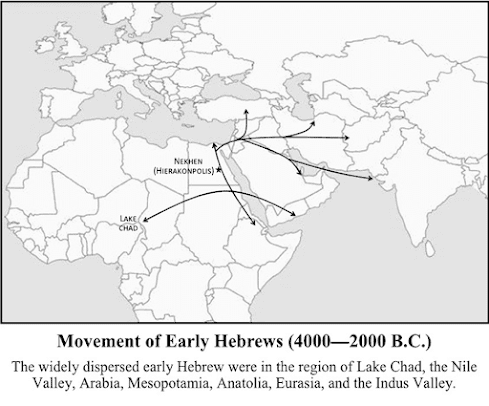
Many of the priests of the ancient world, including some Hittite priests, were devotees of God's son Horus. Some shrine centers among the Hittites reflect this: Horoztepe (Horus Hill) and Išuwa (Yeshua/Yesu). According to the early Hebrew (4000-2000 BC), the first act of the Creator at the beginning was šw (Shu), meaning light. This is not the light of day. It is the eternal, uncreated light associated with the High God's son Y-shu (Yeshua), as proclaimed in John's Prologue.

The name Jesus is related to the Hebrew word Yeshua, meaning Salvation. However, the name is older than the Hebrew language. It is found as early as 2600 BC among the Hebrew priests of the Nile Valley as Yesu or Yeshu.

A prince named Yesu is mentioned as the son of Ameny, the son of Shenwy, the son of Nakht on a memorial stela from Abydos. It speaks of Shenwy and his wife, Hedjret. One of Hedjret's grandsons is called išw, which could be an early form of the name Jesus/Yeshu (Bill Manley, Egyptian Hieroglyphics, p. 77.)


The name Yesu is attached to the roles of priest and king in ancient hieroglyphics. Reading from left to right: The feather represents judgment. The horn represents power. The staff represents royal authority, and the chick represents new life. All of these symbols speak of Jesus Christ.

Related reading: The Religious Symbolism of Gold; Malachite and The Ancient EgyptiansBIBLICAL ANTHROPOLOGY: Copper and IronJust Genesis: Why the Name Jesus?


Friday, November 8, 2024

The Earliest Known Site of Horite Hebrew Worship


Dr. Alice C. Linsley


The Hebrew regarded the mountain top as the spatial sacred center between heaven and earth, and high noon as the temporal sacred center, a time without shifting shadows. This belief is expressed in James 1:17 – “Every good and perfect gift is from above, coming down from the Father of the heavenly lights, who does not change like shifting shadows.” There were many Hebrew “high places” and the one that became associated with Judaism is Jerusalem.

High places served by Hebrew priests include Uruk (alt: Erech), Jericho, Heliopolis on the Nile, Nekhen and Karnak. Burnt offerings were made at the high places. This is reflected in the association of the term kar with charcoal and soot. The Turkish kara means "black." In Magyar, korom refers to soot, as does the Korean word kurim. In Dravidian, car means "sheltered together" and kari refers to a river. In Manding, kara means "to assemble." Among the Nilotic Luo, kar specifies a place with boundaries. In ancient Sumerian, é-kur refers to a mountain house, a pyramid, or an elevated temple. It is evident that kar refers to a rock sheltered or fortified site with a temple or shrine tended by priests.

High places are described as “mounds” in the Ancient Pyramid Texts (2400-2000 BC). One of those mounds was Nekhen, the oldest known site of Horite Hebrew worship. Archaeological discoveries there have confirmed the presence of Horite and Sethite Hebrew at Nekhen as early as 5100 years ago. The citizens brewed beer, made pottery, and built homes and public buildings using bundled reeds and large logs. They fashioned sacred objects of flint, gold, and malachite. Green malachite held special significance for the early Horite Hebrew. It was associated with Horus. The Egyptian Book of the Dead speaks of how the deceased will become a falcon "whose wings are of green stone" (chapter 77). The Pyramid Texts speak of Horus as the "Lord of the green stone" (Utterance 301). A leather pouch containing chunks of malachite was found among the grave goods at Tomb 39 in Nekhen, a city dedicated to Horus whose totem was the falcon.


Golden Horus as a falcon found at Nekhen.
 

Early hieroglyphic writing appears on some of the artifacts found at Nekhen. Archaeologists also found the earliest funerary complex in the land that would become known as Egypt, and the exquisite burial goods leave no doubt that this tomb belonged to one of the Upper Nile’s earliest kings.

Nekhen was a center for the worship of the High God and his Son HR. Votive offerings found at Nekhen were ten times larger than the mace heads and bowls found elsewhere, indicating the prestige of the Horus Temple. Royal priests at the Temple of Horus honored the High God, the High God’s son HR, and HR’s mother, Hathor.

An ivory Hathor comb with carved cow horns at the top was found in grave 66F at Nekhen. It dates to between 3650 and 3300 BC.