Followers

Showing posts with label High Places. Show all posts

Monday, November 24, 2025

Royal Hebrew High Places


The winged sun was a symbol of the High God.


Dr. Alice C. Linsley

The early Hebrew lords such as Cain and Nimrod are remembered for their city building efforts. They established settlements at high elevations near permanent water sources. These are what the Bible calls “the high places”. High places were fortified settlements on hills or mountains. The higher elevations made defense of these settlements easier. Built by rulers, the fortifications protected their palaces, royal temples, treasuries, and garrisons.

There were many high places in the ancient world. They were identified by the words "kar" (rock shelter) and "tamana" (great place). The term kar is associated with burnt offerings, charcoal and soot. The Turkish word kara means "black". In Magyar, korom refers to soot, as does the Korean word kurim. In the Sumerian language, Ekur (É.KUR) refers to a mountain house, pyramid, or elevated temple. The place name tamama has been found in over 188 countries and five continents. Votive offerings made at the tamama high places were called tama or tamata. The words are related to the ancient Akkadian word tamitu, meaning oath or pledge.

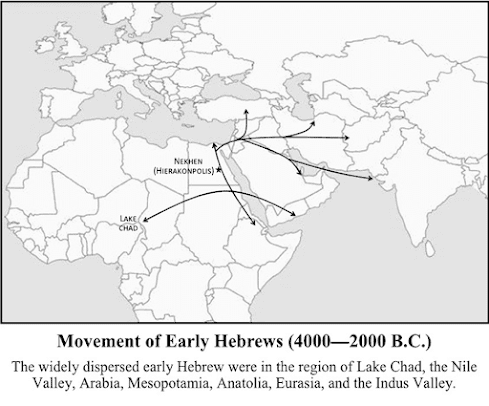
Some fortified settlements and temples were served by Hebrew royal priests. This is especially evident along the Nile River. Nekhen, the oldest known site of Horite Hebrew worship (4000 B.C.), had a temple with a large oval courtyard surrounded by a mud-plastered reed fence. The courtyard was paved with multiple layers of compressed mud. This temple appears to be the pattern for later temples as depicted on seals from the First Dynasty of Egypt (3100 – 2686 B.C.).

Nekhen was an established settlement at the time that some place Adam and Eve. in history. However, priestly some texts found in the Nile Valley have been dated to 4200 BC. Archaeology and anthropology provide some of the backstory to Adam and Eve, the parents of the Hebrew rulers Cain and Seth. These are historical people, but clearly, they were not the only Hebrew lords and ladies 6000 years ago.

The Hebrew ruler-priests living along the Nile were organized into two ritual groups or moieties: the Horite Hebrew and the Sethite Hebrew. The two groups helped each other but were often in competition. Descriptions of the Horites and Sethites are plentiful in ancient texts such as the Pyramid Texts (2400-2200 BC). These descriptions make it clear that the Horites and the Sethites maintained separate settlements. Utterance 308 addresses them as separate entities: "Hail to you, Horus in the Horite Mounds! Hail to you, Horus in the Sethite Mounds!" The more prestigious Horite Hebrew settlements were usually at a higher elevation that those of the Sethite Hebrew. Utterance 470 contrasts the Horite mounds with the Sethite mounds, designating the Horite Mounds "the High Mounds".

Multiple high places attracted pilgrims and generated revenue even as pilgrims and tourists are drawn today to shrines in the British Isles, France, Iran, Italy, Spain, and Jerusalem. The greater the fame and prestige of the shrine or temple, the larger the crowds. Naturally, competition arose between the sacred sites. That competition is evident in the Deuteronomist Historian’s antagonism toward all "high places" other than Jerusalem. A late source (800-400 BC), the Deuteronomist sought to centralize worship at the Jerusalem temple, and to shape national observances such as the Passover and Tabernacles.

Competition between the sacred high places of the Jews and Samaritans is mentioned in the New Testament. When Jesus was going to Samaria, the Samaritans who believed that he might be the Messiah hoped that he would establish Mt. Gerizim as the center of his kingdom. However, they no longer welcomed him once they learned that Jesus had "set his face to Jerusalem" (Lk. 9:51).

Friday, November 8, 2024

The Earliest Known Site of Horite Hebrew Worship


Dr. Alice C. Linsley


The Hebrew regarded the mountain top as the spatial sacred center between heaven and earth, and high noon as the temporal sacred center, a time without shifting shadows. This belief is expressed in James 1:17 – “Every good and perfect gift is from above, coming down from the Father of the heavenly lights, who does not change like shifting shadows.” There were many Hebrew “high places” and the one that became associated with Judaism is Jerusalem.

High places served by Hebrew priests include Uruk (alt: Erech), Jericho, Heliopolis on the Nile, Nekhen and Karnak. Burnt offerings were made at the high places. This is reflected in the association of the term kar with charcoal and soot. The Turkish kara means "black." In Magyar, korom refers to soot, as does the Korean word kurim. In Dravidian, car means "sheltered together" and kari refers to a river. In Manding, kara means "to assemble." Among the Nilotic Luo, kar specifies a place with boundaries. In ancient Sumerian, é-kur refers to a mountain house, a pyramid, or an elevated temple. It is evident that kar refers to a rock sheltered or fortified site with a temple or shrine tended by priests.

High places are described as “mounds” in the Ancient Pyramid Texts (2400-2000 BC). One of those mounds was Nekhen, the oldest known site of Horite Hebrew worship. Archaeological discoveries there have confirmed the presence of Horite and Sethite Hebrew at Nekhen as early as 5100 years ago. The citizens brewed beer, made pottery, and built homes and public buildings using bundled reeds and large logs. They fashioned sacred objects of flint, gold, and malachite. Green malachite held special significance for the early Horite Hebrew. It was associated with Horus. The Egyptian Book of the Dead speaks of how the deceased will become a falcon "whose wings are of green stone" (chapter 77). The Pyramid Texts speak of Horus as the "Lord of the green stone" (Utterance 301). A leather pouch containing chunks of malachite was found among the grave goods at Tomb 39 in Nekhen, a city dedicated to Horus whose totem was the falcon.


Golden Horus as a falcon found at Nekhen.
 

Early hieroglyphic writing appears on some of the artifacts found at Nekhen. Archaeologists also found the earliest funerary complex in the land that would become known as Egypt, and the exquisite burial goods leave no doubt that this tomb belonged to one of the Upper Nile’s earliest kings.

Nekhen was a center for the worship of the High God and his Son HR. Votive offerings found at Nekhen were ten times larger than the mace heads and bowls found elsewhere, indicating the prestige of the Horus Temple. Royal priests at the Temple of Horus honored the High God, the High God’s son HR, and HR’s mother, Hathor.

An ivory Hathor comb with carved cow horns at the top was found in grave 66F at Nekhen. It dates to between 3650 and 3300 BC.


Friday, July 31, 2020

War in the Old Testament


Ramses II at the battle of Kadesh

The Old Testament does not set forth a consistent picture of war or battle. In Genesis, Abraham refuses any personal gain as victor after the battle at Siddim (Gen. 14). He also received what appears to be absolution of blood guilt from Melchizedek, the high priest of Jerusalem.

When Levi and Simeon used the rape of their sister Dinah as an excuse to decimate the male population of Shechem, Jacob objected (Gen. 34:30) says that their actions caused Jacob's clan to "stink" among the peoples. Later Jacob pronounced a judgment on their evil deeds. “Cursed be their anger, for it is fierce, and their wrath, for it is cruel! I will divide them in Jacob and scatter them in Israel” (Gen. 49:7). This judgement on Levi and Simeon removes any ambiguity about their deeds. Their slaughter of the entire male population of Shechem was wrong, and their families suffer the consequences.

Some biblical writers present YHWH as a warrior who fights for Israel to install Israel as a kingdom. This meant uprooting the populations that already lived there and toppling the rulers who controlled Canaan, some of whom were Hebrew. The accounts vary. In some, the women and children are taken captive and only the men are killed. In others, all the inhabitants and their livestock are to be destroyed (a holocaust). 

The genocide advocated by the Deuteronomist represents an extreme far beyond the Levitical "eye for an eye" which was intended to limit acts of violence and vengeance. 

The Deuteronomist is the final hand on the book of Joshua, and even there, the accounts of the Israelite victories are inconsistent. Joshua 11:11 claims that "None of the cities that stood on mounds did Israel burn, except Hazor only; that Joshua burned." However, Joshua 6:24 credits Joshua with burning Jericho, and Joshua 8:28 reports that he also burned Ai.

Israel Finklestein and other archaeologists question the Deuteronomist Historian's claim of the swift invasion of Canaan and the Israelite conquest and destruction of fortified cities such as Jericho and Hazor. The evidence of excavations at those sites does not support the claim. Hershel Shanks has written that archaeology "sometimes provides evidence that seems to refute the Biblical account. That is the case, for example, with the Israelite conquest of the land as described in the Book of Joshua. The various cities that the Israelites supposedly conquered simply cannot be lined up with the archaeological evidence." (BAR, July-August 2013, p. 6)

The Deuteronomist advocated destruction of images and places that were sacred to the early Hebrew. The Deuteronomist writes from the context of c.730-300 B.C., long after the time of Moses, and his perspective does not align well with the historical, archaeological, linguistic, and anthropological data concerning Moses and his Hebrew ancestors.

Related reading: Battles in the Bible; INDEX of Topics at Biblical Anthropology; Understanding the Science of Biblical Anthropology; Does the Bible Advocate Genocide?; The Canonical Texts on the Bad Guys


Friday, May 17, 2019

The Horite High Places


Alice C. Linsley


The mysterious 'Apiru were also known as the Habiru. Habiru is rendered "Hebrew" in English Bibles. In the Akkadian language this caste royal priests was called Abrutu. In the Pyramid Texts (2400 BC), the deceased king is urged to rise to life and to visit the Horite "great houses" or temples. (Utterance 665) The Horites and the Sethites maintained separate high places or "mounds" but they served the same God and the same king.

Another term for was Hapiru. The term piru refers to a house or temple. A temple was the mansion (hâît) or the house (pirû) of the god. The ancient Dravidians referred to their East-oriented temples as Opiru, meaning "Sun House."

In the ancient Egyptian language nibit piru means "lady of the house" or the lady of the temple. This would refer to the mistress of a royal household and to the royal daughter who was in charge of a temple. During his reign (c. 2334–2284 BC) Sargon appointed his daughter Heduanna as the En of the temple at Ur. The Akkadian term En means lord, master, royal official, priest or priestess. En-Heduanna served the High God Anu and his son En-Ki (Lord of the Earth) at the House (pr) of Anu.

In Akkadian the word for priest was abru, and the priesthood or a caste of priests was called abrutu. In the ancient world, there were many castes of priests. They were identified by the deity they served, and it was believed that deity appointed the ruler in whose realm the priests served. The religion of the territory was the religion of the ruler and the priest caste that served the ruler.

The Horite Hebrew priests were unique among the priest castes of the ancient world and greatly respected for their purity and sobriety. Plutarch wrote that the “priests of the Sun at Heliopolis never carry wine into their temples, for they regard it as indecent for those who are devoted to the service of any god to indulge in the drinking of wine whilst they are under the immediate inspection of their Lord and King. The priests of the other deities are not so scrupulous in this respect, for they use it, though sparingly.” Due to their prestige, the Horite Hebrew were sought as servants of the high kings who constructed palaces and royal temple complexes at the "high places." Their association with elevated sites may be why the Horite Hebrew are sometimes described as cave dwellers.

Heliopolis (Sun City) was known by the natives as Iunu, meaning place of pillars. (Likewise, the royal complex of Dendera was known as Iunet. The I represents a pillar.) Iunu was one of the most prestigious Horite high places. The Harris papyrus speaks of the 'Apriu of Ra at Heliopolis (biblical On), as do the Coffin Texts and the Pyramid Texts. Joseph married Asenath, the daughter of the priest of On. Other ancient texts that speak of Horite high places (mounds) include Sumerian and Akkadian cuneiform tablets and the Amarna Letters, a collection of 14th century B.C. letters.

The Horite Hebrew served kings throughout the ancient world. Among the Nilotes, they served Re, which simply means "father of..." in ancient Egyptian. Re is the father of Horus whose mother Hathor conceived him by divine overshadowing (cf. Luke 1). The name Horus is derived from the root HR, which means the "One on high." Related Egyptian words include her, meaning over or above; horiwo - head, and hir - praise. Horus and Hathor are often shown on ancient Egyptian monuments as the father and mother of the dead kings, but whom the deceased hope to rise from the grave.

Among the Mesopotamians, the Horite Hebrew served Anu, the father of Enki. Wherever the Horite Hebrew became established there was a belief that the High God has a son. This is a central belief of the Messianic Faith called "Christianity."

Evidence of the Horite Hebrew can be found at many of the oldest high-elevation temples. This green malachite stone, a gift from the Egyptian king with whom the Hittites signed a treaty in BC 1258, was at the center of a Horite shrine in the Hittite capital of Hattusa (in Çorum Province in Turkey). Among the ancient Nilotes green malachite represented new life and the hope of resurrection. The land of the blessed dead was described as the "field of malachite."


Green stones were associated with Horus, whose animal totem was the falcon. The Book of the Dead speaks of how the deceased will become a falcon "whose wings are of green stone" (chapter 77). The protective Eye of Horus amulet was made of green stone. The Ancient Pyramid Texts speak of Horus as the "Lord of the green stone" (Utterance 301).


Horite Pillars, Pyramids, and Mounds

For the Horites the mound or high place represented the primeval creation. The first land to rise from the primordial flood was called TaTJaNuN by the ancient Egyptians. In the Ugaritic creation story the two mounds are likewise indicated by the sign T. The mounds Trgzz and Trmg emerged from a universal ocean and held up the firmament. They also marked the entrance to the Netherworld, so the phrase pillars refer to the Creator's work whereby the heavens and the earth are connected.

The Pyramid Texts [hereafter PT] describe the four cardinal points as "four pillars" (Utterance 217). The pillars connect heaven and earth, as Dr. Zahi Hawass notes:
"The true pyramid, while retaining its meaning as primeval mound and stairway to the stars, also represents the rays of the sun as they stream down to earth. It echoes the benben, a pointed stone that was the solar symbol par excellence." (Hawass, Mountains of the Pharaohs, p. 34)

The first mound of God is found in the mythology of the Horite settlements at On and Memphis. Their mounds, pyramids, and sacred stone pillars called benben represent the first land that rose from the chaotic waters. In the On myth, Atum-Re arose from the primeval mound and created the first two humans as deities. In the Memphis narrative, Ptah rose from the primeval mound and gave order to the world through his word/speech. The ancient Egyptians called the sacred mound mer, which is also the Egyptian word for love.

The idea of the earth resting on pillars is found in I Samuel 2:8 - "For the pillars of the earth are the Lord’s and he had set the world upon them." This idea is also found in Psalm 75:3: "It is I who have firmly set its pillars." These are the pillars described in Job 9:6 - "Who shakes the earth out of its place, and its pillars tremble."


Nubian captives


The Horite Mounds and the Sethite Mounds

It appears from the Pyramid Texts that the Horites and the Sethites maintained separate settlements. Utterance 308 addresses them as separate entities: "Hail to you, Horus in the Horite Mounds! Hail to you, Horus in the Sethite Mounds!"

PT Utterance 470 contrasts the Horite mounds with the mounds of Seth, designating the Horite Mounds "the High Mounds."

The two groups appear to be separate yet related, suggesting a moiety, such as that of the Red and Black Nubians. The term moiety refers to two social or ritual groups into which a people is divided. The distinction between the two groups is evident in PT Utterance 424: "O King, a boon which the King grants, that you occupy the Mounds of Horus, that you travel about the Mounds of Seth..." Here we find a suggestion that the Horite Hebrew were named for their devotion to Horus.

PT Utterance 424 continues, "that you [King] sit on your iron throne and judge their affairs at the head of the Great Ennead which is in On." Though separate, the Horites and the Sethites are judged by a common king.

That both groups serve the same king is evident from PT Utterance 213: "O King, you have not departed dead, you have departed alive...The Mounds of Horus serve you, the Mounds of Seth serve you."

The extent of the King's reign is considerable. In his resurrection body he is to "traverse the Mound of Horus of the Southerners" and "traverse the Mound of Horus of the Northerners." (PT Utterances 536 and 553) The risen king restores his settlements and cities, and opens doors to the Westerners, Easterners, Northerners and Southerners (Pt Utterance 587). He is to "betake himself to the Mansion of Horus which is in the firmament" (PT Utterance 539).

The risen king unites the peoples, restores the former state of blessedness, and unites heaven and earth. When seen from this perspective, the Horite religion appears to be the foundation of the Messianic hope that is fulfilled in Jesus of Nazareth.


Related reading: Horite Temples; The Pillars of the Earth; The High Places: The Symbolism of the Eye of Horus in the Pyramid Texts; Righteous Rulers and the Resurrection; Horus of the Two Crowns; The Ra-Horus-Hathor Narrative; Blood and the Impulse to Immortality; Aaron Was Buried in Edom

Friday, February 22, 2019

The Ancient Antecedents of Ash Wednesday


Alice C. Linsley

The association of animal sacrifice and ashes at the archaic places of worship is well attested. The oldest places of worship were at elevated sites near permanent water sources. The Bible refers to these as the "high places." Many of these were fortified sites with a temple tended by priests. There are hundreds of such sites: Karnak, Karkor, Karameh, Karampetsos, Karambet, Karoutes, etc. In Sumerian, é-kur refers to a mountain house or an elevated temple. 

Linguistic connections support this. The term kar is associated with charcoal and soot. In Magyar/Hungarian, the word korom refers to soot, as does the Korean word kurim. The Turkish word kara means black. In Dravidian, car means "sheltered together" and in Manding, kara means "to assemble." Among the Nilotic Luo, kar specifies a place with boundaries such as mud ramparts or stone fortifications. In Ancient Akkadian, a ruined high place was called karmu. There likely is a connection between karmu and the Magyar/Hungarian word hamu (ashes).

At the places of burnt offering ashes were gathered and used to purify, or for lustration. In Numbers 9:19, we read how the ashes of the sacrificed red heifer were used for "water of lustration." This explains why there is a linguistic relationship between the ancient word for high place and words for ashes or charcoal.

In the biblical literature we find many figures offering burnt sacrifice on mountains. Noah and Abraham offered burnt sacrifices on mountains. The practice predates the emergence of Judaism by at least 2400 years. In ancient texts a caste of ruler-priests known as Habiru, Hapiru, or Abrutu (Hebrew) offered blood sacrifice on mountains. In Leviticus 6:2-3, we read that the priest is to lift the ashes from the fire that consumed the burnt offering… and place them near the altar. The sacrifice in Hebrew is called korban, from karov קרוב meaning "near" or "at hand". All the verbs that derive from the root of that word - קרב - mean "to come near, to approach".

Ash Wednesday is an invitation to draw near to Christ. The ashes imposed on our brows remind us of our mortality and call us to repentance for our spiritual arrogance and spiritual deceit. The Lenten walk is away from all that hinders our communion with the Lord Jesus Christ. The destination is Pachua and the renewal of our hope of bodily resurrection. That hope comes through faith in the perfect work of Jesus Messiah who offered himself as the single and unique offering by which to be purified. His third-day resurrection testifies to the miracle of dry bones that live again. Hear what the Sovereign Lord says to these bones: "I will make breath enter you, and you will come to life." (Ezekiel 37:5)

Tuesday, January 29, 2019

The T-Shaped Pillars of Gobekli Tepe


The priests of Çatalhöyük (7000 BC) wore leopard skins.


Alice C. Linsley

There were many sacred high places in the ancient world (9000-2000 BC). These were sacred mountains, rock shelters, fortifications, or towers. High places served by Hebrew priests include Uruk (alt: Erech), Jericho (with its conical tower, c. 8000 BC), Heliopolis on the Nile, Nekhen and Karnak.

Burnt offerings were made at the high places. This is reflected in the association of the term kar with charcoal and soot. The Turkish kara means "black." In Magyar, korom refers to soot, as does the Korean word kurim. In Dravidian, car means "sheltered together" and kari refers to a river. In Manding, kara means "to assemble." Among the Nilotic Luo, kar specifies a place with boundaries. In ancient Sumerian, é-kur refers to a mountain house, a pyramid, or a temple at an elevation above the rest of the city. It is evident that kar refers to a rock sheltered or fortified site with a temple or shrine tended by priests.

Such places are described as “mounds” in the Ancient Pyramid Texts (2400-2000 BC). One of those mounds was Nekhen, the oldest known site of Horite Hebrew worship. Archaeological discoveries there have confirmed the presence of Horite and Sethite Hebrew at Nekhen as early as 5100 years ago

High places such as Göbekli Tepe and Çatalhöyük had temples that would have been built under the direction of the "Mighty Men of Old" (Gen. 6:4) or what I call "The First Lords of the Earth" in my book. Such rulers were served by priests and skilled stone masons. The T shape can be found among many ancient sites and in many languages, the T speaks of the High God who is represented by the sun which appears to arc from east to west. The oldest known name for the High God in China was Tian. In Mongolian the High God's name is Tengri, a reference to the sky, which is Tenger in Mongolian. In Ancient Akkadian a high place is called Tillu.

Göbekli Tepe predates the oldest known temple to have been built by Abraham's Hebrew ancestors at Nekhen by about 3000 years. It is the oldest known temple, and it remains shrouded in mystery.

Göbekli Tepe is classified as a Pre-Pottery Neolithic site (PPN). It is designated PPNA (ca 10,500 to 9,500 BC) which puts it in the same class as Jericho, Netiv Hagdud, Nahul Oren, Gesher, Dhar', Jerf al Ahmar, Chogha Golan and Abu Hureyra.

Göbekli Tepe is located in what is today Turkey. This "land between the rivers" was an ancient crossroads for peoples migrating between Africa and Southern Europe.


Each of the circular enclosures at Göbekli Tepe consists of 10 to 12 massive stone pillars surrounding two larger monoliths positioned in the middle of the structure.

"The Göbekli Tepe ruins and enclosures—the earliest monumental ritual sites of Neolithic religion and possibly the oldest religion in the world—are causing experts to rethink the origins of religion and human civilization." (Read more here.)
Göbekli Tepe human and animal figures
National Geographic


Perhaps the animals represent clan totems similar to that of the Horite and Sethite Hebrew clans. This paper explores that interesting theory.

Totems can be used by anthropologists to trace ancestry, clan affiliations, and marriage ties. Most totems of biblical clans are representations of animals. To understand their symbolism, we must place these animals in their natural habitats of Africa, Anatolia, and the Arabian Peninsula. Animal totems are evident in the names of the Horite Hebrew listed in Genesis 36. These include Zibeon (hyena), 
who was the father of Anah (wild donkey), and Aiah (kite); Dishan (gazelle), who was the father of Aran (wild goat); and Akan (roe), who was the son of Ezer. Other Horite Hebrew names are Cheran (lamb) and Shobal (young lion). Such a large number of animal names among the Horite Hebrew suggests a totemic clan organization.

The vulture, scorpion, horse and lion are found on the stone pillars, and they appear to correspond to constellations at a time when Thuban was the pole star. These creatures are commonly found on African images, which suggests that the structure at Göbekli Tepe may have been influenced by priests whose origins were in Africa. The vulture is an important totem among the ancient Nubians.

It is thought that the Hittites introduced iron work to Anatolia, but the term "Hittite" is an anachronism when we speak of populations as early as 7000 BC. Hittite is derived from the root HT which is the Hebrew and Arabic root for copper - nahas-het. Nahash means serpent. As an adjective it means shining bright, like burnished copper. The clans of HT were Bronze Age copper smiths who ranged from Timna to Anatolia. Their totem was the burnished serpent, just as it was for the Hebrew ruler Moses.


Archaeologists and anthropologists hope to unravel the mystery surrounding the T-shaped monoliths that stand at the perimeter of the sacred mounds at Göbekli Tepe. The pattern resembles Stonehedge with rings of pillars. At the center are twin pillars. The twin pillars and most of the pillars at the periphery are carved to form bas-reliefs of various animals, anthropomorphic figures, and human-animal creatures.


T-shaped pillar


The earliest pillars are the biggest and most sophisticated in construction and artistry. The later pillars are smaller, less intricate in design and mounted with less precision.

Nate Ramsayer has made a case for the view that the stone pillars might represent individual people. As he states, "This interpretation fits well with the emerging concept of social stratification that can be seen in Anatolia during the PPN at sites like Çayönü and Neval Çori."

If the T-shaped pillars represent humans, they were probably rulers, high ranked priests, or the heads of clans. It may be that clan leaders intended to have stone pillars with the clan's animal totem as a display of wealth or power. Or it may be that the 16-ton limestone pillars represent deified rulers who were venerated as ancestors. Each pillar served as the ruler's presence by which he also represented his clan, before the deity.


The T shape appears to be a very ancient symbol that represented a complex of ideas including heaven, the High God, sacred high places, and high-ranking rulers. These come together in the Tyet symbol of the Old Kingdom (shown above). It consists of a solar orb above a human form and is a variation of the ankh. Here the symbol appears above the waters or firmament. An image of Hathor is seen at the right.

Mystery surrounds how the huge pillars were transported from the quarry. Were hundreds of beasts of burden used? If so, why do these animals not appear on the carvings? The animals carved on the pillars include bulls, cranes, ostriches, vultures, lions, serpents and crocodiles. All these animals were of symbolic significance to populations of the Fertile Crescent.

Another mystery surrounds the twin pillars at the center of the shrine. They are superior in quality to the perimeter stones. Tatiana V. Kornienko ("Cult Buildings of Northern Mesopotamia") sees the placement of pairs of stones as an important aspect of early cosmology:

The worship of pairs of central objects in ancient sanctuaries or temples is a characteristic feature of a number of early Near Eastern cultures. Such symbolism represents the binary basis and dualism of people’s mythological perception of natural phenomena.

(Note that Kornienko fails to make a distinction between the binary and dualistic worldviews, a distinction that needs to be clarified to correctly trace origins and antecedents.)


Related reading: The Hittites of AnatoliaThe Ostrich in Biblical Symbolism; Megalithic Totemism of the Individual: A new Analysis of Gobekli Tepe's Monumental Pillars; Ethics and Religious Practices of the Afro-Asiatics; The Trapezoid on Ancient Architecture and TechnologyNeolithic Bread at Catal Hoyuk - Biblical Archaeology Society