Followers

Showing posts with label Canaanites. Show all posts

Tuesday, May 13, 2025

Ethnography in the Book of Judges


“Again the Israelites did evil in the eyes of the LORD…” (Jdg 10:6)


The Book of Judges is about a Hebrew population known as the "Israelites." The writer of Judges records the repeated cycles of disobedience, oppression, repentance and deliverance as God raised up rulers, judges and prophets to free the Israelites. The narratives illustrate the consequences of unfaithfulness to God and the need for righteous rulers if the exiles hope to live in peace in the land claimed by their Israelite forefathers.

The Book probably was written closer to the time of the Babylonian Exile (597- 587 BC) than to the time of Samuel (1100- 1001 BC). As such, the author of Judges relied on early ethnographic material to set the stage.

According to Judges 3:5, "The Israelites lived among the Canaanites, Hittites, Amorites, Perizzites, Hivites and Jebusites."

The Israelites were but one clan of the Hebrew ruler-priest caste. They are the Hebrew people associated with Jacob/Yacob who was called Israel/Yisrael. Well before the time of the Judges, there were other Hebrew clans dispersed throughout the Nile Valley, Canaan, Arabia, Mesopotamia, Anatolia, and the Zagros Mountains. Arishen was a Horite Hebrew who ruled a territory in the central Zagros between 2400-2301 BC.


The term "Canaanite" refers to a mixed population living in Canaan. Some Hebrew people lived among the people living in Canaan. Rahab and her family are an example. 

The Jebusites, such as the priest-king Melchizedek, were also kin to the Hebrew. Melchizedek and Abraham were kinsmen. Before David became King of Israel, the Jebusites controlled Jerusalem and much of the land surrounding the sacred city.

The Hittites claim the Hebrew ruler Heth as an ancestor. That means that the Hittites living in Canaan and Anatolia were kin to the Israelites. Canaan became the father of Sidon his firstborn, and Heth and the Jebusites, the Amorites, the Girgashites, the Hivites, the Arkites, the Sinites, the Arvadites, the Zemarites, and the Hamathites. (Gen. 10:15-18 NRSV) The Hittites of Canaan recognized Abraham the Hebrew as a "great prince" among them. 

The Amorites appear to have been a migrating population that dispersed into Mesopotamia and the Orontes River Valley. Amorite was a Northwest Semitic language, like Ugaritic, Hebrew, and Aramaic. It has striking similarities to Moabite and to the language found in the 14th-century BC Amarna Letters.

The Perizzites were also kin to the Israelites. Perez was a son of Judah who never settled in Egypt.

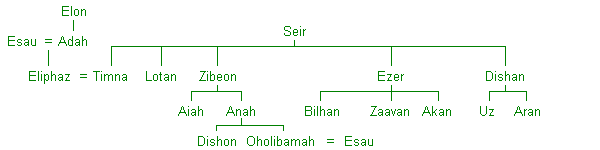
The term "Hivites" refers to the Horite Hebrew who never left Edom and parts of Canaan. The Bible scholar, E.A. Speiser called attention to Hurrian/Horite personal names associated with Shechem and with other areas whose inhabitants the Bible calls "Hivites." Genesis 34:2 specifies Shechem as a Hivite or Horite settlement. He noted the juxtaposition of the Hurrian Jebusites and the Hivites in various biblical references and he concluded that “Hivite” was a biblical term for Horite/Hurrian. Speiser supported his identification of the Hivites with the Horite/Hurrians by reference to Genesis 36:2 and 36:20, where the terms Hivite and Horite are used interchangeably. In Genesis 36:2, Zibeon is called a Hivite, and in Genesis 36:20 Zibeon is identified as a Horite descendent of Seir. 


Other examples of the interchange of the terms Hivite and Horite may be found by comparing the Masoretic Text and the Septuagint. The Septuagint reads "Horites" for the "Hivite" of the Masoretic Text in Genesis 34:2 and Joshua 9:7.


Tuesday, August 6, 2019

Blaming the Evil Canaanites


These standing stone at Tell Gezer date to the period of the standing stones erected on Salisbury Plain in England around 2500 BC. Photo: Dennis Cole


Alice C. Linsley

There were many religious practices among the Canaanites, but most of the shrines and temples were at elevated sites, called "high places" in the Bible. Most of the high places of the Judean and Edomite hills were under Egyptian control from about 2000 to 1178 BC.

In Hebrew, the high places and fortified mounds are called "ophel" (Hebrew עֹ֫פֶל). The root of the word ophel is OP and pertains to a complex of interrelated ideas: seeing (optic); armed guards (opiltes); walled towns (oppida), and sun shrines (O'piru) served by a caste of priests known in the ancient world as Abru, Ha'piru, Ha'biru and 'Apiru. Abru is the Akkadian word for priest, and the English word Hebrew come from the word Habiru.

Through archaeology and biblical anthropology, we have come to know a great deal about the peoples who lived in Canaan. Their shrines were built at high elevations near water systems and they were later fortified. They were masters of stone work and left behind standing stones of monumental proportions such as those at Tell Gezer.

The term "Canaanite" refers to many different peoples, some of whom were ethnically Nilotic. Genesis 10:15-19, traces the Canaanite peoples to an otherwise unknown descendant of Noah named "Canaan."
"Canaan fathered the Sidon his first-born, then Heth, and the Jebusites, the Amorites, Girgashites, Hivites, Arkites, Sinites, Arvadites, Zemarites and Hamathites. Later Canaanite clans spread out. The Canaanite frontier stretched from Sidon all the way to Gerar near Gaza and all the way to Sodom, Gomorrah, Admah and Zeboiim near Lehsa."

There were Horite Hebrew priests at many of the Canaanite shrines long before the Jews returned there from Babylonian exile. The Deuteronomist is a post-exilic source with an agenda. The Deuteronomist Historian presents the Canaanites as decadent, idolatrous, and deserving of being displaced from the land, even exterminated. Doubtless, there were practices surrounding fertility that were contrary to the purity code of the Horite Hebrew. These made it easy to cast all Canaanites as decadent.

The Deuteronomist mentions the destruction of Jericho, a pre-pottery Neolithic (PPN) settlement (10,500 to 9,500 BC) whose prestige as a fortified shrine city surpassed that of Jerusalem. There is evidence of competition here.

The Deuteronomist's main concerns were to establish Jerusalem as the only place of worship for Jews as a way of melding the people into a nation. The Deuteronomist encourages the destruction of all high places except Jerusalem. The targets to be destroyed were the bamot. Bamot is the plural form of the word bamah, meaning high or exalted. The word appears in names like Oholibamah and Obamah.

The Deuteronomist revises the history of Abraham's Horite Hebrew people to present a narrative about Moses and the Law that serves to strengthen Jewish identity.The focus is shifted from the archaic Hebrew rulers and their hope for a Righteous Ruler conceived by divine overshadowing and destined to rise from the grave to centralized worship at the Jerusalem temple. This source is also responsible for reshaping the Passover and Tabernacles into national observances. He promotes the power of the Jerusalem elite, and Israel’s possession of the land. This is the beginning of political Zionism.

Sunday, June 17, 2012

The Men Who Spied on Canaan


Alice C. Linsley


Numbers 13:4-16 gives the names of the spies sent by the Moses the Horite to the land of Canaan. These were given the mission to go into the Negev and into the mountains to investigate the land, its inhabitants and their wealth. Their journey was north from Kadesh-Barnea to Hebron, a distance of about 75 miles.

Each member of the spy team is called a "leading man." The first six names indicate prominent elders among the people in Egypt and each has a connection to the Horite Hebrew ruler-priest caste. The last six names appear to be synthetic and do not appear to reflect historical persons.

These are the names of the spies:

....from the tribe of Reuben, Sham-mua son (ben) of Zakkur

Sham (Shams in Arabic) refers to the Sun. A variant spelling is Shamma, one of David's three great champions. This Shamma was the son of Elah the Horite (II Sam. 23:11). He was known as a great warrior. Mua is a common name in Arabic and Aramaic (likely the original language of the material collected in the Qur'an).

Consider these:

Muamur Gadaffi
Mua'ad Ibn Jabal
Sa'ad ibn Mua'dh
Mua'yyad (Persian)
The muathi مؤذن  is the man at the mosque who calls the people to prayer.

Zakkur is a name associated with a West Semitic prophet (See Zakkur Stela).

From this information we might infer that Shammua was a religious leader associated with the Sun, the Horite symbol for the Creator. He belonged to a family of prophets and warriors.


5 from the tribe of Simeon, Shaphat son (ben) of Hori

Hori refers to the Horites, a Hebrew caste or ruler-priests. Shaphat is a name associated with the divine council described in Psalm 82:1-6. They are called elohiym (deified rulers), and in Psalm 72 they are called shaphat.

Psalm 82:1-2 - "God presides in the great assembly; he gives judgment among the gods [rulers]. How long will you judge unjustly, And show partiality to the wicked? Selah.”

Psalm 82:6 - "I said, 'You are gods; you are all sons of the Most High.”

From this information we might infer that Shaphat was a Horite ruler. His connection to the tribe of Levi would reinforce this, as the Horites were a caste of ruler-priests, devotees of the high God Ra and his son Horus. Horus means "One on high" and he was said to be conceived when his mother Hathor was divinely overshadowed (cf. Gen. 3:15; Luke 1).


6 from the tribe of Judah,Caleb son (ben) of Jephunneh

Jephunneh יְפֻנֶּה means "for whom a way is prepared." Jephunneh was a descendant of Kain which is why he was called a ‘Kenizzite’ הַקְּנִזּי haKenizi (cf. Gen. 15:19). The Kenizzites were a Horite clan according to Gen. 36:11 - "And the sons of Eliphaz were Teman, Omar, Zepho, Gatam, and Kenaz.” Caleb's connection to the Kenites is explictly stated in 1 Chronicles 2:55 which says that Caleb's sons were Kenites. Kenaz was a son of Eliphaz by Timna, daughter of Seir, a Horite Hebrew ruler.


The dog was the totem of Caleb’s clan. This was a symbol of the warrior. The Hebrew word for warrior is Gid'on (Gideon). This allusion to the dog clan is found in Judges 7:4-7:

But the Lord said to Gideon, "There are still too many men. Take them down to the water, and I will sift them for you there. If I say, 'This one shall go with you, he shall go; but if I say, this one shall not go with you, he shall not go." So Gideon took the men down to the water. There the Lord told him, "Separate those who lap the water with their tongues like a dog from those who kneel down to drink." Three hundred men lapped with their hands to their mouths. All the rest got down on their knees to drink. The Lord said to Gideon, "With the 300 men that lapped I will save you and give the Midianites into your hands. Let all the other men go, each to his own place.

Based on this information, it is possible to trace Gideon’s ancestry back to Caleb whose Horite wife was Ephrathah. I Chronicles 2:50 tells us that the firstborn son of Caleb and Ephrathah was Hur (Horus in Greek). Hur’s firstborn son was Shobal, the founder of Kiriath-jearim where the Ark resided until it was moved to Jerusalem in David’s time. Shobal was a Horite chief and his totem was the lion.

One of Caleb's grandsons was named Korah (I Chron. 2:43), which refers to the Horite priesthood. Moses' half-brother was Korah. The name means "shaved one" as Horite priests shaved their bodies before their terms of service.

From this information we may infer that Caleb also was associated with the Horites. His family settled in Bethlehem, a Horite settlement. Caleb's son Salma is designated the "founder" of Bethlehem in I Chronicles 2:51.


7 from the tribe of Issachar, Igal son (ben) of Joseph

Igal is also spelled Yigal and means "He redeems." A later hero by this name was listed among David's thirty champions in II Samuel 24:36. The name Joseph is a common name among the Horites. Joseph, son of Jacob, married Asenath, the daughter of the priest of the Horite shrine at Heliopolis (Onn). Joseph who married the Virgin Mary was a descendant of these ruler-priests. According to Matthew 1:15, Joseph was of the priestly line of Mattai (Matthan/Matthew). Luke 2 tells us that Joseph was to register for the census in Bethlehem which was originally a Horite settlement.


from the tribe of Ephraim, Joshua son (bin) of Nun

Joshua is said to have lived to the ripe age of 110 (Judges 2:9). He was buried at Timnah of Horus in Ephraim.

In this list of spies everyone is referred to as “so-and-so ben (son of) so-and-so,” except for Joshua. He is called Joshua bin Nun, using a non-Hebrew word for son. The explanations given by rabbis for this curiosity are fanciful rather than historical. Here are some examples:

Rabbi Moshe ben Nachman (1195–1270) suggests that the bin Nun should be read together as “binnun.” The word is related to the Hebrew word binah, meaning “the understanding one.”

The Torah tells us that Joshua was Moses’ prize student. Exodus 33:11 says, “His attendant, Joshua bin Nun, a lad, would not depart from the tent.” The bin is suggested as an explanation of Joshua' dual parentage: he was Nun’s biological child, but he was Moses' son by training.

Rabbi Moses Sofer (1762–1839) offers this explanation. According to the Midrash (Bereishit Rabbah 47), when G‑d changed Sarai’s name to Sarah, the Hebrew letter yud was removed from the holy woman's name and felt wronged. G‑d placated the letter by promising to make amends at a future date. This was accomplished when Moses added the letter yud to Joshua’s name (Yehoshua), which was originally Hoshea. This explanation does not however, explain the appearance of the Arabic word for son. So the following explanation was offered by Rabbi Baruch S. Davidson.

In its original state, when it was the final letter of Sarai’s name, the yud did not have a vowel—as is the case with most letters which come at the end of a Hebrew word or name. Now, in order to be the yud which begins the name Joshua, it would need the sheva vowel, which is comprised of two dots vertically aligned. These two dots were “borrowed” from the segol vowel which normally is beneath the word ben, which is three dots set up as a triangle. This leaves only one dot for the word ben. One dot is the chirik vowel, which changes the pronunciation to “bin.”


The name Joshua is Yeshua (Jesus).In Numbers 13:16, Moses changed Joshua's name to Hoshea. Why this change was made is uncertain since the names are linguistically equivalent. Probably this is a late gloss on the text. Both are variants of one original name meaning "the Lord saves."

The most historically accurate interpretation of Joshua bin Nun rest in examination of the word Nun. Nun is found at the Horite shrine of Heliopolis in Egypt and represents the cosmic waters which are separated into the firmament above and firmament below (Gen.1:6). In Heliopolitan cosmogony the two watery realms were connected by the great pillars of the temple of Heliopolis.

Deified rulers were shown as the pillars holding up the watery firmament. In the temple of Ramesses II at Abu Simbel in Nubia the pillars are in the form of massive statues of the king. Nefertari is also shown on a pillar. Abu Simbel was a temple dedicated to Hathor, the virgin queen mother of Horus.

This conception of the ordering and control of cosmic water originated in the Nile region where stone pillars and mounds of earth were erected. In the Lower Nile small pyramids were carved from a single block of stone. These were known as a bnbn, from the root, bn, meaning to "swell forth" or to "come forth" and this is the likely meaning of the tern bin (bn) in reference to Joshua's descent.


9 from the tribe of Benjamin, Palti son (ben) of Raphu

The name Raphu is Rafu in the Abydos King Listand is a reference to Ra, the Creator and father of Horus. Palti is also spelled Paltiel. The name refers to a noble family as is evident in Saul decision to give his princess daughter Michal to Palti the son of Laish (I Sam. 25:44). In doing so, Saul was likely showing favor to a fellow tribesman.


A List of Suspicious Origin

The first six names have connections to historical persons and extant texts. However, from this point on the names appear to be synthetically constructed to make up the balance of 12 tribes.

10 from the tribe of Zebulun, Gaddiel son of Sodi

Gaddiel (or Gadiel in Arabic) likely means warrior of God. The -iel refers to God and gid'on means warrior. This is the only place where the name Sodi is found in the Bible.


11 from the tribe of Manasseh, Gaddi son of Susi

These names are suspiciously like the names Gaddi and Sodi, so one wonders if this might be a replication from a different source. Susi appears to be a variant of the Akkadian Susinak.


12 from the tribe of Dan, Ammiel son of Gemalli

Ammiel means "people of God" and Gemalli appear to be a compound of g-m-al, which means "God gathers." The suggestion is that God gathers his people appealed to the author, but this does not appear to have an historical reference.


13from the tribe of Asher, Sethur son of Michael

Seth is combined with Ur, both ancient names in the Afro-Asiatic Dominion of Abraham' s ancestors. Michael means “the one who is as God."  The oldest reference to the name Michael is in the book of Daniel (8:16, 10:13) which dates long after the time of Moses and the spies. In Jewish tradition, the Archangel Michael was said to have destroyed the city of Babylon.


14 from the tribe of Naphtali, Nahbi son of Vophsi

In some Bibles this is rendered: Nahabi the son of Vapsi. Nahbi appears to relate to the word for prophet, נְבִיא (nabi). Vophsi or Vapsi does not appear to have an historical reference.


15from the tribe of Gad, Geuel son of Maki

The names Geuel and Maki (Machi) are found only here and do not appear to have an historical reference.


Conclusion

Given this information it appears that the spies sent by Moses were his Horite kinsmen. Given that only six of the names can be verified as historical it is possible that only six spies were sent. If Moses sent only six spies, they most likely would have gone in three teams of two. This would explain why Joshua sent two spies into Jericho (Joshua 2:1 and 8). The Horites were particularly fond of the numbers 2 and 3.

Monday, June 27, 2011

The Peoples of Canaan


Alice C. Linsley


The term "Canaanite" can refer to many different peoples, some of whom were ethnically Nilotic. Most of the high places of the Judean hills, for example, were under Egyptian control from about 2000 to 1178 BC. Through biblical archaeology and biblical anthropology, we have come to know a great deal about the peoples who lived in the land of Canaan. Their shrines were built at high elevations near water systems and they were later fortified. They were masters of stone work and left behind standing stones of monumental proportions.


Photo: Dennis Cole

These standing stone at Tell Gezer date to the period of the standing stones erected on Salisbury Plain in England around 2500 BC.

The high places and fortified mounds are called "ophel" (Hebrew עֹ֫פֶל). The root of the word ophel is OP and pertains to a complex of interrelated ideas: seeing (optic); armed guards (opiltes); walled towns (oppida), and sun shrines (O'piru) served by a caste of priests known in the ancient world as Ha'piru, Ha'biru (Hebrew) and 'Apiru.

The oldest elevated settlements were near water sources. The oldest ophel in Jerusalem is near the Gihon Spring. Similar sites include Deir Tasi in Egypt; Jarmo in Iraq, and Tell Hassuna in Iraq. Of particular interest is the Paleolithic population that lived near the ravine or wadi known as Wadi-en-Natuf near Jerusalem. The Natufian population employed micro-flints, weapons, stone tools, and primitive agriculture. Artistic expressions included rock drawings and wall paintings, and they were sea travelers between 12,000 and 10,000 B.C. There are about 40 Paleolithic sites in the hills surrounding Jerusalem, many of them near Bethlehem. Surrounding Jerusalem, there are at least 28 Neolithic sites that fit the same description: elevated shelters near a water source.

Evidence of human habitation in the area of Bethlehem between 100,000-10,000 BC is well-attested along the north side of Wadi Khareitun where there are three caves: Iraq al-Ahmar, Umm Qal’a, and Umm Qatafa. These caves were homes in a wooded landscape overlooking a river. At Umm Qatafa archaeologists have found the earliest evidence of the domestic use of fire in Palestine.


The Canaanites in retrospect

Bible passages that speak about “the Canaanites” reflect authors who lived well after the time of the Patriarchs. The Canaanites are viewed by these later write, especially the Deuteronomist Historian, as decadent, idolatrous and deserving of being displaced from the land, even exterminated.

In Genesis 10 the peoples who descend from Noah through his grandsons Sidon and Het (Heth) are said to be the original inhabitants. This is supported by evidence from many disciples, including linguistics, archaeology, anthropology and genetics.

In II Chronicles 8:7 and I Kings 9:20 the term “Canaanite” is used to distinguish the Israelites from the other clans living in the land. However, it is clear from Genesis 10 that the Israelites were related to these Canaanite clans. The so-called Canaanites were blood-related Afro-Arabian peoples whose ancestry can be traced back to the Nile Valley and ancient Kush.

It is clear from analysis of the Genesis genealogical data that the ruling lines descending from Noah intermarried. This was the custom among the ancient Kushite rulers.  This means that it is impossible to say that the descendants of Ham and the descendants of Shem are different and unrelated peoples. Genesis 10 acknowledges this fact by listing the people as descendants of the same Patriarch, Noah and by designating the lines of descent as “clans.”  We are not talking about different ethnic groups.

Further, the Genesis 10 record tells a story of dispersal across the ancient Afro-Asiatic world. This too is fully supported by findings in linguistics, archaeology, anthropology and genetics. The Kushite migration has been well established. Nimrod (Sargon the Great) ruled over a great empire in Mesopotamia yet Genesis 10:8 states that he was one of Kush’s sons.

The list of “Canaanite” peoples in Genesis 10 attempts to reconstruct the confederation of peoples living in Palestine before the Israelites arrived after wandering in the wilderness. The difference between the lists is telling. Genesis 10 is much longer and more descriptive. Genesis 10: 15-19, traces the Canaanite peoples to an otherwise unknown descendant of Noah named "Canaan."

Canaan fathered the Sidon his first-born, then Heth, and the Jebusites, the Amorites, Girgashites, Hivites, Arkites, Sinites, Arvadites, Zemarites and Hamathites. Later Canaanite clans spread out.  The Canaanite frontier stretched from Sidon all the way to Gerar near Gaza and all the way to Sodom, Gomorrah, Admah and Zeboiim near Lehsa.

In II Chronicles and I Kings 9:20 only the Hittites, Amorites, Perizzites, Hivites and Jebusites are identified as still living in the land, and they are identified as non-Israelite. So what happened to all the other clans? Many intermarried with the Israelites, though the priestly lines of Israel intermarried exclusively with other priestly lines (not all of which were Israelite).

Genesis tells us that these are clans, not ethnic groups. That’s important because all the clans listed in Genesis 10 are blood related. They are classified linguistically as Afro-Asiatics and their ethnicity is Kushite. They spread across the ancient Afro-Asiatic Dominion, taking their language and religious practices with them.

Confusion has arisen because in Genesis 10 the Hebrew word goy has been translated “nation” and goyim as “nations.” The Greek Septuagint renders goy as “ethnos” and goyim as “ethne” in the plural. Both translations are misleading. Genesis 10 says that all these peoples are descendants of the same Patriarch, Noah, and are therefore related. They do not represent different nations in the modern sense. Nor do they represent different ethnic groups. They are related clans which recognized their blood ties and which performed work which was expected of their caste. Some of the occupations involved metal work and scribal expertise.

Once we set aside the misconception that Genesis 10 is a “Table of Nations” we are able to explore the relationship of the clans and to reconstruct the confederations based on what is known about the Proto-Saharan languages spoken by Abraham's ancestors.


Reconstruction of the Kushite Confederations

Confederations of peoples listed in Genesis 10 are based on kinship and occupation, which indicates a caste structure. Castes are characterized by endogamy. Priestly lines intermarried exclusively. Metalworkers intermarried exclusively. Scribes intermarried exclusively. Merchants of purple dye (murex) intermarried exclusively. This was the caste structure of the ancient Afro-Asiatic Dominion.

It is possible to reconstruct the Genesis 10 confederations using what is known about the Proto-Saharan languages spoken by Abraham's ancestors. These languages were characterized by two-consonant roots (a “biconsonantal” system).  So we begin by eliminating the vowels and searching for the most basic consonantal unit in each of the names. To illustrate the method we will use the names Hittite and Hivite. The most basic root for these names is HT and is the same as the name Het (Heth). Genesis 10 tells us that these two clans are of Heth and a confederation. The name HT appears in the Hebrew and Arabic world for copper - nahas-het. Nahash means serpent. As an adjective it means shining bright, like burnished copper. So the evidence suggests that the clans of HT were Bronze Age coppersmiths. The serpent image was sacred for them, just as it was for Moses and the people of Israel in the wilderness. It was as they looked upon the bronze coiled serpent (a solar image) that the people were saved.

Genesis 23:3-20 tells us that the descendants of Heth were living in the land of Canaan where Abraham lived.  He bought a burial site from them. They considered Abraham “a prince of God” among them (Gen. 23:6)

The Hittites spread into Anatolia and introduced iron work there. They didn’t call themselves “Hittites” (an anachronism) but Nes or Nus (Nuzi), and their language was called Nesli. They were Afro-Asiatic metal workers and the root of their original name is NS. As the letter N remains unchanged in the older Proto-Saharan languages we can be fairly certain that this was the name of the Anatolian Hittites. They are the likely source of over 5000 Horite texts found in Nuzi in Mesopotamia. These are written using the Akkadian script.


The Clans of Het and the Clans of Ar were related 

The Arkites and the Arvadites were another two-clan confederation. The word “Arvadites” refers to residents of the Mediterranean island-city of Arvad (Arpah or Arphad in other ancient sources). Arvad is an extremely ancient city. Before the Phoenicians, it was populated seasonally by peoples passing from north Africa to Asia. Some of these were Netufians.

The Arvadites had close ties the Egyptians, and paid tribute to the Kushite Pharaohs for protection from the Assyrians. The Kushite Pharaoh Tahar-qo called the land of Canaan and Syria “Khor” which is a compound of K for Kush and Hor for Horus. (Kash, Kwash, Akwanski and Kush are cognates referring to the First People, who were considered deified ancestors.)  In 2010, the 4400 year old tomb of a Kushite priest was found at Giza. The tomb belongs to a priest named Rudj-Ka (or Rwd-Ka) and dates to the 5th Dynasty, between 2465 and 2323 B.C.

In a message sent to the King of Tyre Tahar-qo wrote, “Oh Amun, what I did in the land of Nubia, let [ … … ], let me do it with your tribute (inw) of Khor (Syria-Palestine) which has been turned aside from you.” (http://jan.ucc.nau.edu/gdc/ssea/vol31/kahn%20article.pdf, p. 115)

The older root of the names Arkite and Arvadite is AR and its origin is likely Proto-Saharan. Among the Igbo of Nigeria, the scribe clans were called Ar or Aro. The word Ar-ab means “father is scribe.” The earliest known writing originated in Canaan among the coastline peoples of the Red Sea and Phoenicia. The Arabic word for throne is aarsh/ash and likely related to the scribal function attached to rulers.

The Egyptian Asa-ar means the Serpent of Asa (Deity). The peoples living in Arvad, Tyre and Sidon employed serpent imagery in their temples.

There are Israelites who were associated by their names with the Ar patrimony. They are Aroch (1 Chr 7:39, Ezr 2:5, Neh 6:18, Neh 7:10) and Ariel (Ezr 8:16, Isa 29:1, Isa 29:1, Isa 29:2, Isa 29:2, Isa 29:7). Ariel means “Scribe/Messenger of God.” So it appears that the Ar clans were scribes or messengers. This is further suggested by the name Ar-vad. Vad means “to speak” in Sanskrit. The association of the name Ar with the scribal caste is further demonstrated by the discovery of Aramaic scrolls from Arsames, the satrap, to his Egyptian administrator Psamshek and to an Egyptian ruler named Nekht-hor. (A.T.Olmstead, History of the Persian Empire, Chicago, 1948, pp.116-117) Some variations of the name Ar include Ar-Shem, Arsames, Artix, and Araxes, and all of these are figures named in historical texts.