Followers

Showing posts with label totems. Show all posts

Saturday, April 26, 2014

The Lion and Judah


Alice C. Linsley

The Habiru (Hebrew) clans and their animal totems make a fascinating study. The animal totem of the clan of Hamor, one of David’s “great men,' was the wild donkey. The animal totem of Zibeon's clan was the the hyena and the totem of the clan of Dishan was the gazelle. The totem of Caleb's clan was the dog and the totem of Judah's clan was the lion. The Horite patriarch Jacob refers to his son Judah as a Gur Aryeh גּוּר אַרְיֵה יְהוּדָה, which means "young lion" (Gen. 49:9). The totem of Shobal's clan was also the lion fierce in it youthful strength (young lion). Shobal was one of the Horite chiefs named in the Genesis 36 king list.


The association of the lion with Judah has antecedents in the Nilotic image of Akar (shown above). The Sun represents the Creator. The Sun rests on the Nile river bed between twin lions facing the two horizons. In Elephantine (Yebu) theology, the sun at noon over the Nile represented the temporal and spatial sacred center. This image of Akar appears on the ancient Egyptian papyrus of Ani (Oni/Ainu) that is in the British Museum.

The Sun's cradle between the lions is also the form upon which the ancient horned altars were patterned (shown left). This pattern signified God's sovereignty over the earth, but here the orb of the Sun has disappeared and God's presence is evident as negative space. This suggests apophatic prayer. Apophatic refers to empty space which is filled by God. It means emptying the mind of words and ideas and simply resting in the sacred center. This is sometimes called "centering prayer."

When the priest elevates the consecrated host over the chalice, he is presenting an apophatic image. Christ's body is broken in two in order that God might create a place for us in that sacred center. This image is very like the image of the Sun resting between the banks of the life-giving Nile.

Likewise, twin lions often indicate the place of entrance. Many arched entrances were flanked by twin lions. They often appeared at the center of lintels or on the sides of gates and arches. The entrance to the Roman basilica in Libya (below) is flanked by lions.


This idea extends to the throne of king's and priests. The throne was a door for the passage of Wisdom. Solomon's throne was flanked by two lions, as described in II Chronicles 9:18:  "There were six steps to the throne and a footstool in gold attached to the throne, and arms on each side of the seat, and two lions standing beside the arms." Solomon's was one of several seats of wisdom mentioned in the Bible.

I Kings 10:18,19 tells of a great ivory throne with two lions standing on the arm rests. This also described the throne of the Coptic Pope. It was common for the back of ancient thrones to have an ivory and gold inlay image of Horus the Golden. Horus continued to be venerated in some Old Coptic texts even into this century.

The Horus image appears between two lions in ancient India in the Harappa culture (see below). Har-appa means "Horus is Father" in Dravidian. It also appears in ancient Persia.

Horus between lions (India)
Horus between lions (Persia)


A variation on this motif is Horus between the two horizons. In the image below Horus is shown as the divine child. The eastern and western horizons are staffs. One is topped by a falcon, Horus' animal totem, and the other is topped with the sema sign (singing papyrus reed), the plant totem of Horus who unites the Upper and Lower Nile. The serpents represent the Nile waters which sustain life for humans and animals. The Egyptians believed that chaos (tehom) dwelt south of Elephantine Island (Yebu) as a great river serpent between the east (bahku) and west (manu) banks of the Nile.


Both lions and serpents are associated with the long-awaited Messiah, as is evident in Psalm 91:11-13:

For he will command his angels concerning you
to guard you in all your ways;
they will lift you up in their hands,
so that you will not strike your foot against a stone.
You will tread on the lion and the cobra;
you will trample the young lion and the serpent.


In some ancient images, serpents replace lions. In this artifact from ancient Crete, Horus' mother Hathor appears between serpents and geese. Though Hathor's animal totem was the cow, in later depictions as Isis she was shown with the goose. Isis was called the "egg of the goose" because Geb (Earth) is the father of Isis and his animal totem was the goose.


In the Askelon image (below) Hathor is shown between the horizons with the triangular mountain lexeme above her head. The mountain was the place of meeting God. Above the mountain are Hathor's cow horns in which the Sun rests at the sacred center.

Askelon tanit shows Hathor between the horizons.

The Askelon icon reflects the older images of Hathor whose crown of horns cradles the Sun. This indicates that she was divinely appointed by overshadowing. This is the Proto-Gospel. Luke 1:35: "The angel answered, "The Holy Spirit will come on you, and the power of the Most High will overshadow you. So the holy one to be born will be called the Son of God."

The Tanit of Carthage conveys a similar iconic message. This is not an image of a goddess, as some suppose. It is a symbol of the cosmology of Abraham's Nilo-Saharan and Saharo-Nubian ancestors. It designates the temporal center with the sun resting at noon (midway between east and west) and the spatial center with the sun resting on top of a mountain.

The Lion of Judah in modern Ethiopia

In Ethiopia the Lion of Judah is associated with Messianic glory and Haile Selassie. The golden Lion of Judah Monument stands in the square in front of the train station in Addis Ababa. It is mounted on a black granite pedestal which is decorated with relief portraits of Emperors Menelik II, Haile Selassie I, Empress Zewditu and RasMakonnen. The statue was erected in 1930 before Emperor Haile Selassie's coronation. Selassie claimed a continuous lineage of from Adam to Solomon, and as Emperor of Ethiopia was regarded by many of his followers as God's rightful ruler on earth. His emergence at a time when Africans were casting off colonial rule was seen as Messianic. He liberated his people. The mark of the true Messiah is to lead his people through death to immortality, something Salassie failed to do, seeing that he never rose from the dead.

In 1935, during the Italian occupation of Ethiopia, the Lion of Judah statue was taken to Rome, where it remained for several decades. It was finally returned to Addis Ababa after long negotiations in the 1960's.

Monday, November 5, 2012

Totems HelpTrace the Relationship of the Horite Clans


Alice C. Linsley

Totems can be used by anthropologists to trace ancestry, clan affiliations, and marriage ties. Most totems of biblical clans are animals, and to understand their symbolism we must place these animals in their natural habitats of Africa and Arabia.

Animal totems are found associated with many African clans. In Kano, Nigeria we find animal totems for the Gusii clans. The Abagirango's totem is the leopard (engo); the Ababasi totem is the zebra (enchage); the Abasweta, Abagetutu, Abanyaribari and Abamachoge have the baboon (engoge); and the Abanchari's totem is the hippo (engubo), which corresponds to the constellation Draco

Animal totems can be used to trace marriage and blood ties. The animal totems of the Israelite clans present a productive area of investigation to round out the picture provided by analysis of the kinship data.

For example, the totem of David’s clan was the lion and the lion appears to have connections to the clan of Nahash (serpent totem). Nahash was the father of Shobi, Abigail and Zeruiah (II Sam. 17:25). David had a sister named Abigail and a wife named Abigail. These may have been the same person.

It is also possible that Abigail, the “daughter of Nahash”, was David's patrilineal cousin bride. If this is the case, taking Abigail as his second wife signaled David's intention to rule. Ascending to the position of ruler required taking a second wife, which for the Horite Hebrew was usually a patrilineal cousin. (See the Marriage and Ascendancy Pattern of the Horite Hebrew.)

The lion was the totem for the clan of Judah. Jacob refers to his son Judah as a Gur Aryeh גּוּר אַרְיֵה יְהוּדָה, which means "young lion" (Gen. 49:9). The totem of Shobal's clan was also the lion fierce in it youthful strength (young lion). Shobal was one of the Horite chiefs named in the Genesis 36 king list.


Using Totems to Trace Clans

Clans took both planets and animals as their totems. The animal totem of the clan of Hamor (one of David’s “great men”) was the wild donkey, the totem of the tribe of Issachar. Hamor was a descendant of Jacob by Leah and was related to the Horite Hebrew listed in Genesis 36. Genesis 36:24 makes the association between the Horite Anah and the wild donkey.


The Horites of Genesis 36


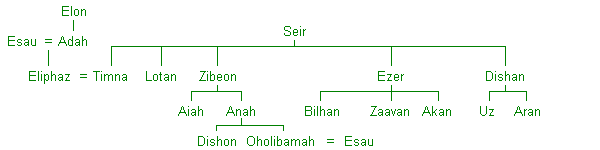
Animal totems are evident in the names listed in the Genesis 36 diagram. These include Zibeon (the hyena), Aiah (the kite), Akan (the roe), and Dishan (the gazelle). Dishan was the father of Aran (the wild goat). The totem of the clan of Caleb was the dog. 1 Chronicles 2:55 says that Caleb's sons were Kenites. Kenaz was a son of Eliphaz by Timna, daughter of Seir, a Horite Hebrew ruler-priest (Gen. 36). Caleb or Kelev means dog. The Canaan Dog (Kelev) was a symbol of the warrior. The Hebrew word for warrior is Gid'on (Gideon). This allusion to the dog clan is found in Judges 7:4-7.

Another Horite Hebrew animal totem is Cheran (the lamb). Such a large number of animal names among the Horite Hebrew suggests a totemic organization of the Horite ruler-priest clans.


Celestial Totems

In the ancient world, animal totems often served as symbols for planets, stars, or constellations. The dog-faced baboon (Papio hamadryas) was brought to Egypt from Nubia and was trained as a pet in noble households. It was associated with the Sun due to its habit of screeching at the first break of dawn. In ancient Egyptian paintings, baboons were shown with the solar orb on their heads and sometimes riding in Re’s solar boat.

The baboon is not a totem of the tribes of Israel as this creature was not a native of Arabia. However, the baboon totem was familiar to the Nilotic Horites and the baboon appears on one of the canpoic jars that held the organs of the Nilotic rulers. The Nilotic Horites were devotees of Horus and the baboon was one of the four manifestations of Horus, along with the falcon, the jackal, and the divine Man.


Baboons on Ra's solar boat facing the scarab.
All are overshadowed by the Sun, the symbol of the Creator.


Among some Horites the equivalent totem was probably the lion’s mane shown as the circle of the sun. This suggests that Judah was the central tribe around which the other totems cycled in a progression that paralleled the celestial bodies.

There is a further suggestion of this in Numbers 2 where each "house" is to camp under its "dgl" which certainly doesn't mean banner or flag. It probably means celestial totem or heavenly covering.

The animal totems often appear on the astronomical ceilings of the tombs of ruling Egyptians such as Senenmut and Seti I. Senemmut was an astronomer.

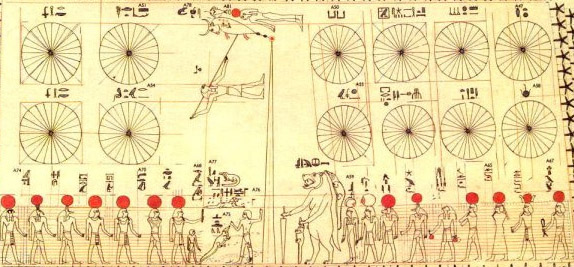
Senenmut astronomical ceiling c. 1500-1400 BC


The connection between cattle horns and Horus' mother Hathor is shown in the following panel. The Y shape of the horns is a solar cradle and designates divinely appointed rulers among the Horites: Yaqtan (Joktan) who was Abraham's first born son; Yishmael (Ishmael), Yitzak (Isaac), Yacob (Jacob), Yosef (Jospeh), Yetro (Jethro), Yesai (Jesse, Yeshua (Joshua/Jesus), etc. 


Hathor amulet found at Hazor in Israel.


The sun resting on Hathor symbolizes divine overshadowing by which she conceived Horus. Hathor is a type of the Virgin Mary who conceived by the overshadowing of the Holy Spirit (Luke 1:26-38). Hathor's totem was the long-horned cow and she is show with the solar orb resting in the horns as a sign of divine overshadowing.


Copyright: Dr. Karl H. Leser (Iufaa)

Dr. Leser writes as follows:

The ceiling is divided into two sections representing the northern and the southern skies. The southern - upper part shown in the picture above - is decorated with a list of decanal stars, as well as constellations of the southern sky belonging to it like Orion and Sothis (Sopdet). Furthermore, the planets Jupiter, Saturn, Mercury and Venus are shown and associated deities who are traveling in small boats over the sky. Thus, the southern ceiling marks the hours of the night.

The northern - lower part - shows constellations of the northern sky with the large bear in the center. The other constellations could not be identified. On the right and left of it there are 8 or 4 circles shown and below them several deities each carrying a sun disk towards the center of the picture. The inscriptions associated with the circles mark the original monthly celebrations in the lunar calendar, whereas the deities mark the original days of the lunar month (after Meyer, 1982).

The astronomical ceiling is divided along its east-west axis by a text band composed of five registers. The central line which is wider than the other four registers bears together the titles of Hatshepsut and some titles as well as the name of Senenmut....."

Note the bull at the top and the baboon at the bottom.

Ceiling of the tomb of Seti I (c. 1300 B.C.)


Here animal totems and their astronomical relationship are shown, with the Sun and Horus as a Falcon at the the top center. Horus perches on the horn of the celestial bull, a Messianic image. Horus also rests on the celestial lion, the constellation of Leo, and the animal totem of the tribe of Judah. The dog-faced baboon is seen at the far right.


Related reading: Totemism in the Old Testament; Sky Bull Eaten to Gain Immortality; Horite Mounds; The Lion and Judah


Sunday, June 17, 2012

The Men Who Spied on Canaan


Alice C. Linsley


Numbers 13:4-16 gives the names of the spies sent by the Moses the Horite to the land of Canaan. These were given the mission to go into the Negev and into the mountains to investigate the land, its inhabitants and their wealth. Their journey was north from Kadesh-Barnea to Hebron, a distance of about 75 miles.

Each member of the spy team is called a "leading man." The first six names indicate prominent elders among the people in Egypt and each has a connection to the Horite Hebrew ruler-priest caste. The last six names appear to be synthetic and do not appear to reflect historical persons.

These are the names of the spies:

....from the tribe of Reuben, Sham-mua son (ben) of Zakkur

Sham (Shams in Arabic) refers to the Sun. A variant spelling is Shamma, one of David's three great champions. This Shamma was the son of Elah the Horite (II Sam. 23:11). He was known as a great warrior. Mua is a common name in Arabic and Aramaic (likely the original language of the material collected in the Qur'an).

Consider these:

Muamur Gadaffi
Mua'ad Ibn Jabal
Sa'ad ibn Mua'dh
Mua'yyad (Persian)
The muathi مؤذن  is the man at the mosque who calls the people to prayer.

Zakkur is a name associated with a West Semitic prophet (See Zakkur Stela).

From this information we might infer that Shammua was a religious leader associated with the Sun, the Horite symbol for the Creator. He belonged to a family of prophets and warriors.


5 from the tribe of Simeon, Shaphat son (ben) of Hori

Hori refers to the Horites, a Hebrew caste or ruler-priests. Shaphat is a name associated with the divine council described in Psalm 82:1-6. They are called elohiym (deified rulers), and in Psalm 72 they are called shaphat.

Psalm 82:1-2 - "God presides in the great assembly; he gives judgment among the gods [rulers]. How long will you judge unjustly, And show partiality to the wicked? Selah.”

Psalm 82:6 - "I said, 'You are gods; you are all sons of the Most High.”

From this information we might infer that Shaphat was a Horite ruler. His connection to the tribe of Levi would reinforce this, as the Horites were a caste of ruler-priests, devotees of the high God Ra and his son Horus. Horus means "One on high" and he was said to be conceived when his mother Hathor was divinely overshadowed (cf. Gen. 3:15; Luke 1).


6 from the tribe of Judah,Caleb son (ben) of Jephunneh

Jephunneh יְפֻנֶּה means "for whom a way is prepared." Jephunneh was a descendant of Kain which is why he was called a ‘Kenizzite’ הַקְּנִזּי haKenizi (cf. Gen. 15:19). The Kenizzites were a Horite clan according to Gen. 36:11 - "And the sons of Eliphaz were Teman, Omar, Zepho, Gatam, and Kenaz.” Caleb's connection to the Kenites is explictly stated in 1 Chronicles 2:55 which says that Caleb's sons were Kenites. Kenaz was a son of Eliphaz by Timna, daughter of Seir, a Horite Hebrew ruler.


The dog was the totem of Caleb’s clan. This was a symbol of the warrior. The Hebrew word for warrior is Gid'on (Gideon). This allusion to the dog clan is found in Judges 7:4-7:

But the Lord said to Gideon, "There are still too many men. Take them down to the water, and I will sift them for you there. If I say, 'This one shall go with you, he shall go; but if I say, this one shall not go with you, he shall not go." So Gideon took the men down to the water. There the Lord told him, "Separate those who lap the water with their tongues like a dog from those who kneel down to drink." Three hundred men lapped with their hands to their mouths. All the rest got down on their knees to drink. The Lord said to Gideon, "With the 300 men that lapped I will save you and give the Midianites into your hands. Let all the other men go, each to his own place.

Based on this information, it is possible to trace Gideon’s ancestry back to Caleb whose Horite wife was Ephrathah. I Chronicles 2:50 tells us that the firstborn son of Caleb and Ephrathah was Hur (Horus in Greek). Hur’s firstborn son was Shobal, the founder of Kiriath-jearim where the Ark resided until it was moved to Jerusalem in David’s time. Shobal was a Horite chief and his totem was the lion.

One of Caleb's grandsons was named Korah (I Chron. 2:43), which refers to the Horite priesthood. Moses' half-brother was Korah. The name means "shaved one" as Horite priests shaved their bodies before their terms of service.

From this information we may infer that Caleb also was associated with the Horites. His family settled in Bethlehem, a Horite settlement. Caleb's son Salma is designated the "founder" of Bethlehem in I Chronicles 2:51.


7 from the tribe of Issachar, Igal son (ben) of Joseph

Igal is also spelled Yigal and means "He redeems." A later hero by this name was listed among David's thirty champions in II Samuel 24:36. The name Joseph is a common name among the Horites. Joseph, son of Jacob, married Asenath, the daughter of the priest of the Horite shrine at Heliopolis (Onn). Joseph who married the Virgin Mary was a descendant of these ruler-priests. According to Matthew 1:15, Joseph was of the priestly line of Mattai (Matthan/Matthew). Luke 2 tells us that Joseph was to register for the census in Bethlehem which was originally a Horite settlement.


from the tribe of Ephraim, Joshua son (bin) of Nun

Joshua is said to have lived to the ripe age of 110 (Judges 2:9). He was buried at Timnah of Horus in Ephraim.

In this list of spies everyone is referred to as “so-and-so ben (son of) so-and-so,” except for Joshua. He is called Joshua bin Nun, using a non-Hebrew word for son. The explanations given by rabbis for this curiosity are fanciful rather than historical. Here are some examples:

Rabbi Moshe ben Nachman (1195–1270) suggests that the bin Nun should be read together as “binnun.” The word is related to the Hebrew word binah, meaning “the understanding one.”

The Torah tells us that Joshua was Moses’ prize student. Exodus 33:11 says, “His attendant, Joshua bin Nun, a lad, would not depart from the tent.” The bin is suggested as an explanation of Joshua' dual parentage: he was Nun’s biological child, but he was Moses' son by training.

Rabbi Moses Sofer (1762–1839) offers this explanation. According to the Midrash (Bereishit Rabbah 47), when G‑d changed Sarai’s name to Sarah, the Hebrew letter yud was removed from the holy woman's name and felt wronged. G‑d placated the letter by promising to make amends at a future date. This was accomplished when Moses added the letter yud to Joshua’s name (Yehoshua), which was originally Hoshea. This explanation does not however, explain the appearance of the Arabic word for son. So the following explanation was offered by Rabbi Baruch S. Davidson.

In its original state, when it was the final letter of Sarai’s name, the yud did not have a vowel—as is the case with most letters which come at the end of a Hebrew word or name. Now, in order to be the yud which begins the name Joshua, it would need the sheva vowel, which is comprised of two dots vertically aligned. These two dots were “borrowed” from the segol vowel which normally is beneath the word ben, which is three dots set up as a triangle. This leaves only one dot for the word ben. One dot is the chirik vowel, which changes the pronunciation to “bin.”


The name Joshua is Yeshua (Jesus).In Numbers 13:16, Moses changed Joshua's name to Hoshea. Why this change was made is uncertain since the names are linguistically equivalent. Probably this is a late gloss on the text. Both are variants of one original name meaning "the Lord saves."

The most historically accurate interpretation of Joshua bin Nun rest in examination of the word Nun. Nun is found at the Horite shrine of Heliopolis in Egypt and represents the cosmic waters which are separated into the firmament above and firmament below (Gen.1:6). In Heliopolitan cosmogony the two watery realms were connected by the great pillars of the temple of Heliopolis.

Deified rulers were shown as the pillars holding up the watery firmament. In the temple of Ramesses II at Abu Simbel in Nubia the pillars are in the form of massive statues of the king. Nefertari is also shown on a pillar. Abu Simbel was a temple dedicated to Hathor, the virgin queen mother of Horus.

This conception of the ordering and control of cosmic water originated in the Nile region where stone pillars and mounds of earth were erected. In the Lower Nile small pyramids were carved from a single block of stone. These were known as a bnbn, from the root, bn, meaning to "swell forth" or to "come forth" and this is the likely meaning of the tern bin (bn) in reference to Joshua's descent.


9 from the tribe of Benjamin, Palti son (ben) of Raphu

The name Raphu is Rafu in the Abydos King Listand is a reference to Ra, the Creator and father of Horus. Palti is also spelled Paltiel. The name refers to a noble family as is evident in Saul decision to give his princess daughter Michal to Palti the son of Laish (I Sam. 25:44). In doing so, Saul was likely showing favor to a fellow tribesman.


A List of Suspicious Origin

The first six names have connections to historical persons and extant texts. However, from this point on the names appear to be synthetically constructed to make up the balance of 12 tribes.

10 from the tribe of Zebulun, Gaddiel son of Sodi

Gaddiel (or Gadiel in Arabic) likely means warrior of God. The -iel refers to God and gid'on means warrior. This is the only place where the name Sodi is found in the Bible.


11 from the tribe of Manasseh, Gaddi son of Susi

These names are suspiciously like the names Gaddi and Sodi, so one wonders if this might be a replication from a different source. Susi appears to be a variant of the Akkadian Susinak.


12 from the tribe of Dan, Ammiel son of Gemalli

Ammiel means "people of God" and Gemalli appear to be a compound of g-m-al, which means "God gathers." The suggestion is that God gathers his people appealed to the author, but this does not appear to have an historical reference.


13from the tribe of Asher, Sethur son of Michael

Seth is combined with Ur, both ancient names in the Afro-Asiatic Dominion of Abraham' s ancestors. Michael means “the one who is as God."  The oldest reference to the name Michael is in the book of Daniel (8:16, 10:13) which dates long after the time of Moses and the spies. In Jewish tradition, the Archangel Michael was said to have destroyed the city of Babylon.


14 from the tribe of Naphtali, Nahbi son of Vophsi

In some Bibles this is rendered: Nahabi the son of Vapsi. Nahbi appears to relate to the word for prophet, נְבִיא (nabi). Vophsi or Vapsi does not appear to have an historical reference.


15from the tribe of Gad, Geuel son of Maki

The names Geuel and Maki (Machi) are found only here and do not appear to have an historical reference.


Conclusion

Given this information it appears that the spies sent by Moses were his Horite kinsmen. Given that only six of the names can be verified as historical it is possible that only six spies were sent. If Moses sent only six spies, they most likely would have gone in three teams of two. This would explain why Joshua sent two spies into Jericho (Joshua 2:1 and 8). The Horites were particularly fond of the numbers 2 and 3.

Wednesday, May 4, 2011

Using Totems to Trace Ancestry and Marriage Ties


Alice C. Linsley

Much has been written about the animal totems of the ancient Israelite clans, but little investigation has been done to show that these totems have antecedents among their Horites ancestors. For the Biblical Anthropologist this is a potentially productive exploration because it can render clues as to how the clans were related and which lines intermarried. This helps to round out the picture provided by analysis of the genealogical data.

Animal totems can be used to trace descent. The animal totem of the clan of Hamor (one of David’s “great men”) was the wild donkey, the totem of the tribe of Issachar. This means that Hamor was a descendant of Jacob by Leah and that he was related to the Horites listed in Genesis 36. There we are told about the association between Anah and the wild donkey (Gen. 36:24).

The Horites listed in Genesis 36
Animal totems are evident in the names of the Horites listed in the Genesis 36 diagram. These include Zibeon (the hyena), who was the father of Anah (the wild donkey), and Aiah (the kite); Dishan (the gazelle), who was the father of Aran (the wild goat); and Akan (the roe), who was the son of Ezer. Other Horites names are Cheran (the lamb) and Shobal (the young lion). Such a large number of animal names among the Horites suggests a totemic organization of the Horite clans (Abraham’s people). It has yet to be demonstrated how the totems played a role in alliances by marriage, but there is evidence that marriages took place between clans that were related by totems.


The Relationship of the Lion and the Serpent

The totem of David’s clan was the lion which appears to have connections to the clan of Nahash. Nahash is the Hebrew word for serpent. Nahash was the father of Shobi, Abigail and Zeruiah, the mother of Joab and Abishai (II Sam. 17:25). David had a sister named Abigail and a wife named Abigail. These may have been the same person, but probably not. The selection of marriage partners involved consideration of totems. The close association between the lion and the serpent suggest that Abigail, David’s wife, was probably a patrilineal cousin and the “daughter of Nahash” (II Sam. 17:25). She is said to have married Nabal of Carmel.

The dog was the totem of Caleb’s clan. This was the symbol of the brave and bold warrior. The Hebrew word for warrior is Gid'on (Gideon). This allusion to the dog clan is found in Judges 7:4-7:

But the Lord said to Gideon, "There are still too many men. Take them down to the water, and I will sift them for you there. If I say, 'This one shall go with you, he shall go; but if I say, this one shall not go with you, he shall not go."  So Gideon took the men down to the water. There the Lord told him, "Separate those who lap the water with their tongues like a dog from those who kneel down to drink." Three hundred men lapped with their hands to their mouths. All the rest got down on their knees to drink.  The Lord said to Gideon, "With the 300 men that lapped I will save you and give the Midianites into your hands. Let all the other men go, each to his own place.

Based on this information, it is possible to trace Gideon’s ancestry back to Caleb whose Horite wife was Ephrathah. 1 Chronicles 2:50 tells us that the firstborn son of Caleb and Ephrathah was Hur. Hur’s firstborn son was Shobal, the founder of Kiriath-jearim where the Ark resided until it was moved to Jerusalem in David’s time. As discussed above, Shobal was a Horite chief and his totem was the lion. This makes it possible to trace Gideon’s ancestry back to the Horites of Genesis 36.


Likely Progression in Consideration of Marriage Partners

In the ancient world, animal totems served as symbols of planets, stars or constellations. The relationship of these celestial bodies is likely the pattern for the ties between the clans. This is very old and can be traced back to ancient Nubia. Consider the case of the dog-faced baboon (Papio hamadryas) which was brought to Egypt from Nubia and was trained as a pet in noble households. It was associated with the Sun due to its habit of screeching at the first break of dawn. In ancient Egyptian paintings baboons were shown holding the eye of Horus, a solar symbol and were sometimes shown riding in Re’s solar boat.

The baboon is not a totem of the tribes of Israel as this creature was not a native of Arabia. However, the baboon totem was familiar to the Horites who originated in the Nile Valley. Among the Arabian Horites the equivalent totem was probably the lion’s mane shown as the circle of the sun. This suggests that Judah was the central tribe around which the other totems cycled in a progression that paralleled the celestial bodies.

There is a further suggestion of this in Numbers 2 where each "house" is to camp under its "dgl" which certainly doesn't mean banner, but probably means celestial totem. The verb d-g-l is related to the ancient Akkadian dagalu meaning "to rest eyes upon" or "to look at fixedly." 


Finding Antecedents in Africa

In 1904, A.B. Fisher procured six goat-shaped war horns from the Luo, a Nilo-Saharan people. He wrote, "I then found that each had its own peculiar mark: one resembled most clearly the planet Saturn, another, the Pleiades, others various hieroglyphic designs. Questioning the folk as to the significant meaning of each, they expressed total ignorance beyond that they were intended for ornamentation by their early fathers ….” (A.B. Fisher, 1904, p. 250). Each clan had its own mark, preserved from time immemorial, but the significance of these symbols was not readily apparent.

Antecedents to the celestial totems of the tribes of Israel are evident among the Gusii clans of Nigeria and Kenya. The Abagirango's totem is the leopard (engo); the Ababasi totem is the zebra (enchage); the Abasweta, Abagetutu, Abanyaribari and Abamachoge have the baboon (engoge); and the Abanchari's totem is the hippo (engubo) which corresponds to the constellation Draco.

Ceiling of the tomb of Seti I
Animal totems appear on the astronomical ceilings of the tombs of ruling Egyptians such as Senmut, a favourite courtier of Hatshepsut (1473-1458 BC), and Pharaoh Seti I. Seth (Set) is associated with ancient Kush, what is today southern Egypt, eastern Sudan and northern Ethiopia. In Egyptian writings this land was called Ta-Seti, meaning "Land of the Bow," perhaps referring to the weapon used by warriors and hunters. Khaem-wa-set (1302-1290 BC), the brother of King Seti I, was the Chief of the bowmen of Kush. He lived about 600 years after Abraham.


Pharaoh Seti I was likely named for an earlier Seti to whom he was related. While it may not be possible to trace him back to Seth, Kain’s brother, it is possible to trace Seti's Kushite origins. In Genesis 5 we read the list of rulers who descended from Seth. The tenth from Seth is Kush, a son of Ham. 


Related reading:  Totemism in the Old Testament; Who Were the Horites?; The Lines of Ham and Shem Intermarried