

Women of East Africa
Alice C. Linsley
The word "race" does not appear in the Bible because that word represents a conception of human diversity which is untrue. All humans living today have ancestry that can be traced using molecular genetics back to Africa and from the beginning of human existence there was great diversity of appearance.
 It is not so much that "our genes have been mixing since we evolved" as that all the genetic variables have existed in humans from the beginning. This is evident from studies of archaic human fossils and ancient mummies found in Africa, our common point of origin. Blue-eyes, red hair, and red beards are as African as black skin and heliotrichous hair.
There is great variation in physical attributes among peoples who are identified with Africa. One of the more intriguing discoveries at Nekhen on the Nile (4000 BC) was the discovery of an almost complete beard in association with the redheaded man in Burial no. 79. The Nekhen News (p. 7) reports, "The vast majority of hair samples discovered at Nekhen were cynotrichous (Caucasian) in type as opposed to heliotrichous (Negroid)."
The Nubians are one people, yet organized into two ritual groups (moiety): red Nubians and black Nubians. Both appear on many ancient monuments. They preserved their distinctive skin tones by marrying within their own group (endogamy).
A moiety refers to each of two social or ritual groups into which a people is divided, especially among Australian Aborigines, some American Indians, and the ancient Nubians.
 |
| Red and black Nubian cattle herders |
The San Bushman are one of the oldest known people groups and they have a distinctive yellow skin tone.
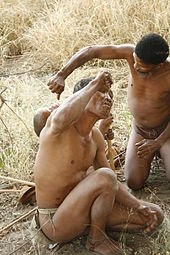 |
| San of Botswana |
The "father" of genetic mapping, Luigi Cavalli-Sforza, believes, "The most important difference in the human gene pool is clearly that between Africans and non-Africans…" This is because the farther archaic peoples dispersed from their point of origin in Africa the less diverse their genetic makeup. This is also true for world languages.
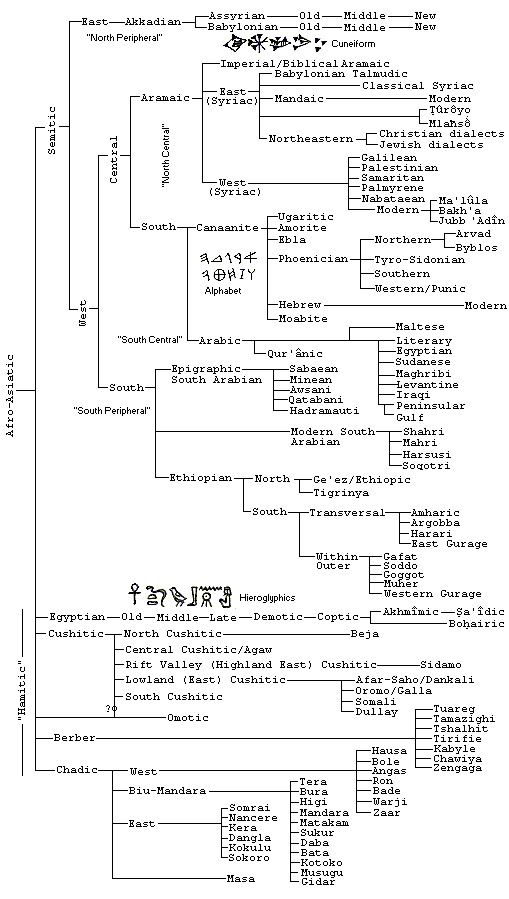
The oldest phonemes and roots are found in the Afro-Asiatic language family shown below. Hebrew is in this family and many Hebrew words are of African origin or derived from ancient Akkadian which also has affinity to African words.
 |
In the New Testament, the Greek word ethnos is used for peoples or nations. The Hebrew goy or goyim is used to distinguish non-Jews from Jews. Both Goy and Ethnos refer to "peoples" or "nations" and not to races.
For both Y-chromosome and Mitochondrial DNA, a couple of hundred haplogroups have been identified. On the molecular level, human diversity is much greater than generally recognized. That diversity and the existence of humans on earth for more than 3 million years pose insurmountable problems for those who believe that three races come from Noah's sons, Shem, Japheth and Ham.
In this view, Japheth is the father of the Caucasian or white race; Shem of the Mongoloid or yellow race; and Ham of the Negroid or black race. This is contrary to what Genesis reveals. Analysis of the King Lists in Genesis 4 and 5 makes it clear that the lines of Ham and Shem intermarried. Abraham was a descendant of both Ham and Shem.
Noah and his sons were Nilotic rulers whose lines intermarried. The idea that Noah cursed black people when he cursed Ham/Canaan is false and despicable. Since Ham and Shem's lines intermarried, Noah’s curse would have fallen upon all his descendants by Ham and Shem. There is no ground here for assuming that Noah's curse involves black people as was taught by those seeking to justify enslavement of Africans in the 19th Century.
Noah lived approximately 2490-2415 B and was not the only ruler on Earth. This is the period of the Old Kingdom, a time of great cultural and technological achievement in Egypt.
Ethnic and genetic diversity existed long before Noah's time. Human populations mined red ocher in the Lebombo Mountains more than 50,000 years before Noah. River peoples (Pengtoushan culture) thrived along the Yangtze River between B.C. 7500–6100, and the Yangshao culture flourished along the central Yellow River between B.C. 5000 and 3000. Yangshao nobles wore silk garments. During Noah's time, the Baodun culture was established in numerous settlements along the Min River in China. The Qafzeh population made tools about 125,000 years ago at Jebel Faya in the Arabian Peninsula. There is no evidence that any of these peoples were wiped out by a worldwide flood.
Young Earth Creationists insist on imposing their simplistic view of race on Genesis despite the overwhelming evidence that Genesis is not so much about human origins and the age of the Earth as it is about the origins of Messianic expectation among Abraham's Nilotic ancestors. In their Affirmation VI which appear at the back of their books, we read: We affirm that the genealogies in Genesis 5 and 11 are chronological, enabling us to arrive at an approximate date of creation of the whole universe.
They clearly have no understanding of the nature of the King Lists because they never mention Genesis 4 which must be read with Genesis 5, as the lines of Cain and Seth intermarried. The intermarriage is evident in the cousin bride's naming prerogative as in the case of Lamech's daughter Namaah (Gen. 4: 22) who married her cousin Methusaleh and named their first-born son Lamech (Gen 5: 25) after her father, to whose throne Lamech the Younger ascended.
The fact that the Hamites and Semities cannot be separated linguistically or genetically in Genesis or in molecular genealogy underscores that the text is speaking of one people in different ruling houses, not of different races.
Young Earth Creationism promotes racism in Affirmation XII: We affirm that all people living and dead are descended from Adam and
Eve...and that the various people groups (with their various languages,
cultures, and distinctive physical characteristics, including skin color) arose
as a result of God's supernatural judgment at the Tower of
Babel..."
What astonishing ignorance about Genesis! All of the rulers named in Genesis are Afro-Asiatics and their skin color and other physical features varied greatly long before the Akkadian 7-tiered temples were built in Babylon. It is ignorant and racist to insist that genetic diversity or black skin color is the result of God's judgment.
Dr. Joshua Zorn, a former Young Earth Creationist, is right in saying, "The worst aspect of YECS teaching is that it creates a nearly insurmountable barrier between the educated world and the church."
Further, in their untenable scheme Young Earth Creationists make no mention of a red people, the oldest genetic group to which Abraham's Ainu father belonged. Abraham's ancestors originated in the Upper Nile. From the Nile his ancestors moved into Mesopotamia. They have been identified as Edomites (meaning red) and Horite Habiru (Hebrew devotees of Horus).
If Abraham's Ainu ancestors spread far and wide as Genesis 10 reports, we would expect them to be an early stock from which many other peoples come. This has been confirmed by Luigi Cavalli-Sforza's genetic distance studies which places the Ainu at the center.
Molecular Genealogy Confirms Genesis
Molecular genealogy has forever changed our understanding of race. Classifications based on outward appearance are misleading. There is a range of physical characteristics within a single haplogroup. So Luigi Luca Cavalli-Sforza was correct when he wrote in 1994, "The classification into races has proved to be a futile exercise for reasons that were already clear to Darwin."
Darwin's discovery of the diversity, complexity and isolation of species in Galapagos has application for understanding human diversity, genetic complexity and the effects of isolation on populations. When it comes to the rulers listed in the "begats" the tools of kinship analysis enable us to discover the marriage and ascendancy structure. This information helps us to understand how these early ancestors of Christ became the founders of the Afro-Asiatic Dominion. Analysis of the "begats" also reveals that these rulers were not the founders of the human race, but great kingdom builders of the archaic world.
Archaeological and anthropological research has demonstrated that there was a wide range of physical appearance among those Nilotic peoples. Some were light brown with blue eyes, other had a reddish skin tone and green eyes, and others were black with dark brown to amber-colored eyes.
Abraham means “burnt father” and refers to his reddish skin color. In Arabic, the word ham means burnt. The Nilotic peoples were referred to burnt because they had a reddish skin tone. Abraham was a descendant of these ancestors, who the Bible designates as Kushites. Their skin color ranged from the black Nubians to the reddish brown Egyptians.
The Ainu originated in the Nile Valley by migrated as far as Japan and North America. They have a red skin tone. David is described as having a reddish skin tone like that of Egyptians who work in the sun (I Sam. 16:12; 17:42). The Hebrew word for red or ruddy is edom. The Hebrew root is DM, as there are no vowels. Edom is equivalent to the Hamitic/Hausa odum, meaning red-brown and to the word Adam, the first man whom God formed from the red clay which washed down to the Upper Nile Valley from the Ethiopian highlands.
Recent DNA studies indicate that the lighter skin gene of Europeans is a relatively recent development. For images of how the Ainu probably looked before the lighter skin gene, go here.
Related reading: The Genesis 10 Ethnography; The Edomites and the Color Red; Answers to High Schoolers' Questions About Noah's Flood; Who Were the Kushites?; The Christ in Nilotic Mythology; A Kindling of Ancient Memory; Getting the Facts About Human Origins; The Annu/Ainu of On (Iunu)
What astonishing ignorance about Genesis! All of the rulers named in Genesis are Afro-Asiatics and their skin color and other physical features varied greatly long before the Akkadian 7-tiered temples were built in Babylon. It is ignorant and racist to insist that genetic diversity or black skin color is the result of God's judgment.
Dr. Joshua Zorn, a former Young Earth Creationist, is right in saying, "The worst aspect of YECS teaching is that it creates a nearly insurmountable barrier between the educated world and the church."
Further, in their untenable scheme Young Earth Creationists make no mention of a red people, the oldest genetic group to which Abraham's Ainu father belonged. Abraham's ancestors originated in the Upper Nile. From the Nile his ancestors moved into Mesopotamia. They have been identified as Edomites (meaning red) and Horite Habiru (Hebrew devotees of Horus).
If Abraham's Ainu ancestors spread far and wide as Genesis 10 reports, we would expect them to be an early stock from which many other peoples come. This has been confirmed by Luigi Cavalli-Sforza's genetic distance studies which places the Ainu at the center.
 |
| Cavalli-Sforza's Genetic Distance Chart |
Molecular Genealogy Confirms Genesis
Molecular genealogy has forever changed our understanding of race. Classifications based on outward appearance are misleading. There is a range of physical characteristics within a single haplogroup. So Luigi Luca Cavalli-Sforza was correct when he wrote in 1994, "The classification into races has proved to be a futile exercise for reasons that were already clear to Darwin."
Darwin's discovery of the diversity, complexity and isolation of species in Galapagos has application for understanding human diversity, genetic complexity and the effects of isolation on populations. When it comes to the rulers listed in the "begats" the tools of kinship analysis enable us to discover the marriage and ascendancy structure. This information helps us to understand how these early ancestors of Christ became the founders of the Afro-Asiatic Dominion. Analysis of the "begats" also reveals that these rulers were not the founders of the human race, but great kingdom builders of the archaic world.
Archaeological and anthropological research has demonstrated that there was a wide range of physical appearance among those Nilotic peoples. Some were light brown with blue eyes, other had a reddish skin tone and green eyes, and others were black with dark brown to amber-colored eyes.
Abraham means “burnt father” and refers to his reddish skin color. In Arabic, the word ham means burnt. The Nilotic peoples were referred to burnt because they had a reddish skin tone. Abraham was a descendant of these ancestors, who the Bible designates as Kushites. Their skin color ranged from the black Nubians to the reddish brown Egyptians.
The Ainu originated in the Nile Valley by migrated as far as Japan and North America. They have a red skin tone. David is described as having a reddish skin tone like that of Egyptians who work in the sun (I Sam. 16:12; 17:42). The Hebrew word for red or ruddy is edom. The Hebrew root is DM, as there are no vowels. Edom is equivalent to the Hamitic/Hausa odum, meaning red-brown and to the word Adam, the first man whom God formed from the red clay which washed down to the Upper Nile Valley from the Ethiopian highlands.
Recent DNA studies indicate that the lighter skin gene of Europeans is a relatively recent development. For images of how the Ainu probably looked before the lighter skin gene, go here.
Related reading: The Genesis 10 Ethnography; The Edomites and the Color Red; Answers to High Schoolers' Questions About Noah's Flood; Who Were the Kushites?; The Christ in Nilotic Mythology; A Kindling of Ancient Memory; Getting the Facts About Human Origins; The Annu/Ainu of On (Iunu)


