Followers

Showing posts with label Petra. Show all posts

Saturday, February 15, 2020

Who were the Nabataeans?


Alice C. Linsley


The term "Nabataean" refers to the empire and city-building royal house of Idumea. Idumea is a Greek word meaning "Land of Red People" and is another reference to ancient Edom. According to Josephus, Idumea extended in antiquity from Hebron (where Sarah resided) to Beersheba (where Keturah resided). This is the extent of Abraham's territory. The map shows Abraham's territory extending between the settlements of his two wives in Hebron and Beersheba.


Some have speculated that the Magi were Nabataeans. This is not an unreasonable thesis (though the biblical text says the Magi came from the east, not the south.) The rulers of Idumea were heirs to a body of astronomical knowledge and a Messianic expectation that was common to the people of Idumea (ancient Edom) and Judah. Ancient Edom once included what is today a large section of Judah. 

The antiquity and prestige of the Edomite rulers is expressed in Jeremiah's reference to Edom and Teman of Edom as ancient seats of wisdom (Jeremiah 49:7). Genesis 36 explains, "These are the kings who reigned in the land of Edom, before any king reigned over the children of Israel."

The Nabataeans are the heirs of that wisdom. They are mentioned in historical records such as Diodorus Siculus' Bibliotheca (book 19), dating to 312 BC, and in an Egyptian papyrus dating to 259 BC. They are mistakenly classified as Arabs. Jan Retso's excellent paper on Nabataean origins indicates that it is misleading to apply the label "Arabs" to the Nabataeans. Retso observes that in 1 Maccabees 5 (v. 25) the Nabataeans were allied with Judas Maccabees while the Arabs are named as his enemies (v. 39).

The Nabataean capital of Petra reflects the pillared architecture of the Horite shrines of the Nile, and the first ruler of Petra, Obodas, took his name from the Edo/Edomite name for ruler which is Oba.

According to the linguist Helene Longpre, Nabataean Aramaic most closely correspond to Meroitic or Old Nubian. (See H. Longpre, "Investigation of the Ancient Meroitic Writing System", Rhode Island College, 1999.) 


Saturday, August 26, 2017

The Temple of the Winged Lions


Alice C. Linsley

It is said that the Temple of the Winged Lions was built to honor al-Uzza, a goddess of the pre-Islamic Quraysh. The temple stands on a promontory overlooking Petra and was accessible by ascending a massive staircase. The entrance was flanked by huge columns and the inner chamber has multiple columns, typical of the ancient Nilotic temples. The twelve columns surrounding the main podium were adorned with “winged lion” capitals.

In the ancient world, the lion was the animal totem of the rulers identified in Genesis as the "mighty men of old." This is why the names of many biblical rulers have the ar affix. It signifies both the lion and the ruler. Ari was an honorific for a man of distinction and power. The Hebrew word ari (or aryeh), the Akkadian aria, the Aramaic arya, and the Sanskrit word aryeh  mean "noble." In Genesis 49:9, Jacob refers to his son Judah as Gur Aryeh גּוּר אַרְיֵה יְהוּדָה, a "young lion."

The totem of Shobal's clan was the lion, fierce in it youthful strength. Shobal was one of the Horite Habiru kings named in the Genesis 36 ruler list.

The ruler Ar-pacshad is named in Genesis as one of Abraham's ancestors. His name means "happy ruler" or "happy lion." He ruled sometime in the period between 2445–2160 BC.

The narrative surrounding the goddess Uzza comes from a later time, about 200 AD, and mainly from Islamic sources. In his effort to eradicate idolatry Mohammed is said to have ordered the destruction of shrines dedicated to al-Uzza.Yet this monumental temple stands and was clearly a prestigious religious site in the time of Jesus when the Nabateans controlled the Arabian incense trade and a kingdom that stretched from Damascus to the Hejaz.


The Nabataean warriors had long wavy hair and wore feathers. 


Was Uzza a goddess or a clan designation?

It is strange that to find the name Uzza associated with a goddess because Uzza is a man's name. In Hebrew the names Uzza עזא and Uzzah עזה apply only to men. A man named Uzza tried to stop the Ark from falling off a cart (1 Chronicles 13:7; also 2 Samuel 6:6.) 

Another Uzza is mentioned in 1 Chronicles 8:7 as a son of Gera of Benjamin and a brother of Ahihud. Ezra 2:49 mentions a temple servant named Uzza who returned with Zerubbabel from Babylonian captivity.

There is also a man named Uzza associated with a palace garden in which king Manasseh is interred (2 Kings 21:18). Some think this might king Uzziah (2 Chronicles 26:23).

The root of the names Uzza, Uzzah, and Uzziah is Uz. The "land of Uz" is Job's homeland, according to Job 1:1. Uz is also associated with the rulers of Edom, the region where Petra is located. Uz was a grandson of Seir the Horite (Genesis 36). 


It seems likely that the temple of Uzza was dedicated to Hathor, not a goddess named Uzza. The Horites of Edom venerated Hathor, the mother of Horus. The three trees symbolism at the temple of the Winged Lions likely represents the divine Triad: Ra, Horus and Hathor. Generally, the architecture at Petra reflects the Horite three-part structure of the Divine Triad

The Nabataean kings, such as Harithath IV, bear the Horus name. King Harithath is called King Aretas in II Corinthians 11:32. Coins bearing the image of Aretas have been found in the Nabataean town of Avdat. He was called "King of the Nabatu, who loves his people" (Philopatris), and it was during his reign that the greatest of Petra's tombs were created.

The word Nabataean is related to Naba or Nabu, the guardian of scribes and prophets. This is the origin of the Hebrew word nabi, meaning prophet. The earliest scribes were Horite priests. The cult of Nabu was introduced into Mesopotamia and Babylon by the Kushites. Kushite kings sometimes bore the name Nabu, as with Nabu-shum-libur, an early Kushite king in Babylon and Nabu-apluiddina.

The first ruler of Petra was Obodas. This name is derived from the Edo/Edomite name for ruler which is Oba. Linguist Helene Longpre recognizes that Demotic Egyptian (7th-5th c. B.C.) and Nabatean Aramaic most closely correspond to Meroitic or Old Nubian. (Longpre, "Investigation of the Ancient Meroitic Writing System", Rhode Island College, 1999.) Demotic is the script of the Rosetta stone in the Ptolemaic period (BC 332-30).


Friday, July 29, 2016

The Antiquity of the Edomite Rulers


Alice C. Linsley

Note that both Hebron (where Sarah lived) and Beersheba (where Keturah lived) are in Idumea or ancient Edom. Abraham's territory extended on a north-south axis between the settlements of his two wives and was entirely in the region the Greeks called Idumea. Idumea means "land of red people" and Esau is described in Genesis has having a distinctive red skin tone, typical of the Edomite rulers. The words Edom and Adam both relate to the word dam/dm - blood, and signify the color red.

Edom
Even the hills of Edom appear red due to the iron deposits. Deuteronomy 8:9 describes Edom in these words: "A land whose stones are iron and out of whose hills you can dig copper."

Edom was ruled by Horite kings. Seir the Horite is listed in Genesis 36 as one of the Edomite kings. He was a contemporary of Esau the Elder.

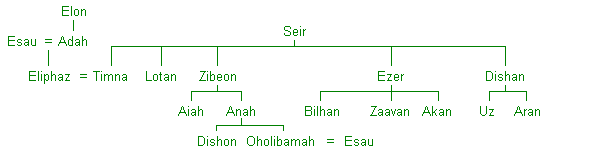
In this diagram of the Edomite rulers listed in Genesis 36 we see that there were two chiefs named Esau. Esau the Elder married Adah. Esau the Younger married Oholibamah.


Jeremiah refers to Edom and Teman of Edom as seats of wisdom. The prophet writes: Concerning Edom: This is what the Lord Almighty says: 'Is there no longer wisdom in Teman? Has counsel perished from the prudent? Has their wisdom decayed? (Jeremiah 49:7)

The wisdom to which Jeremiah refers is that of the Horite ruler-priests who were renown in the ancient world for their wisdom and skill at metal work. The Horites were a caste of royal priests and sages who were devotees of Ra, Horus and Hathor. Hathor was the patroness of metal workers. The word "Horite" is the English variant of the word Horim, the term Jews use when speaking of their ancestors.

Timna or Tema plays an important role in early Biblical history. Known by Arabs as Taima, this water source lies about 70 miles north-east of Dedan. During the Chalcolithic Period, Kushite artisans lived here in subterranean dwellings carved out of the limestone with metal tools. The Bible refers to these cave-dwellers as Dedanites. Dedan, Tema and Buz comprized a Horite confederation. Rock drawings from the 13 century BC have been found at Timna.

Timna is the site of 6,000 years old mines. The oldest mines were worked almost continuously until the Roman Period. There are ancient rock carvings showing warriors in chariots, holding axes and shields. A temple dedicated to Hathor was discovered at the southwestern edge of Mt. Timna by Professor Beno Rothenberg of Hebrew University.

The Chalcolithic metal works at Timna were found at the Wadi Nehushtan in the foothills along the western fringe of the southern Arabah Valley. The smelting works, slag and flints at this site were found to be identical to those discovered near Beersheba where Abraham spent much of his time. The metal workers of Timna and the metal workers of Beersheba were kin and the patroness of their mining operations was Hathor, the mother of Horus, who the Horite venerated. Hathor's temple there dates to 1318-1304 BC. In the temple courtyard there was a workshop for casting copper figurines as votive offerings.

In his book Timna, Rothenberg concluded that the peoples living in the area were "partners not only in the work but in the worship of Hathor." (Timna, p. 183)

The wisdom of the Horites extended to medicine, astronomy, commerce, navigation, natural sciences, metal work, stone work, architecture, and writing. They were wise men, prophets and scribes. The term "Nabatean" is derived from the name Naba or Nabu, the guardian of scribes and prophets. The cult of Nabu was introduced into Mesopotamia and Babylon by the Kushites. Some Kushite kings bore the name Nabu, as with Nabu-shum-libur, an early Kushite king in Babylon, and Nabu-aplu-iddina. The Hebrew word nabi, meaning prophet is related.

Genesis 36 speaks to the antiquity of the Edomite rulers
"These are the kings who reigned in the land of Edom, before any king reigned over the children of Israel. Bela, the son of Beor, reigned in Edom. The name of his city was Dinhabah. Bela died, and Jobab, the son of Zerah of Bozrah, reigned in his place. Jobab died, and Husham of the land of the Temanites reigned in his place. Husham died, and Hadad, the son of Bedad, who struck Midian in the field of Moab, reigned in his place. The name of his city was Avith. Hadad died, and Samlah of Masrekah reigned in his place."
An archaeological survey in the early 2000's, led by Dr. Thomas E. Levy, yielded early dates than had usually be assigned to the Edomite culture. The team uncovered scarabs, ceramics, metal arrowheads, hammers, and grinding stones and found slag heaps.

Edom had a large copper ore zone with industrial scale copper production. Radiocarbon analysis of charred wood, grain and fruit in several sediment layers revealed two major phases of copper processing, first in the 12th and 11th centuries, and later in the 10th and 9th BC.

Evidence was found of the construction of fortifications and over 100 building complexes. Khirbat en-Nahas is 30 miles north of Petra in Jordan. Khirbat en-Nahas means "ruins of copper" in Arabic. Nahash means serpent in Hebrew. As an adjective it means shining bright, like burnished copper. Khirbat en-Nahas was one of the first ancient occupation sites in the Edomite lowlands to be investigated. The ruins spread over 24 acres, and the fortifications enclose an area 240 by 240 feet. 

Dr. Levy stated, "Only a complex society such as a paramount chiefdom or primitive kingdom would have the organizational know-how to produce copper metal on such an industrial scale." 

Nabatean warriors on camels
The 400-acre Edomite complex at Petra reflects Horite beliefs. At Petra we find the same pillared architecture of the Horite shrines of the Nile. The first ruler of Petra, Obodas, took his name from the Edo/Edomite name for ruler which is Oba.

The linguist Helene Longpre points out that Demotic Egyptian (7th-5th century BC) and Nabatean Aramaic most closely correspond to Meroitic or Old Nubian. (Longpre, "Investigation of the Ancient Meroitic Writing System", Rhode Island College, 1999.) 

The mysterious Shasu were related to the Horites of Edom and according to monument inscriptions in Nubia, they called upon the God YHWH.  Lists of place names in Nubian temples of Soleb and Amara West record six toponyms located in “the land of Shasu.” A monument of Ramesses II claims that he “has plundered the Shasu-land, captured the mountain of Seir” in Edom; a 19th Dynasty letter mentions “the Shasu-tribes of Edom” and Ramesses III declares that he has “destroyed the Seirites among the tribes of the Shasu.” Clearly, the Egyptians regarded the Shasu as a prominent part of the Edomite population which is described in Genesis 36.


Saturday, September 24, 2011

The Edomites and the Color Red


Alice C. Linsley

The point of origin for humans is Africa and from the beginning humans exhibited a wide range of physical traits, including skin color, hair textures, eye shape, etc. The San (Bushmen) are one of the oldest people groups of Africa and they have a yellow skin tone. The peoples of the Upper Nile had both black and red skin tones. Images of black and red Nubian appear on ancient Egyptian monuments.

Petrie's study of ancient images suggested to him that Egypt was the product of racial mixture. He found images of Nubians in which some have black skin, others red skin, and some have brown skin. This confirmed what had been discovered by the 1828 Franco-Italian expedition to Egypt led by Jean-Francois Champollion and Ippolito Rosellini. Below is a detail from one of Rosellini's drawings showing both black and red Nubians taken captive by the Egyptians under Rameses II (1279-1213 B.C.).


The red skin tone is especially evident in peoples of Haplogroup R1b. Among these peoples were the Edo of Nigeria and Benin and the Edomites.


The Edo and the Edomites are related genetically. These are among Abraham's ancestors who came out of Africa. These were originally river peoples who moved along river systems and mountain ridges (the "high places"). They dispersed rather widely and settled in different regions including the Tigris-Euphrates River Valley and Southern Europe. Some lived in the red city of Petra, the capital of the Nabataean territory in Edom (modern Jordan).

The Greeks called the Edomites the "Idumea" or red people. Esau of Edom was described as having a red skin tone in Genesis 25:25. He was also described as hairy. Abraham's Ainu ancestors also were hairy and had a red skin tone. Abraham's father was called Tera (Terah) a royal name associated with the Ainu of the Upper Nile. These spread as far as Japan where only about 300 pure-blooded Ainu still remain on the island of Hokkaido. The original name of Tokyo was Edo. Among the Ainu the word "Tera" (Terah) means priest. Abraham's father was Terah, a ruler-priest whose territory along the Tigris River extending between Ur and Haran.

The Edomites of the Bible are related to the Edo or Idu of Nigeria and Benin. The title of their rulers is further evidence. The ruler of the Edo is called "Oba" and the first ruler of Petra was the deified Nabataean King Obodas.


The Clan of Seir the Horite (Genesis 36).

Esau the Elder and Seir were contemporaries and possibly brothers. Therir lines intermarried.


The biblical Edomites are associated with the color red. Edom means red and Genesis 25:25 links Esau to the Edomites. Esau was the name of at least two Edomite rulers. Isaac’s sons were not Jews, but Horites like their father and grandfather Abraham. That is why Esau the Elder married into the line associated with Seir the Horite (Gen. 36) and why Jacob married into the Horite line of Na-Hor. See diagram and note that there are 2 named Esau.  Esau the Elder married Adah, the daughter of the Horite ruler Elon.  Esau the Younger was Esau the Elder's grandson.  Esau the Younger married Oholibamah, a high-ranking Horite maiden.

The Edomites, along with the Jebusites, appear to have belonged to the Horite Confederation which originated in the Upper Nile region.  This is the homeland of Abraham's ancestors and is called Kush in Genesis 10. From ancient Kush, the peoples spread in many directions. Some live today in Nigeria and Benin as the Edo or Idu. 


Edo ruler called "Oba"  (Benin)
Likewise, the Biblical Jebusites have living descendants in Nigeria. They are called the Ijebu. The Jebusites built and controlled Jerusalem. Melchizedek was the priest-king of Jerusalem in Abraham's time. Very likely he and Abraham were kin. Read more here.

The Shasu were related to the Horites of Edom and according to monument inscriptions in Nubia, they called upon the God YHWH.


Related reading:  The Nubian Contecxt of YHWHThe Genesis Record of Horite Rule; Two Named Esau; A Kindling of Ancient Memory; Edo, Edom, Idumea; Edom and the Horites; The Red Heifer; The Bible and the Question of "Race"; Intermarriage Between the Dedanites and the Edomites