Followers

Showing posts with label Nazareth. Show all posts

Saturday, December 7, 2024

The Historical Mary: What We Know


Dr Alice C. Linsley

The biblical and historical data that helps us to understand Mary's social status is evident in the reaction of the first century Jews who hated her. They had to admit that she was a descendant of kings and governors. Concerning Mary, Sanhedrin 106a says: “She who was the descendant of princes and governors played the harlot with carpenters.”

The marriage of Mary and Joseph of Nazareth represents an endogamous marriage pattern. The Hebrew married only members of their caste. Their marriage represented the connection between the priestly order of Abijah in Bethlehem (the home of Mary's mother Anne) and the priestly order of ha·pi·TSETS (Happizzez) in Nazareth (the home of Mary's father Joachim).

Abijah was the eighth priestly division and Happizzez was the eighteenth division. During the time of Mary and Joseph, the twenty-four priestly divisions served in the Temple at Jerusalem in a rotation system. A list of priestly divisions is found in 1 Chronicles 24:7-18. However, this system was already in place among the early Hebrew priests of the Nile Valley. During the Predynastic period (c.4000-3000 BC) and the Old Kingdom (c. 2575-2130 BC), the Hebrew priests of the Nile Valley were organized into "phyles". Each phyle served a two-week duration before returning home. The later organization of priests in Israel appears to have developed from the phyle system.

When Joseph took Mary as his second wife, he was marrying a temple-dedicated virgin of high status. Her high status is depicted in some icons that show her holding a spindle.


The Virgin Mary holds a spindle, the symbol of a Rabitu, a Bronze Age title for a queen mother.


It is likely that Mary was dedicated to the Temple by her parents, as was Samuel dedicated by his parents Hannah and Elkanah. The duties of the Temple virgins included singing and playing musical instruments such as the sistrum and the tambourine. They ministered to women who came for ritual purification. The women performed practical tasks such as drawing water, baking bread, and brewing beer. They were skilled weavers who produced veils and vestments. The Gospel of Pseudo-Matthew describes how Mary and the other Temple virgins were spinning purple thread in the Women's compound when the Angel Gabriel appeared to Mary. 

Mary is designated almah in the Scriptures. The Hebrew word almah (עַלְמָה) is derived from a verb meaning “to conceal” or “to hide away”. Temple virgins were alamot because they were cloistered until they married. In Antiquitates judaicae, the historian Flavius Josephus (c.37-100 AD) refers to the cloisters in Book XV, Chapter 11. The King James Version refers to the alamot as “damsels”. The singers went before, the players on instruments followed after; among them were the damsels playing with timbrels. (KJV, Psalm 68:25)

Some temple-dedicated virgins chose not to marry. Entering the service of the Temple made that choice possible. Some daughters were denied marriage for political reasons. Some were released from their vows and returned to their fathers' houses. Some who were released, married. Depending on the vow, some who married remained celibate. This was the case mainly with cousin brides who were not expected to produce an heir. As a righteous man, Joseph honored Mary’s vow of celibacy. He already had a proper heir by his first wife.

Mary's conception of Jesus was by divine overshadowing as the Angel Gabriel explained (Lk. 1:35). This is exactly what the early Hebrew anticipated concerning the Son of God, and it is a significant detail of the ancient Messianic mystery. The Magnificat expresses Mary's wonder at being appointed to this unique role, especially because her lineage was deemed unworthy of honor by the Jewish elites after the time of Herod the Great. One of Mary’s ancestors Matthias (Mattat), the 61st High Priest and a descendant of David, was deposed and had limited political influence with the House of Zadok. The ancestral family of Jacob ben Mattat, once a favorite of Herod the Great, appears to have been ostracized from Jewish political life.

That Jesus was the son of Mary is not doubted. He took his flesh from the Virgin Mary, the daughter of Anne and Joachim. As a descendant of the Hebrew ruler-priests who married only within their caste, Mary's bloodline is traceable to the early Hebrew (4000-2000 B.C.) who expected one of their temple virgins to conceive the Son (HR) by divine overshadowing, exactly as the Angel Gabriel explained to Mary (Luke 1:26-38).


Mary's Perpetual Virginity
 
Mary is believed to have been a virgin before, during, and after the birth of Christ. This belief, known as the doctrine of Mary’s perpetual virginity, was officially declared at the Fifth Ecumenical Council in Constantinople in 553 AD.

Writing in 210 A.D., Hippolytus of Rome believed, “But the pious confession of the believer is that . . . the Creator of all things incorporated with Himself a rational soul and a sensible body from the all-holy Mary, ever-virgin, by an undefiled conception, without conversion, and was made man in nature, but separate from wickedness. . .” (Against Beron and Helix: Fragment VIII)

Athanasius wrote in 360 A.D. against those “who deny that the Son is by nature from the Father and proper to his essence deny also that he took true human flesh from the ever-virgin Mary” (Discourses Against the Arians 2:70).

Writing in 374 AD, Epiphanius of Salamis, affirmed the creedal faith: “We believe in one God, the Father almighty, maker of all things, both visible and invisible; and in one Lord Jesus Christ, the Son of God . . . who for us men and for our salvation came down and took flesh, that is, was born perfectly of the holy ever-virgin Mary by the Holy Spirit” (The Man Well-Anchored 120).

Others who believed in Mary’s perpetual virginity include Ambrose of Milan (339-97 A.D.), John Chrysostom (347-407 A.D.), Jerome (347-420 A.D.), and Augustine (354-430 A.D.). Many Protestant reformers affirmed their belief in the doctrine, including Martin Luther, John Calvin, and Huldrych Zwingli. In England the belief was held by Hugh Latimer (1487-1555 A.D.), Thomas Cranmer, (1489-1556 A.D.), John Jewel (1522-1571 A.D.), and Lancelot Andrewes (1555-1626 A.D.).


Friday, March 8, 2024

Rabbis and Priests


A member of the Facebook group The Bible and Anthropology has asked, "Could a priest be a rabbi and vice versa? Those are always mentioned as two distinct categories, or so it seemed to me."


Dr. Alice C. Linsley

Many rabbis were also priests. The roles are different but could overlap. Rabbis taught and preached in the local synagogues. If their synagogue was in a town with a priestly division such as Nazareth, they also served for a term at the Temple in Jerusalem. 

During the Second Temple period (586 BC-70 AD) the twenty-four priestly divisions or "courses" served in the Temple in rotation. Each course served twice a year for a duration of two weeks. A list of priestly divisions is found in 1 Chronicles 24:7-18.

Nazareth was the home of the eighteenth priestly division, ha·pi·TSETS (Happizzez). In 1962 excavators discovered in the ruins of a synagogue at Caesarea a small piece of a list of the twenty-four priestly divisions. This third to fourth-century marble fragment is inscribed with the names of the places where four of the divisions resided, including Nazareth, the residence of Happizzez.

The priests lived in settlements throughout Israel. When it was "time for the division to go up [to Jerusalem]" (Mishnah, Ta'anit 4:2), the priests went up to Jerusalem to fulfill their obligations. When their appointed time of service in Jerusalem ended, the priests returned to their homes. When not functioning as a priest, these individuals went about their normal routines, tending to their various occupations: stone masons, miners, tomb builders, potters, tent makers, shepherds, goatherds, farmers, merchants, smiths, and carpenters. They also taught and preached in the local synagogues.


Deeper Roots

The point of origin of the Hebrew ruler-priest caste is the Nile Valley long before the time of Abraham. That caste had a moiety system, meaning that it was organized into two ritual groups, the Horite Hebrew and the Sethite Hebrew. Both groups built and maintained shrine and temples along the Nile. The oldest known site of Horite Hebrew worship is at Nekhen on the Nile (4200 BC). 

The Hebrew are probably the oldest known caste. They served at shrines, temples, and mortuary sites at least 1000 years before the caste system of India emerged. Their preserved their ethnic identity by marrying only within their caste (caste endogamy).

During the Old Kingdom (c. 2575-2130 BC) the Hebrew priests were organized in groups called "phyles." Each phyle served a two-week duration at the royal temple before returning home. The later organization of priests in Israel appears to have developed from the earlier Hebrew phyle system.


Sanhedrin Members

The Great Sanhedrin (the highest Jewish court) met in the Hall of Hewn Stones in the Temple in Jerusalem. It convened every day except festivals and Shabbat. Its members included priests, high ranking rabbinical authorities (rabbis), and wealthy Jews whose pure Hebrew ancestral lineages could be verified. The daughters of Sanhedrin members only married priests and rabbis. Only Jewish men belonging to prominent families were members of the Great Sanhedrin (the Beth Din HaGadol). The lesser Sanhedrin courts had members who were priests and rabbis also, but these courts had less authority.

The New Testament reports that many priests became followers of Jesus (Acts 6:7). At least three of Jesus' followers were members of the Sanhedrin: Nicodemus, Joseph Arimathea, and James the Just. The first priests in the service of Christ in southern England were likely ordained by Joseph Arimathea with the written consent of 2 other Sanhedrin members who were followers of the Way.

Members of the Sanhedrin served under the presidency of the high priest much as priests today serve under the presidency of their bishop. The high priest bore the title nasi (ruler, king, prince) and retained this title even after the presidency was transferred to other hands. Similarly, in Anglican and Roman Catholic orders a bishop retains the title "bishop" even after he has stepped down from serving in that office.

Jewish ordination was called semichah and it was necessary for membership in the Great Sanhedrin (The Great Court). Ordination was also required to serve in the lesser courts. Ordination was required to be a member of the Sanhedrin and that was obtained by the imposition of hands by someone who himself had been properly ordained. This is the precedent for the concept of Apostolic Succession in the Church. 

The Sanhedrin members served under the presidency of the high priest much as priests today served under the presidency of their bishop. The high priest bore the title nasi (ruler, king, prince) and retained this even after the presidency was transferred to other hands. Similarly, in Anglican and Roman Catholic orders a bishop retains the title "bishop" even after he has stepped down from serving in that office.

As individuals within the Sanhedrin passed away, or became unfit for service, new members were ordained in what Jews describe as an "unbroken succession" from Moses to Yehoshua the priest of the two crowns (Zec. 6:11), to the elders of Israel, to the prophets (including Haggai, Zechariah and Malachi), to the Anshei Knesses HaGedolah or "Men of the Great Assembly" founded by Ezra c. 520 B.C., to the sages of the Sanhedrin of the Second Temple (c. 520 - A.D. 70).

The second in charge was a ruler-priest who was called ab bet din (father of the court). The role of the ab bet din appears to have been a combination of the roles of the bishop's chaplain and the chancellor of the diocese who serves as the chief legal consultant to the Diocesan bishop. The polity and ordination procedures of the Anglican Church seem to parallel the Sanhedrin. As priestly ordination in Judaism was abolished in 358 AD, Christian priests stand alone as the living succession of priests in the Messianic Faith that we call "Christianity."

The third century Rabbi Johanan enumerates the qualifications for members of the Sanhedrin as follows: they must be tall, of imposing appearance, of advanced age, and scholars. They were also required to be adept in the use of foreign languages. When testimony was given to the Sanhedrin in a foreign language, at least two members who spoke that language were required to examine the witness. There was also a third member who understood the language. These three members constituted a minor court of three, who then reported the testimony to the entire Sanhedrin.

Some High Priests lived in exile among foreign peoples. One example is Hyrcanus who was living among the Parthians. Members of the Sanhedrin did business in foreign parts and visited the local synagogues. Joseph Arimathea would have had Jewish contacts in Cornwall and Devon, places he visited as a mining consultant. Mining in Cornwall and Devon in England began as early as 2150 BC. The Ding Dong mine is one of the oldest mines in Cornwall. An old miner told A. K. Hamilton Jenkin in the early 1940's: "Why, they do say there's only one mine in Cornwall older than Dolcoath, and that's Ding Dong, which was worked before the time of Jesus Christ." (Hamilton Jenkin, A. K. Cornwall and its People. London: J. M. Dent; p. 347) 

Tin ingots from Cornwall dating to 2000 BC have been found in Israel and ingots from Cornwall dating to 1300 BC have been found at archaeological sites in Turkey and Greece. The tin trade brought people together from the Levant, the Nile Valley, Mesopotamia, and parts of Europe.

Local legend holds that the Din Dong mine was one of the places visited by Joseph Arimathea. According to the Sanhedrin rules of ordination Joseph could rightfully ordain the first "Christian" priests while in England. He needed the written consent of only 2 other ruler-priests, and it is inconceivable that he would have neglected to do so.

Thursday, November 2, 2023

Jesus' Ruler-Priest Ancestors


Jesus’ hometown of Nazareth is in Galilee. Nazareth was the home of the eighteenth priestly division, ha·pi·TSETS (Happizzez). Matthew 2 explains that "Nazarene" is derived from the prophecy "He will be called a Nazorean", but this has no source in the Hebrew Bible. The term is from the Akkadian language, the oldest known Semitic language. Na-Zor in Akkadian means "belonging to the Zorites". In 1 Chronicles 2:54, Salma of Judah is called the “father” of the Zorites. 1 Chronicles 2:5 states that Salma is also the "father of Bethlehem". So, the prophecy connects Jesus to both Nazareth and Bethlehem. These are the ancestral settlements of Jesus' Hebrew ancestors.

In 1962 excavators discovered in the ruins of a synagogue at Caesarea a small piece of a list of the twenty-four priestly divisions. This third to fourth-century marble fragment is inscribed with the names of the places where four of the divisions resided, including Nazareth, the residence of Happizzez. Until that discovery there was no record of Nazareth's existence before the sixth century A.D., other than in the New Testament and some Christian literary sources.

Since Jesus grew up in Nazareth, it is not surprising that his closest followers were Galileans. It was to Galilee that Jesus returned after His resurrection. At the Last Supper He informed his disciples: "After I have been raised, I will go before you to Galilee.” (Matt. 26:32) This reminds us that Jesus was fully human. He expresses a desire to return home one last time before ascending to the Father.

Luke 2:4 indicates that Mary and Joseph traveled from Nazareth to Bethlehem in order to participate in a census. The Romans kept records of the growth of the Jewish population, and they knew that Jewish identity was (and still is) traced through the mother. Bethlehem was Mary's hometown. Her father, Joachim, was a shepherd-priest of Bethlehem. Mary clearly was of the Hebrew ruler-priest lines. This is acknowledged even by those who hated her, as it is written in the Talmud: “She who was the descendant of princes and governors played the harlot with carpenters.” (Sanhedrin 106a)


Wednesday, December 27, 2017

Jesus of Nazareth, Son of David


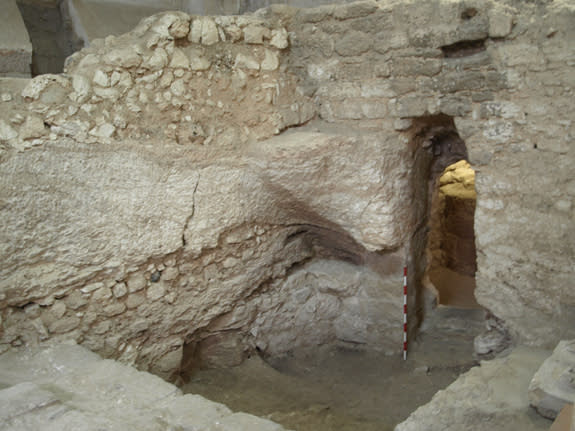
Was this the house in Nazareth where Jesus grew up?


Alice C. Linsley

Nazareth was the home of Jesus, a descendant of King David. There appears to have been a connection between the clans of Nazareth and the clans of Bethlehem. In Jesus' day, both towns were small and essentially comprised of one family. These kinsmen had common Horite Hebrew ancestry. I Chronicles 4:4 lists Hur (Hor) as the "father of Bethlehem." No priestly division was assigned to Bethlehem by King David because his sons served as the rulers over all the priestly divisions (2 Sam. 8:18).

Nazareth sat in a basin. It was described as a flower or a shell protected all around by hills. A caravan route connected Nazareth and Jerusalem. To the south of Nazareth, a road led to Egypt. This would have been the route that Joseph traveled with Mary and Jesus on their return from Egypt.

Archaeological findings in Nazareth include an ancient wine press, terraced hillsides used as vineyards, an irrigation system, and three watchtowers in the fields. These date to Jesus' time. Perhaps these were in Jesus' mind when He told the parables of the sower, the wheat and the tares, and the vineyard workers.

Archaeologists working in Nazareth also have identified a first-century house that has been regarded as the place where Jesus lived with Mary and Joseph. The house is cut into a rocky hillside and built out from the hill with mortar-and-stone walls. It was first uncovered in the 1880s, but it wasn't until 2006 that archaeologists dated the house to the first century. The Horite Hebrew ruler-priests were famous for their monumental stone work. They were responsible for building the tombs of rulers, so this house would have been a rather humble home in comparison.

Nazareth of Galilee was of less concern to Herod than Bethlehem. Herod knew that the Messiah's birthplace was prophesied to be Bethlehem, David's city, and that the eternal kingdom was to be that of David's lineage. His slaughter of the baby boys in Bethlehem was to eliminate this future king who posed a threat to Herod's dynasty. Herod was born in Idumea or Edom around 74 B.C. He knew that Messiah's appearing would change everything because his Edomite ancestors were the Horite Hebrew of Edom (Gen. 36). They expected Messiah to be born of a virgin of their Horite Hebrew ruler-priests lines. Some of those priests resided in Bethlehem, and some in Nazareth.

Nazareth was on an ancient trade route that went north from Egypt through Galilee. It was called the "Via Maris" in Roman times, but the route was traveled for many centuries before the Roman presence in Palestine. Another ancient road went from Nazareth to Jerusalem. It was along this road that the priests of Nazareth traveled to the temple to perform their sacred duties when it was their appointed time of service.

In 1962, excavators discovered in the ruins of a Caesarea synagogue a small 3rd to 4th century marble fragment with a list of the twenty-four priestly divisions. This list names the places where four of the divisions resided, including Nazareth, the home of the eighteenth priestly division, hapiTSETS (Happizzez). Until the discovery of this fragment, there was no extra-biblical record of Nazareth's existence before the sixth century A.D, and no identification of a priestly division at that town.

According to 1 Chronicles 24:15, the eighteenth priestly division was called hapiTSETS (Happizzez). The name is related to the ancient Egyptian word for the life-sustaining Nile, Hapi. Many claim that the word Nazareth is related to the Hebrew word for branch, but it is more likely that Nazareth is related to the Ge'z rwt, meaning king, and the Nilotic Shilluk word reth, also referring to a king. According to Strong's Hebrew Concordance: 5145. נֵ֫זֶר (nezer) refers to consecration or a crown. Melchi, a name that appears twice in the Virgin Mary's ancestry, means "my image" in Amharic, a language spoken in the Upper Nile.

The Apostle Peter performed a miracle in the name of Jesus Christ of Nazareth (Acts 3:6). The phrases "Jesus of Nazareth" and "Jesus, Son of David" apparently became synonymous in the minds of people who had heard about Jesus. When the blind beggar Bartimaeus heard that Jesus of Nazareth was near him, he began to cry out, “Jesus, Son of David, have mercy on me!” (Mark 10:47)


Tuesday, March 3, 2015

Jesus' Home in Nazareth?


OWEN JARUS
LIVE SCIENCE 
3-2-2015

Archaeologists working in Nazareth — Jesus' hometown — in modern-day Israel have identified a house dating to the first century that was regarded as the place where Jesus was brought up by Mary and Joseph.

The house is partly made of mortar-and-stone walls, and was cut into a rocky hillside. It was first uncovered in the 1880s, by nuns at the Sisters of Nazareth convent, but it wasn't until 2006 that archaeologists led by Ken Dark, a professor at the University of Reading in the United Kingdom, dated the house to the first century, and identified it as the place where people, who lived centuries after Jesus' time, believed Jesus was brought up.

Whether Jesus actually lived in the house in real life is unknown, but Dark says that it is possible. 


Jesus' House? 1st-Century Structure May Be Where He Grew Up


"Was this the house where Jesus grew up? It is impossible to say on archaeological grounds," Dark wrote in an article published in the magazine Biblical Archaeology Review. "On the other hand, there is no good archaeological reason why such an identification should be discounted."

Jesus is believed to have grown up in Nazareth. Archaeologists found that, centuries after Jesus' time, the Byzantine Empire (which controlled Nazareth up until the seventh century) decorated the house with mosaics and constructed a church known as the "Church of the Nutrition" over the house, protecting it.

Crusaders who ventured into the Holy Land in the 12th century fixed up the church after it fell into disrepair. This evidence suggests that both the Byzantines and Crusaders believed that this was the home where Jesus was brought up, Dark said.

Read it all here.


This is a fascinating article and there is anthropological support for the identification of this structure as a possibility, but nothing like proof.

The ruler-priest caste/clans, to which Jesus' mother and Joseph belonged, were known to be mining experts who also were the builders of stone tombs. They also lived in similar stone structures. Their skill is evident in Joseph of Arimathea who was a mining expert (with connections in Cornwall) and a tomb builder. Jesus was laid in Joseph's personal stone tomb, one fitting for a high ranking member of the Sanhedrin.


Thursday, September 4, 2014

Early Christian Amulet Discovered


A 1,500-year-old papyrus is one of the earliest surviving Christian amulets and was likely worn by an average person. It was re-discovered in the University of Manchester’s John Rylands Library. The text makes reference to the Lord's Supper and was written on the back of a grain tax receipt. Read about the discovery here.

Amulets were worn by early Christians, and this continued a tradition from before the time of Abraham. This article places too much emphasis on the influence of Egyptian magic. Amulets were worn for protection, as Christians today place crosses over doorways and in their cars.

The practice of writing sacred texts on objects was largely a priestly practice. In part, this is because the priests were the only people who knew how to write (scribes). The priests of Abraham's time wrote blessings and curses on the insides of bowls from which they poured out the blessings or curses. This is the significance of the seven bowls of Revelation 16.

This text reflects the Messianic vision and uses a very ancient reference - Christ "our God." The full text of the papyrus reads:

'Fear you all who rule over the earth.

'Know you nations and peoples that Christ is our God.

'For he spoke and they came to being, he commanded and they were created; he put everything under our feet and delivered us from the wish of our enemies.

'Our God prepared a sacred table in the desert for the people and gave manna of the new covenant to eat, the Lord’s immortal body and the blood of Christ poured for us in remission of sins.'

Dr. Tom McCollough of Centre College (Kentucky) has excavated in Galilee and found many amulets that date to Jesus' time and after. His team excavated at Sepphoris, a sprawling site on top of a large hill in Galilee. There was an amphitheater, a synagogue, a rich collection of mosaics and several nearby villages and roads. Sepphoris is located only 5 miles from Nazareth, northwest across the rolling hills. The influence of Egypt is evident in the mosaic floor of the Nile House in Sepphoris (shown below).


Thursday, October 24, 2013

The Priests of Nazareth


Alice C. Linsley


Jesus grew up in Nazareth in Galilee. He was brought here as a child from Egypt. Nazareth is on an ancient trade route that goes north from Egypt through Galilee. In Roman times it was called the "Via Maris" but the route was traveled for many centuries before the Roman presence in Palestine. Another ancient road went from Nazareth to Jerusalem and it was along this road that the priests of Nazareth traveled to the temple to perform their sacred duties when it was their appointed time of service.


In Nazareth, Jesus preached his first recorded sermon (Luke 4:16). He read Isaiah 61:1-3, a Messianic prophesy, and then declared, "Today this Scripture is fulfilled in your hearing." His hearers understood that he claimed to be the fulfillment of the prophesy and this aroused their anger. Because of their unbelief "He did not many mighty works there" (Matthew 13:58).

When Nathaniel was told that the Messiah was from Nazareth, he wondered, "Can any good thing come out of Nazareth?" (John 1:46)  From Nathaniel's perspective, there was nothing remarkable about this town in the heart of an agricultural area in Galilee.

Jesus' closest followers were from Galilee, and it was to Galilee that He returned and met with His disciples after His resurrection. At the Last Supper, He informed his disciples: "After I have been raised, I will go before you to Galilee.” (Matt. 26:32)

In 1962 excavators discovered a small 3-4th century marble fragment with a list of the twenty-four priestly divisions in the ruins of a Caesarea synagogue. This list names the places where four of the divisions resided, including Nazareth. Until the discovery of this fragment, there was no extra-biblical record of Nazareth's existence before the sixth century A.D and no identification of a priestly division at that town.

There were twenty-four priestly divisions after the construction of the Second Temple. Nineteen of these divisions are listed in Nehemiah 12:10-22. In the Nehemiah list we find these names of particular interest: Joachim, Joseph, and Mattenai (also spelled Mattai/Mattan/Matthew). These are the names of priests who married the daughters of priests and from these lines came John the Baptist, Joseph, Mary and Jesus, the Incarnate Son of God. This was the line of Joseph of Hari-mathea, a voting member of the Sanhedrin. He and Nicodemus, another member of the Sanhedrin, buried Jesus’ body in a cave tomb similar to those used by their Horite ancestors in Bethlehem and Hebron. Joseph and Nicodemus experienced first-hand Jesus' death. They buried him and sealed the tomb. They believed that He rose from the grave, and at great personal risk, they testified to His resurrection.

Writing in the third century, Hippolytus records that Mary’s mother was a daughter of a priest named Matthan. Mary's father was the Horite shepherd-priest Yaochim (Joachim). Therefore, Mary was of the Horite ruler-priest lines that can be traed back to Abraham's Nilo-Saharan ancestors. Even those who hated Mary acknowledged her ruler status, as it is written in the Talmud: “She who was the descendant of princes and governors played the harlot with carpenters.” (Sanhedrin 106a)

According to 1 Chronicles 24:15, Nazareth was the home of the eighteenth priestly division, hapiTSETS (Happizzez). The name is related to the ancient Egyptian word for the life-sustaining Nile which was called Hapi. Again we have evidence that Jesus of Nazareth was of the Horite ruler-priest lines that can be traced back to the Nile Valley.


Related reading:  The Priestly DivisionsWhich Bethlehem is Jesus' Birthplace?Who Were the Horites?; Jesus' Horite Ancestry; The Genesis Record of Horite Rule; Mary's Ruler-Priest Lineage; Jesus' Hidden Years at Nazareth