Followers

Showing posts with label Two wives. Show all posts

Thursday, November 26, 2026

What Science Reveals About the Hebrew Caste


Dr. Alice C. Linsley

Genesis 4 provides important details about Cain and some of his descendants. Genesis 5 provides important details about Seth and some of his descendants. When these early Hebrew lists are studied together it becomes apparent that the descendants of Cain and Seth intermarried (caste endogamy). This kinship diagram shows one example of the intermarriage between the 2 lines.


Note that Lamech the Elder had two wives, Adah and Zillah.

Lamech the Elder is a descendant of Cain (Gen. 4). His daughter Naamah married her cousin Methuselah (Gen. 5) and named their firstborn son after her father. Lamech the Younger was the father of Noah. Among the early Hebrew (4200-2000 B.C.) high status cousin brides often named their firstborn sons after their fathers. This is termed "the cousin bride's naming prerogative".

The Hebrew persons listed in Genesis chapters 4, 5, 10, 11, 25 and 36 were rulers, not commoners. These are king lists similar to the Sumerian king lists, only more easily authenticated using kinship analysis. The Genesis 4 and 5 lists are older than the Sumerian king lists.

The early Hebrew were a ruler-priest caste and one of the traits of all castes is endogamy. Caste endogamy refers to the custom or rule of marrying only within one's own caste or subcaste. The Hebrew people named in Genesis chapters 4-36 practiced endogamy. 

Hebrew marriages were arranged. Deliberation about suitable partners pertained to the "father's house", and were conducted under the authority of the fathers, village elders, clan chiefs, and sometimes the king. However, the young woman was given a choice could decline to marry. This is evident in Genesis 24:58. Rebekah's family called her and asked if she consented to marry Isaac and she answered, "I will go." 

Young Hebrew women could avoid unwanted marriages by being dedicated to God. This meant service in the temples and water shrines. Apparently, this is what happened with Jephthah's daughter, whose story is recounted in Judges 11. She mourned her virginity (Jdg. 11:37-38) because dedication to the Lord's service in the temple required celibacy. This is the most sensible interpretation of that story because the Hebrew ruler-priests did not practice human sacrifice. (That being the case, the narrative of Abraham on Mount Moriah also needs to be reconsidered.)


Marriage partner selection

The selection of marriage partners was based on consideration of political alliances, distribution of wealth, building up of the Hebrew lineages, and the necessity of heirs. There were multiple potential matches because there were many Hebrew clans other than Jacob’s clan (the Israelites). It appears that priority was given to marriage partners within the 3-clan confederations such as Ham, Shem, and Japheth, Nahor, Haran and Abraham, Og, Gog, and Magog, and Huz, Buz, and Uz.

Analysis of the marriage and ascendancy pattern among the early Hebrew is complicated by the fact that most of the high-ranking Hebrew men had 2 wives. Among them were Lamech the Elder, Terah, Abraham, Isaac, Esau the Elder, Amram, Jesse, Elkanah, Ashur, and Joash. Abraham's two wives were Sarah (his half-sister) and Keturah (his patrilineal cousin). They resided in separate settlements in Hebron and Beersheba.

In 1 Chronicles 4:5, we read that "Ashur, the father of Tekoa, had two wives, Helah and Naarah." In 1 Chronicles 4:17-18, we read that Mered had two wives, and one was "Pharaoh’s daughter Bithiah, whom Mered had married."

Because there were often two wives, the list in Genesis 4 represents Cain's descendants by only one of his wives. Likewise, the list in Genesis 5 represents Seth's descendants by only one of his wives. 


How to identify the social structure of the biblical Hebrew

Kinship analysis is a tool of cultural anthropology that studies how societies organize family and social ties and how those relationships determine rights, obligations, inheritance, residency, and social exchanges. 
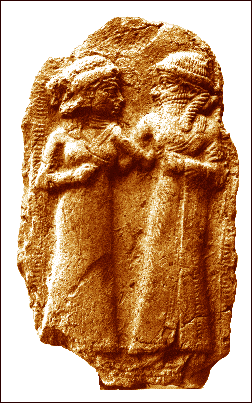
Kinship analysis is also used to confirm the historicity of biblical figures such as the two men named Lamech, Noah, Abraham, Moses and their wives.

Analysis of the social structure of the biblical Hebrew reveals these traits:

caste endogamy
moieties

Saturday, February 4, 2023

Sovereignty and Two Wives


Sumerian King Dumuzi and his royal bride. He is mentioned in the Sumerian King List.


Alice C. Linsley

Bridal imagery is found throughout the Bible. Hosea 2 describes how YHWH sets aside Israel, his bride, and vows to win her back, even if it means moving heaven and earth.

In the Gospel according to John, John the Baptist speaks of Jesus Christ as the bridegroom. "The bride belongs to the bridegroom. The friend who attends the bridegroom waits and listens for him, and is full of joy when he hears the bridegroom’s voice." (John 3:29)

In Ephesians 5:22-33, Paul uses marriage to analogize Christ as the husband of the Church.

In Matthew 22:2, Jesus compares heaven to a wedding banquet that a king had prepared for his son.

Consider how in the Bible brides are often found at wells. Abraham met Keturah at the Well of Sheba. Jacob met Rebekah at a well in Padan-Aram. Moses met Zipporah at a well in Midian. Jesus met Photini at the Well of Jacob and she, a Samaritan, became the first evangelist. 

Among the early Hebrew ruler-priests, it was a common practice to have two wives. Like his father Terah, Abraham had two wives: Sarah and Keturah. The Hebrew priest Elkanah had two wives: Peninnah and Hannah. Other Hebrew rulers with two wives include Lamech, Jacob, Amram, Moses, Jesse, and Joash.

In 1 Chronicles 4:5, we read that "Ashur, the father of Tekoa, had two wives, Helah and Naarah."

In 1 Chronicles 4:17-18, we read that Mered had two wives and one was "Pharaoh’s daughter Bithiah, whom Mered had married."

Those who are troubled by the idea of two wives should consider that this is exactly what is presented in Jeremiah 3:8 which speaks of God divorcing the northern kingdom of Israel for being an unfaithful bride. The same judgement is spoken over the southern kingdom of Judah. “And I saw, when for all the causes whereby backsliding Israel committed adultery I had put her away, and given her a bill of divorce; yet her treacherous sister Judah feared not, but went and played the harlot also.” Here God is presented as having two unfaithful wives.

The ruling house of a high-status Hebrew man consisted of two wives. Two wives were instrumental in establishing and maintaining territorial boundaries for the early Hebrew rulers. Abraham's territory in ancient Edom (Idumea) extended between the settlements of Sarah in Hebron and Keturah in Beersheba. Both locations are shown on this map.


Jesse's two wives resided in separate settlements. David's mother probably resided in Bethlehem and Jesse's other wife probably resided in Hebron. This would explain why David was anointed first in Bethlehem and later anointed in Hebron (2 Sam. 2:1-4).

2 Samuel 23:24 mentions three sons, Abishai, Joab and Asahel, born to Jesse's daughter Zeruiah. Zeruiah was David's half-sister.

The Song of Songs speaks of two brides. One is "dark as the tents of Kedar" (1:5) and the other is "fair as the Moon" (6:10). This exalts Solomon's reign as divinely appointed since in the ancient world the High God's sovereignty was expressed by the journey of the Sun between the houses of his two wives.

This is typical of the territorial claims of high kings in the Ancient Near East. The brides represent the east and the west, the territorial boundaries observed by the solar arc, the symbol of the God’s High rule over the Earth. This was a way of identifying the authority of the high king with the authority of the High God.

Psalm 19:5-6 says God "has set a tent for the sun, which comes forth as a bridegroom out of his chamber and, like a strong man, runs its course with joy. Its rising is from the end of the heavens, and its circuit to the end of them, and there is nothing hidden from its heat."

The names of Lamech’s two wives Adah and Tzillah (Gen. 4) are a claim to expansive earthly rule. The Bible scholar, Theodore H. Gaster, noted that the east-west arrangement is suggested by the names Adah (dawn) and Tzillah (dusk). 


Monday, November 18, 2019

Identifying the Status of the Two Wives


Alice C. Linsley

A reader has asked for a list detailing the "patriarchs" and their wives in a simple format like this.

1. husband
a. wife 1
b. wife 2

The term "patriarch" does not appear in the Bible. The men with two wives were rulers and chiefs over their clans. These rulers were related as it was their practice to marry within and between the Hebrew clans (endogamy).

The pattern of two wives is found throughout the Bible among the Hebrew people. However, we are not always provided with the data we need to identify which wife is the first and which is the second. Some wives are not named. Moses' Kushite wife is an example, as are King Joash's two wives,  chosen for him by the priest Jehoiada.

In the case of sent-away sons there may be disruption of the usual pattern of marrying a half-sister in the man's youth and marrying a patrilineal cousin in later life. Jacob is an example. Leah is the first wife and her sister Rachel is the second wife. According to the biblical data, both women were Jacob's cousins.

In some cases, we are not told the names of the bride's father, which makes it difficult to identify her clan and whether she is the first or second wife. The second wife can be identified by "the cousin bride's naming prerogative." She is the cousin bride if her first born son is named after her father. The cousin bride is the second wife. The chief's first wife is usually a half sister, as was Sarah to Abraham. They had the same father but different mothers.

Examples of the cousin bride include Lamech's daughter Naamah, Abraham's wife Keturah, and Amram's wife Ishar. In this diagram we see that Lamech's daughter Naamah (mentioned in Genesis 4) married her patrilineal cousin Methuselah (Genesis 5) and named their first born son Lamech after her father. This is why it is necessary to speak of "Lamech the Elder" and "Lamech the Younger."


Here is a list, as requested. When no data is available about the marriage order, I assume that the order of the women's names in the Bible represents their status. The first wife is the principal wife as her first born son is her husband's proper heir. The first born son of the cousin wife belongs to the household of his maternal grandfather after whom he is named.

Lamech (Genesis 4)
1. Adah
2. Zillah

Terah (Genesis 11)
1. unnamed sister wife was a daughter of Nahor the elder
2. unnamed cousin wife was a daughter of Haran the elder. Her brother Haran died in Ur.

Abraham
1. Sarai/Sarah, half-sister wife (Genesis 12, Genesis 20:12)
2. Keturah, cousin wife of the royal house of Sheba (cf. Genesis 10:7)

Jacob
1. Leah, posed as a cousin wife, but she may have been a half-sister
2. Rachel, cousin wife

Amram, father of Moses
1. Jochebed
2. Ishar

Moses
1. unnamed "Kushite" or Nilotic wife
2. Zipporah

Elkanah, priest father of Samuel
Two wives, Penninah and Hannah. No data as to which was the first.

Ashur 
Two wives (1 Chronicles 4:5)
1. Helah is probably the half-sister wife
2. Naarah is probably the patrilineal cousin wife.

Joash
Two wives chosen for him by the High Priest Jehoiada. Joash's mother was Zibiah of Beersheba. Here we again see a connection between the royal house of David and the royal house of Sheba.