

Many images of shaved priests have been found. This shaved priest is sacrificing a ram.
Dr. Alice C. Linsley
There are many ancient words that are translated "priest" though the function of the priest certainly varied from community to community. Priests in the ancient world served as scribes, lectors, funerary officials, embalmers, advisers to kings, and priests who offered animal sacrifices.
Ancient words for priests include terah, korah, harwa, sem, wabau, kalu (lamentation priest), hekau, and šangû. The Akkadian term šangû is the likely origin of the Latin word saguis and the English word sanguine, both referring to blood. The šangû probably offered animal sacrifice at royal sanctuaries.
Another Akkadian word for priest is abru from which the word Hebrew is likely derived. The Hebrew were a caste of royal priests called abrutu.
In ancient Egypt not everyone who served at the temples and shrines was a priest. Both men and women of the Hebrew caste took turns offering praise to the High God and his son HR. The men who offered praises were called hem-netjer and females were called hemet-netjer. In ancient Egyptian the word hem/HM refers to praise.
The term korah refers to a shaved priest (Biblical Archaeology Review, July/August 2007, p.37.) Moses had a half-brother named Korah. Both Aaron and Korah were priests. The korahs shaved their bodies before their time of service at the temple or shrine. This was part of their ritual purification.
Herodotus observed that ritual purity was a prominent feature of the Nilotic priest's life (II:37):

The Terah named as Abraham's father (Gen. 11) was a powerful chief over a clan. He would have played a role in decisions about widows. Among the Nilotic Luo, the priest who performs the widow cleansing rituals is called Ja'Ter. Among the Dinka, the word for priest is tier.
.jpg) This tile shows a tera (priest) neter or netjer (of God or the divine) of the Sethite moiety who served at a temple in a city of the Nilotic Annu.
This tile shows a tera (priest) neter or netjer (of God or the divine) of the Sethite moiety who served at a temple in a city of the Nilotic Annu.
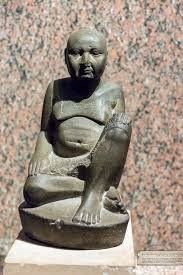
Another term for priest is harwa. Anceint images of the harwa priests shown them with shaved bodies and usually seated. A famous Nilotic priest called "Harwa" served as the high steward of God's wife early in the seventh century BC.

In ancient Egypt, the ka priests were paid by a family to perform the daily offerings at the tomb of their deceased loved ones.
Some priests served as royal lectors. The lector-priest was called hekau. These priests read ancient texts and were known as the keepers of the received tradition (hakem).
The ordinary priest was called wabau, which comes from the hieroglyphic word wab meaning 'to be pure' or 'purified'. The priests of the ancient world were concerned about purity of life as well as ritual purity. Herodotus observed that "The Egyptians were the first who made it a point of religion not to lie with women in temples, nor to enter into temples after going away from women without first bathing." (II:64)
Related reading: Moses and the Kushite Bride; Hebrew Names and Titles; The Afro-Asiatic Conception of Purity; Moses' Horite Hebrew Family; Denying Marriage: A Cunning Royal Strategy; Righteous Rulers and the Resurrection; 2400 BC Tomb of a Purification Priest; Physician Priests in Antiquity; Tomb of the Priest Shepseskaf-ankh
The term korah refers to a shaved priest (Biblical Archaeology Review, July/August 2007, p.37.) Moses had a half-brother named Korah. Both Aaron and Korah were priests. The korahs shaved their bodies before their time of service at the temple or shrine. This was part of their ritual purification.
Herodotus observed that ritual purity was a prominent feature of the Nilotic priest's life (II:37):
"They are religious excessively beyond all other men, and with regard to this they have customs as follows: they drink from cups of bronze and rinse them out every day, and not some only do this but all: they wear garments of linen always newly washed, and this they make a special point of practice: they circumcise themselves for the sake of cleanliness, preferring to be clean rather than comely. The priests shave themselves all over their body every other day, so that no lice or any other foul thing may come to be upon them when they minister to the gods; and the priests wear garments of linen only and sandals of papyrus, and any other garment they may not take nor other sandals; these wash themselves in cold water twice in the day and twice again in the night; and other religious services they perform (one may almost say) of infinite number."
The term korah is likely related to the language of the Nilotic Luo, for whom Ja'Kor refers a priest-seer who offers incantations and prayers concerning the future. According to rabbinic sources, Korah possessed the power to foresee the future. These priests were in the service of rulers and high kings. Joseph may have been regarded as a korah when he foretold the future calamity that was coming upon Egypt.
Korah was born to Amram and his cousin wife Ishara. Ishara named their son "Korah" after her father, Korah the Elder. This is another example of the cousin bride's naming prerogative, a distinctive feature of the early Hebrew marriage and ascendancy pattern.
1 Chronicles 23:18 says that Ishara's first son was named Shelomith. As "Korah" is a title, it is possible that Moses' half-brother was named Shelomith. The name identifies Shelomith as a member of a ruling family. In the ancient Akkadian language, shal means rule or reign, and mit refers to a mace, a symbol of royal authority.
Ishara (Ušḫara) is a Hittite name possibly meaning, or referring to, making a binding oath since Ishara/Ushara was perceived as a goddess by whose name oaths were sworn. According to Stol and Wiggermann, Ishara was the figure to whom women turned to bare sons (Birth in Babylonia and the Bible: Its Mediterranean Setting, p. 79).
If Amram married according to the custom of the high-ranking Hebrew ruler-priests, Ishara's Hittite name would suggest that his cousin bride was of a Hebrew clan of Canaan or Anatolia where the Hebrew clans had dispersed long before Amram's time. The Hittites are related to Heth of Kiriath Arba (Hebron) where Sarah lived. Hebron was part of ancient Edom in Abraham's time.
In 1 Chronicles 23:18, Ishara/Ishar is named as a chief. Another woman named as a chief is Anah in Genesis 36. Genesis 36 lists the rulers of Edom that descend from Seir the Horite Hebrew. Abraham's territory was in ancient Edom and Aaron was buried there.

Though the Horite and Sethite Hebrew were widely dispersed among other peoples, they maintained their unique culture and religious heritage as a ruler-priest caste. Within that caste there were orders of priests and temple guilds whose functions varied according to their clan.
.jpg)
The Ter/Terah title was found among the rulers of the Annu who inhabited the Upper Nile. In Japan, the word tera refers to a temple priest.
The so-called "God's wife" was a princess who was to oversee affairs of the temple. Royal daughters were dedicated to the temple when they were denied marriage, or they refused to marry. The two highest ranks a woman could hold in ancient Egypt were the positions of the God’s Wife (Hemet Netjer) and the Divine Adoratrice (Duat Netjer). These women are sometimes referred to as "priestesses" though they served no priestly functions.
Sargon (reigned c. 2334–2284 BC) appointed his daughter En-Heduanna as the royal official in charge of the shrine at Ur. The Akkadian term En means lord, master, or royal official. The Creator’s son was called En-ki, meaning “Lord of the Earth.” En-Heduanna served the Creator God An, at the House (pr) of Anu (Iannu). As with Roman Catholic nuns, she would have been considered “married” to the deity she served. En-Heduanna is credited with a large body of cuneiform poetry.

Another term for priest is harwa. Anceint images of the harwa priests shown them with shaved bodies and usually seated. A famous Nilotic priest called "Harwa" served as the high steward of God's wife early in the seventh century BC.

Some priests were responsible for funerals and the maintenance of burial sites. The sem priests presided over mortuary rituals and conducted funeral services. These were the embalmers who recited prayers to God Father and God Son (Ra and Horus) while wrapping the mummies. Many of the prayers of the sem priests are found in ancient writings such as the Pyramid Tests (2400 BC) and the Coffin Texts (2000 BC). These texts speak of the hope of bodily resurrection.
A Horite song found at the royal complex at Ugarit, speaks of Horus descending to the place of the dead "to announce good tidings." Horus is described as rising on the third day (The Ancient Egyptian Pyramid Texts, Utterance 667).
Other significant (Messianic) utterances include:
Other significant (Messianic) utterances include:
"Horus has shattered (tbb, crushed) the mouth of the serpent with the sole of his foot (tbw)." Pyramid Texts, Utterance 388
"I am Horus, the great Falcon upon the ramparts of the house of him of the hidden name. My flight has reached the horizon. I have passed by the gods of Nut. I have gone further than the gods of old. Even the most ancient bird could not equal my very first flight. I have removed my place beyond the powers of Set, the foe of my father Osiris. No other god could do what I have done. I have brought the ways of eternity to the twilight of the morning. I am unique in my flight. My wrath will be turned against the enemy of my father Osiris and I will put him beneath my feet in my name of 'Red Cloak'." Coffin Texts, Utterance 148
In ancient Egypt, the ka priests were paid by a family to perform the daily offerings at the tomb of their deceased loved ones.
Some priests served as royal lectors. The lector-priest was called hekau. These priests read ancient texts and were known as the keepers of the received tradition (hakem).
Related reading: Moses and the Kushite Bride; Hebrew Names and Titles; The Afro-Asiatic Conception of Purity; Moses' Horite Hebrew Family; Denying Marriage: A Cunning Royal Strategy; Righteous Rulers and the Resurrection; 2400 BC Tomb of a Purification Priest; Physician Priests in Antiquity; Tomb of the Priest Shepseskaf-ankh


