
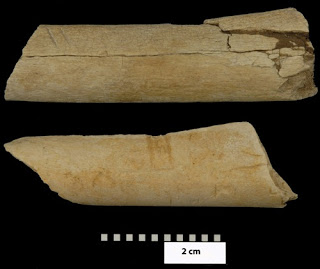
Evidence of meat consumption 3 million years ago.
Dr. Alice C. Linsley
The members and followers of the BioLogos Foundation are almost entirely Evangelicals and they have been countering Young Earth Creationists with important data since the organization's founding in 2007. The BioLogos Foundation supports the view that God created the world using evolution of different species as the mechanism. The organization was established by Francis S. Collins who served as director of the National Institutes of Health (NIH) in Bethesda, Maryland, from 17 August 2009 to 19 December 2021.
In his 2006 book The Language of God, Collins presents his struggle to reconcile Faith and Science. In my view, Collins' personal struggle was the task of meticulously setting aside false interpretations on both sides. Collins believed that scientific discoveries are an "opportunity to worship" and he rejected both Young Earth creationism (YEC) and Intelligent Design (ID). He preferred the term "theistic evolution". However, the BioLogos Foundation instead uses the term "evolutionary creationism", the belief that the diversity of organic life results from mutation, adaptation, recombination, natural selection, and common ancestry. In humans, it is estimated that about 36 recombination events occur per generation, one or two per chromosome.
Most members of the BioLogos believe in common ancestry of apes and humans. They conclude this on the basis of models in molecular genetics, not on the basis of material evidence of human morphology. It seems that Evangelicals who claim the Bible as their authority should not so easily ignore what it asserts about Humans as a special creation. Nor should those who honor science ignore what world renown paleoanthropologists have to say on this matter.
Archaic humans (4 million to 300,000 years ago) walked upright, had opposing thumbs, short fingers, human ankle bones, and human dentition. In humans, the back teeth are larger than the front teeth (not so with apes), and the canines are not pointed. Humans also lack the characteristic diastema, or tooth gap, found in apes.
When Jeremy DeSilva, a British anthropologist, compared the ankle joint, the tibia and the talus fossils of human ancestors ("hominins") between 4.12 million to 1.53 million years old, he discovered that all of the ankle joints resembled those of modern humans rather than those of apes. Chimpanzees flex their ankles 45 degrees from normal resting position. This makes it possible for apes to climb trees with great ease. While walking, humans flex their ankles a maximum of 20 degrees. The human ankle bones are quite distinct from those of apes.
The discovery of a complete fourth metatarsal of A. afarensis at Hadar that shows the deep, flat base and tarsal facets that "imply that its midfoot had no ape-like midtarsal break. These features show that the A. afarensis foot was functionally like that of modern humans." (Carol Ward, William H. Kimbel, Donald C. Johanson, Feb. 2011) The Ward, Kimbel and Johanson study is very interesting. Donald Johanson was the person who announced to the world that Lucy was "ape of the South," or Australopithecus. He has since reconsidered that assessment.
Mary Leakey’s 1979 discoveries in Tanzania added to the evidence that humans walked the earth over 3 million years ago. At Laetoli, about 25 miles south of Olduvai Gorge in Tanzania, Leakey discovered footprints of a man, woman and child created about 3.6 million years ago and preserved under falling ash from the nearby Sadiman volcano. The raised arch and rounded heel of the footprints showed that whoever left these footprints walked as humans today.
Unfortunately, Johanson had already presented Lucy as more ape than human though Mary Leakey would have classified her Laetoli finds as Homo/human. She expressed her regret that “the Laetoli fellow is now doomed to be called Australopithecus afarensis.” (Lucy's muscle reconstruction shows that she walked upright.)
Johanson and Mary Leakey were scheduled to speak at a Nobel Symposium in Sweden in May 1978. The conference honored Mary Leakey, who received a medal from the King of Sweden for her scientific investigations. Mary Leakey received the Golden Linnaean Medal, but also was very embarrassed when Johanson announced the new name - Australopithecus afarensis - for his Afar Triangle finds and included Mary Leakey's 4-million-year-old Laetoli specimen (jawbone LH4) from Tanzania as an exhibit.
Johanson, who was scheduled to speak before Leakey, scooped Mary's speech. Leakey was perturbed that Johanson had named her discoveries, using a nomenclature at odds with what she believed to be the evidence.
Unfortunately, Johanson had already presented Lucy as more ape than human though Mary Leakey would have classified her Laetoli finds as Homo/human. She expressed her regret that “the Laetoli fellow is now doomed to be called Australopithecus afarensis.” (Lucy's muscle reconstruction shows that she walked upright.)
Johanson and Mary Leakey were scheduled to speak at a Nobel Symposium in Sweden in May 1978. The conference honored Mary Leakey, who received a medal from the King of Sweden for her scientific investigations. Mary Leakey received the Golden Linnaean Medal, but also was very embarrassed when Johanson announced the new name - Australopithecus afarensis - for his Afar Triangle finds and included Mary Leakey's 4-million-year-old Laetoli specimen (jawbone LH4) from Tanzania as an exhibit.
Johanson, who was scheduled to speak before Leakey, scooped Mary's speech. Leakey was perturbed that Johanson had named her discoveries, using a nomenclature at odds with what she believed to be the evidence.
The Role of Ego
Ego plays a role in science. This is acknowledged by Dr. John Hawks whose scientific credentials are beyond question. In his article "Arguing about Species: Is It evidence or ego", Hawks wrote:
For some people who follow human evolution news, recognizing “species” is really just about whether you’re a lumper or a splitter. Many people assume that the names of species are about ego, not evidence.
But nature presents us with real challenges, which still cause different scientists to approach the past with different assumptions. Let me give some examples.
Just today, I got notification of a new paper by Walter Neves and colleagues, in which they suggest that Australopithecus sediba and Homo naledi are actually South African representatives of Homo habilis. Some people might scoff at this—after all, the Dinaledi fossils are only 236,000–335,000 years old, while the latest-known H. habilis is around 1.6 million. But a young date for some fossils doesn’t bar them from membership in a species with much older fossil representatives. Identity is tested with morphological evidence, not geological age.
Archaic Humans and Modern Humans
But nature presents us with real challenges, which still cause different scientists to approach the past with different assumptions. Let me give some examples.
Just today, I got notification of a new paper by Walter Neves and colleagues, in which they suggest that Australopithecus sediba and Homo naledi are actually South African representatives of Homo habilis. Some people might scoff at this—after all, the Dinaledi fossils are only 236,000–335,000 years old, while the latest-known H. habilis is around 1.6 million. But a young date for some fossils doesn’t bar them from membership in a species with much older fossil representatives. Identity is tested with morphological evidence, not geological age.
Archaic Humans and Modern Humans
Scientific methods of dating are more than adequate when it comes to providing a range of time. However, as more discoveries are made, the ranges can change. For example, generally fossils dating to earlier than 200,000 years ago were regarded as archaic human, though some show features associated with anatomically "modern" humans.
Hawks noted humans were living in the Lake Turkana-Omo region of East Africa 200,000 years ago. He wrote, "Ancient people were using this area throughout, leaving stone artifacts. It is amazing walking along the exposures, noting the stones that are the marks of ancient human activity. These early modern humans were making fundamentally the same kinds of artifacts that we find across western Eurasia, made by the earliest Neandertals, and across most of the African continent at the same time. There were regional differences in the pattern of toolmaking, but there was a broad technological commonality. This was the cultural background of our ancestors."
There were at least 8 groups of archaic humans about 300,000 years ago. However, the genetic ancestry of modern humans appears to be limited to about 4 of these groups: Homo Erectus, Denisovan, Neanderthal, and Homo Naledi. Archaic human populations were more widely dispersed than is generally recognized.
Hawks noted humans were living in the Lake Turkana-Omo region of East Africa 200,000 years ago. He wrote, "Ancient people were using this area throughout, leaving stone artifacts. It is amazing walking along the exposures, noting the stones that are the marks of ancient human activity. These early modern humans were making fundamentally the same kinds of artifacts that we find across western Eurasia, made by the earliest Neandertals, and across most of the African continent at the same time. There were regional differences in the pattern of toolmaking, but there was a broad technological commonality. This was the cultural background of our ancestors."
There were at least 8 groups of archaic humans about 300,000 years ago. However, the genetic ancestry of modern humans appears to be limited to about 4 of these groups: Homo Erectus, Denisovan, Neanderthal, and Homo Naledi. Archaic human populations were more widely dispersed than is generally recognized.
The genomes of other archaic human ancestors have yet to be sequenced and until that is done, we must not jump to conclusions that are unsubstantiated. This is a daunting task because the recovery of viable DNA from archaic specimens is next to miraculous!
Related reading: Time to Jettison Young Earth Creationism; Artifacts of Great Antiquity; Was Lucy Human?

