Followers

Showing posts with label Judges. Show all posts

Saturday, January 14, 2023

Law Enforcement in Ancient Egypt


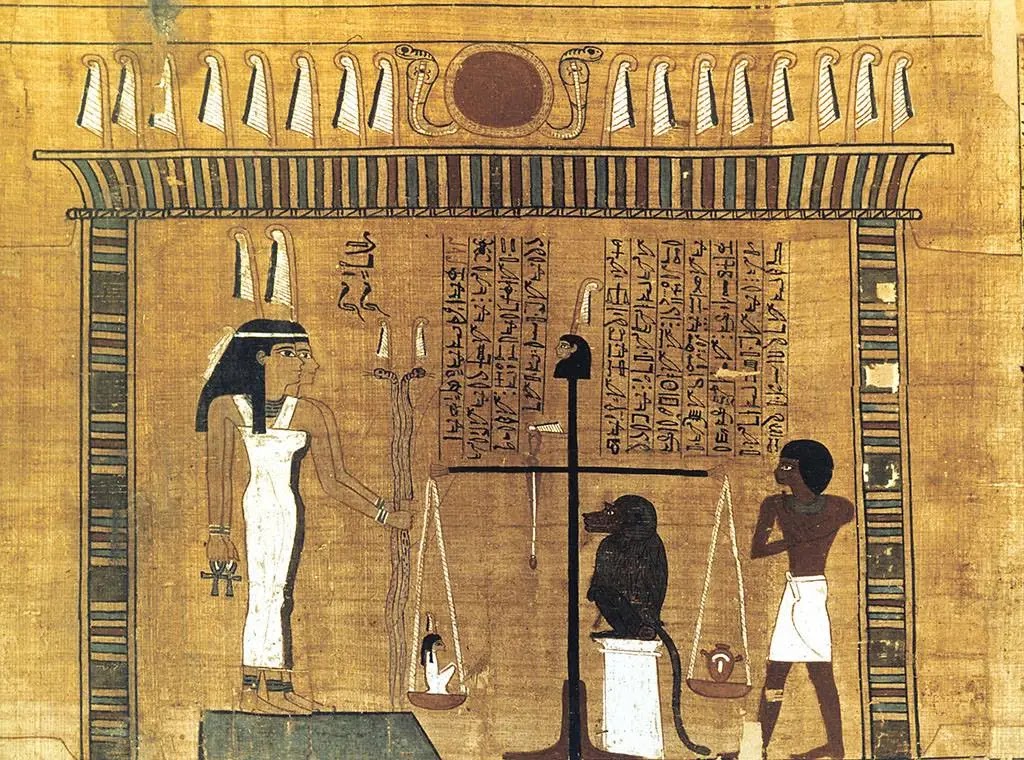
Entrance to the afterlife depended on weight of the heart, a belief that spread to the Indus Valley.

Alice C. Linsley

In ancient Egypt the rule of judges and enforcement by police existed from as early as the Predynastic Period (c. 6000- 3150 BC). The Nile Valley was littered with thousands of small communities in which local elders served as judges.

Later, the Pharaoh was supreme judge as the representative of the High God and his son Horus. The second highest legal authority was the Pharaoh's vizier. In the Book of Genesis, we read that Joseph became Pharaoh's chief steward and his high rank gave him authority to punish crimes.

One of the earliest lawgivers in Egypt was Menes (2930-2900 BC). He administered justice and issued edicts which were designed to improve food production and distribution, guard the rights of ruling families, improve education and enhance knowledge of the natural world through geometry and astronomy. Weinman’s sculpture on the South Wall Frieze of the US Supreme Court building depicts Menes as an early lawgiver.

There are records of an office known as "Judge Commandant of the Police" dating to the Fourth Dynasty (2613-2492 BC).

The earliest law codes were of a religious nature and implemented by rulers who were served by royal priests, some of whom were certainly Hebrew. (In Akkadian, the Hebrew ruler-priest caste was called Abrutu, from the Akkadian word abru, meaning priest).

The Code of Ani
is a negatively worded moral code, like the Ten Commandments. It dates to c. 2500 BC and is contemporaneous with The Reforms of Urukagina (Sumerian, 2500-2350 BC). His reforms are particularly concerned with the governance of the land and rules relating to burials. The text details the role of the king as protector of the weak. However, the Law of Tehut, a nome of Lower Egypt, dates to about 500 years earlier. 

Ancient law codes have a religious quality because religion and government were never separate in the ancient world. Among ancient populations religious laws governed every aspect of the community’s life. Religion and the rule of kings and priests contributed to social stability. Those who violated the law of kings faced punishment. The violation of religious taboos required repentance, sacrificial offerings, and cleansing from the priests. Serious violations (taboos) could result in banishment or execution. Adultery and homosexual relations were regarded as especially serious. These are mentioned in the Egyptian Book of the Dead and the Moral Code of Ani.

Those who broke a taboo by using something they are not to use or touch or by speaking words that they are not to speak, were punished by imprisonment, publicly shamed, or banished. Muttering incantations against the king or blaspheming the throne was a serious offense. The Code of Ani specifically mentions this: "I have not worked witchcraft against the King."

The Pharaoh had the same spiritual and legal authority in his Kingdom as the High Priest had in ancient Israel. Innocent parties were to remain in the city of refuge until the death of the High Priest, at which time the party could return to his people, and he was not to be harmed by any act of retribution.

If a fugitive died in a city of refuge before the High Priest died, he was buried in the city of refuge. His body could be moved for reburial only after the high priest died. This suggests that the legal precedent for treatment of fugitives in the cities of refuge predates Moses. Moses returned to Egypt after the Pharaoh died (Exodus 4:19).

King Nubkheperra Intef (1571-1565 BC) had a Hyskos rival who apparently sought refuge in the Temple of Min. That temple was under the authority of the priest Teti, son of Minhetep. Intef responded by ordering an audit of the temple to uncover irregularities. Whether Teti was guilty of harboring a fugitive is not certain, but Teti was removed from office, lost all royal benefits to himself and his family, and his sons were no longer able to fill the hereditary office. Similar penalties were applied to an Egyptian ship captain who harbored a political fugitive about 240 years earlier (D. Lorton, p. 22).

Among the Kings of Egypt, the more serious the offense, the more terrible the punishment. The Hayes Papyrus of the Late Middle Kingdom (3100-2250 BC) refers to five laws dealing with fugitives. Some fugitives were branded (D. Lorton, p. 18), and some were banished (like Cain).

The most serious crimes were those against the throne: robbing royal graves, insurrection, and hiding political enemies. The punishment for robbing grave goods and selling them was impalement, followed by dismemberment. Insurrectionists were sometimes fed to the crocodiles, which would result in the second death since the body and the soul could not be reunited in the afterlife. A royal decree dating to the First Intermediate Period (c.2170–2008 BC) and designed to protect a high-ranking official’s tomb, states, “As for anyone in this entire land who may do an injurious or evil thing to your statues . . . my majesty does not permit that their property nor that of their fathers remain with them, nor that they join their spirits in the necropolis, nor that they remain among the living.”

Friday, September 25, 2020

The Scatter-Gather Motif in Judges


Alice C. Linsley


The book of Judges contains interesting details about various clans, tribes, and scattered peoples living in Canaan before the establishment of the monarchy. We will focus on three groups whose stories illustrate the scatter-gather motif in Judges. These are the clans of Caleb, Ephraim, and the scattered peoples called “Perizzites.”


The Clan of Caleb

Caleb's name is spelled with the same consonants as כֶּלֶב kéleḇ,  meaning “dog.” The dog was the totem of Caleb’s clan and the clan understood the canine nature. Dogs tend to move in packs and they are the most dangerous when together. They gather to hunt and kill, but they often separate to eat the kill, dragging their piece of flesh away from the pack. In other words, they gather, then scatter.

The clan of Caleb was known to produce brave and bold warriors. The Hebrew word for warrior is gid'on (Gideon). This allusion to the dog clan is found in Judges 7:4-7:

But the Lord said to Gideon, "There are still too many men. Take them down to the water, and I will sift them for you there. If I say, 'This one shall go with you, he shall go; but if I say, this one shall not go with you, he shall not go."  So Gideon took the men down to the water. There the Lord told him, "Separate those who lap the water with their tongues like a dog from those who kneel down to drink." Three hundred men lapped with their hands to their mouths. All the rest got down on their knees to drink.  The Lord said to Gideon, "With the 300 men that lapped I will save you and give the Midianites into your hands. Let all the other men go, each to his own place.

Here we have an acknowledgement of the Caleb clans as chosen warriors. Gideon was a descendant of Caleb.  As such, he might have shown preference to his clansmen who he knew to be great warriors (and loyal to him as their leader), but Gideon can not be accused on showing favoritism since God gathered the warriors from among the many tribes and clans of Israel.

1 Chronicles 2:50 tells us that Caleb’s firstborn son was Hur (HR). Hur’s firstborn son was Shobal, the founder of Kiriath-jearim where the Ark resided until it was moved to Jerusalem. Shobal the Younger was named after his maternal grandfather, according to the Horite pattern whereby the cousin or niece bride named her firstborn son after her father. Shobal is a Horite name, so some of Gideon’s clan can be traced through his cousin or niece wife to the Horites of Genesis 36.

Caleb is noted as being the son of Jephunneh the Kenizzite (Numbers 32:12). The Kenizzites are often listed with the Perizzites as in Genesis 15:18-21. Kenizzite derives from an ancestral name Kenaz and is related to the name Kain and Kenan (Gen. 4).  Caleb’s brother was named Kenaz (Jos. 15:17; Jg 1:13; 1Ch 4:13).  After killing Abel, Kain was banished or told to scat from his homeland.  "Scat" is related to the verb to scatter.  His descendants scattered abroad (cf. Genesis 11:8).


The Clan of Ephraim

A reader from Nigeria who posts as “YT” wondered if some of the Yoruba might be related to the Ephraimites.  He noted that during the Yoruba intertribal wars, a subgroup living in the area of Ibadan in Southwestern Nigeria were identified by their difficulty in pronouncing the sh sound (as in shoe).  The sh sound is not common in the dialect of this Yoruba people. YT wondered if these people might be related to the Ephraimites. He is referring to this verse of Scripture:

The Gileadites captured the fords of the Jordan leading to Ephraim, and whenever a survivor of Ephraim said, "Let me cross over," the men of Gilead asked him, "Are you an Ephraimite?" If he replied, "No," they said, "All right, say 'Shibboleth.'" If he said, "Sibboleth," because he could not pronounce the word correctly, they seized him and killed him at the fords of the Jordan. Forty-two thousand Ephraimites were killed at that time. (Judges 12:5-6)

The strange thing about the Judges story is that the Ephraimites should have been familiar with the sh sound. Egyptians had this sound in their language and Ephraim is associated with Joseph of Egypt. The Egyptian sh was represented by this hieroglyph:


It appears that this Ephraim's descendants spoke a different dialect that their brothers in the clan of Manasseh. This suggests that Ephraim and Manasseh were the firstborn sons of two different wives.  It was the custom of Horite rulers to have two wives.  Since the Egyptians were able to pronounce the sh, we must consider the possibility that Ephraim's mother was not Egyptian. The Egyptian rulers took wives from the Upper Nile, so it is likely that Ephraim's mother was Nubian. In Old Nubian, the sh phoneme (as in shoe)was much less common than the s sound (as in sand).

The historical background of this reference is important. Ephraim was located next to Dan. Joppa, a principal city of Dan, was occupied by an Egyptian garrison during the Late Bronze Age (c. 1550–1200 BC). Ephraim and some of Manasseh's descendants lived on the west side of the Jordan directly opposite the other half of Manasseh and their kinsmen of Gad. Ephraim and Manasseh were of the Niolitic House of Joseph. Their plant totem was the ceph or sedge (Nile reeds). The clans of the so-called "half-tribe of Manasseh" and Gad were of the House of Jacob (Aramean). Living on the opposite sides of the Jordan these clans had to cooperate in their control of the river commerce. The scattered were gathered around the Jordan River, which like tied these clans together.


The Perizzites

After Levi and Simeon murdered the men of Shechem, Jacob declared to them: “You've made the people living in the area, the Canaanites and the Perizzites, hate me.”

In Judges we read that the king of the Scattered People resided in Bezek (Bezeq as in the shattering lightning of Ezekiel 1:14). Bezek means “scatter.”  The king of Bezek delighted in cutting off the toes and thumbs of the rulers he conquered. This was his trademark form of torture. The toes and thumbs were scattered and the rulers were made to gather crumbs like dogs under the Bezek’s table. When Judah and Simeon captured the King of Bezek, they did to him what he had done to the other rulers. Perhaps word of this retributive justice took some of the edge off the Canaanites hatred of Jacob’s people.

Later God warns the clans of Jacob and Joseph through Joshua (Yeshua) that they will be treated the same if the people slip into idolatry: "The LORD will scatter you among the peoples” (Deut. 4:27). This came true as is evident in the story of the Syro-Phoenician woman, a Greek who was born in the land of Canaan. Note how her story relates to this theme of being scattered and gathered.  Here again we find the reference to the dog under the king’s table.

Jesus left that place and went to the vicinity of Tyre. He entered a house and did not want anyone to know it; yet he could not keep his presence secret. In fact, as soon as she heard about him, a woman whose little daughter was possessed by an impure spirit came and fell at his feet. The woman was a Greek, born in Syrian Phoenicia. She begged Jesus to drive the demon out of her daughter.

“First let the children eat all they want,” he told her, “for it is not right to take the children’s bread and toss it to the dogs.”

“Lord,” she replied, “even the dogs under the table eat the children’s crumbs.”

Then he told her, “For such a reply, you may go; the demon has left your daughter.”(Mark 7:24-29)

The brilliant Anglican liturgist Thomas Cranmer understood the scatter-gather motif behind this story. He placed the “Prayer of Humble Access” before the distribution or scattering of the consecrated bread and wine. The prayer appeared in the Order for Communion in 1548 and in First Prayer Book of Edward VI (largely Cranmer’s work) published in 1549. It does not appear in any previous liturgical texts.

Prayer of Humble Access

We do not presume to come to this thy Table (O merciful Lord) trusting in our own righteousness, but in thy manifold and great mercies. We be not worthy so much as to gather up the crumbs under thy Table. But thou art the same Lord, whose property is always to have mercy: Grant us therefore, gracious Lord, so to eat the Flesh of thy dear Son Jesus Christ, and to drink his Blood, in these holy Mysteries, that we may continually dwell in him, and he in us, that our sinful bodies may be made clean by his Body, and our souls washed through his most precious Blood. Amen.


Wednesday, June 6, 2012

The Judges Deborah, Samuel and Huldah


Alice C. Linsley


When it comes to Samuel and Deborah, the place called Ramah always comes up. These two judges share Ramah as a point of reference. The region of Ramah-Dedan-Sheba was ruled by Ramah, the Kushite grandson of Noah. His brother Nimrod ruled in the Tigris-Euphrates valley. Kush and his sons Ramah and Nimrod ruled between BC 2417-2215. Sheba and Dedan were the ruling sons of Ramah, each ruling over his own region in Arabia. Dedan controlled the eastern coastline of the Reed Sea (Yam Suph).


Ramah was also a population center in Canaan. Other population centers in Judges 4–9 can be identified with reasonable certainty. These include Hazor, Bethel, Kedesh-Naphtali, Taanach, Ophrah, Tabbath, Succoth, Shechem, Arumah, and Thebez. However, only Hazor, Bethel, Taanach, Succoth, Shechem, and Thebez have been thoroughly excavated.

Judges 4:4-6 tells us, “Deborah, the wife of Lappidoth, was a prophet who was judging Israel at that time. She would sit under the Palm of Deborah, between Ramah and Bethel in the hill country of Ephraim, and the Israelites would go to her for judgment."

Though Deborah had great authority, she didn’t rule over all of Israel. She lived before the monarchy in Israel, a time which according to the book of Judges, had at least a dozen judges: Othniel, Ehud, Shamgar, Deborah, Gideon, Tola, Jain, Jephthah, Ibzan, Elon, Abdon and Samson. Though they are presented in what appears to be chronological order, some of these judges were contemporaries, each with his or her tribal jurisdictions.

Deborah's duties would have been like those of other judges. She helped to settle disputes, gave direction to people from God, and upheld the religious traditions of her Horim (Horite Hebrew ancestors). She also deliberated about and launched a counterattack against her enemy Jabin of Hazor and his military commander Sisera. Afterwards, the land had peace for forty years under Deborah's rule, according to Judges 4 and 5.

Deborah's Palm was halfway between Ramah (high of lifted up) and Bethel (House of God). Ramah and Bethel are on a north-south axis. Mircea Eliade, a Romanian sociologist of religion, wrote about the significance of the sacred center in his book "Cosmos and History: The Myth of the Eternal Return." Archaic cultures regarded their most sacred places as the center of the cosmos. The ancient Incas regarded Cuzco as the "ombligo" or "omphalos" (navel) of the earth. In the Psalms, Mount Zion is portrayed as the sacred center to which all the peoples would come to worship.

The sacred center or cosmic axis is the place of connection between God and Man, between Heaven and Earth. It is where the four compass directions meet. That is the significance of the north-south axis for Deborah and the east-west axis for Abraham. Abraham set up his tent at the the moreh's tree (the prophet's oak) between Bethel and Ai, on an east-west axis. (Gen. 18)  Here God visited Abraham and Abraham deliberated with the Lord about the fate of Sodom and Gomorrah. Here Abraham received the promise that Sarah would bring forth a son. So Abraham, like Deborah, deliberated with the Lord as a judge and prophet at the sacred center marked by a sacred tree.

In many Bibles, oak tree is rendered as terebinth, which is the word that appears in Hebrew. This might indicate the Pistacia terebinthus, also called turpentine tree, a small deciduous tree related to the pistachio and the earliest known source of turpentine. However, it is more likely that in the original telling of this story, terebinth meant the "tree of the priest's the daughter." In Arabic bint (بنت) means "daughter of" and tera is an ancient Ainu word for priest.  All the leading figures of the Pentateuch met their future wives at wells or river shrines maintained by priests.  In the more arid Palestine, the trees were at oases.

Caesarius of Arles explains that since Isaac, Jacob and Moses are all types of Jesus Christ, "for this reason they found their wives at wells, because Christ was to find His church at the waters of baptism." (Sermon 88:1) The church is symbolized by Photini, the Samaritan Woman at Jacob's Well, who asked the Lord for the Living Water.

In Africa and Arabia, the fronds of Tamars (date nut palms) are cut and used at the installation of a sovereign or a priest of high rank. This is the custom that stands behind the greeting of Jesus as he entered Jerusalem on Palm Sunday. Other trees are also regarded as having sacred uses, such as the Cotton Tree and the Baobab. Jude Adebo Adeleye Ogunade writes in his memoir about growing up Ijebu. He was warned not to touch the leaves of the Igi-Ose tree, because as his Mama Eleni explained: "That tree is the tree whose leaves are used to install Chiefs and Kings of Ijebu and as your grandfather was a custodian of the rites of chieftaincy and kingship you must not play with its leaves."


Samuel's Ramah

Ramah is where the prophet Samuel resided. The word Ramah is associated with the oldest priestly lines. The root is RM. One of Shem's sons was named A'ram (Gen. 10:22) and the priestly lines of Aaron and his half-brother Korah are traced through their Horite priest father Am'ram. David was of the priestly line of Ram. (Ruth 4:19) Samuel was the son of the priest Elkanah. Elkanah had 2 wives, Hannah and Peninnah (1 Samuel 1:2), as was the custom for Horite priests.

The elders of Israel came to Ramah to demand that Samuel appoint a king to rule over them. David fled to Ramah for Samuel's help when Saul sought his life.

The ancient priesthood was associated with the number seven. The number seven is the Priestly Writer's tag in the book of Genesis. God created in six days and rested on the seventh. God commanded Noah to take seven pairs of clean animals (as contrasted with the other version in which he takes only one set). Jeremiah warned that the priests of Israel would not be spared. “The mother of seven will grow faint and breathe her last. She will die, ashamed and humiliated, while it is still daylight” (Jeremiah 15:9).

In ancient Israel, seven sons was as a proverbial expression to describe a family whose future in Israel was guaranteed, but often only one son was born, and this foreshadows the Son of God. When Hannah miraculously conceived and gave birth to Samuel, she said: “The barren has borne seven” (1 Samuel 2:5). After Ruth married Boaz and gave birth to Obed, the women of Bethlehem acclaimed the Moabite mother, telling Naomi that Ruth was better “than seven sons.” (Ruth 4:15)


Huldah, a Judge in Israel

Not all prophets lived at well or oases. Some lived in cities.  II Kings 22:14 reports that King Asaiah sent his priests to consult the “prophetess” Huldah. Her name indicates that she belonged to the tribe of Hul, a son of Aram (Gen. 10:23). Huldah, who lived approximately 655 years after Deborah, resided in Jerusalem, in the "new section." Jerusalem, which was called "Urusalim" in Akkadian, was an important shrine city in David's time, exhibiting typical characteristics of ancient shrine cities. It had flowing water from a perennial spring and was built on a precipice, as was the shrine city Nekhen at El-Kab on the eastern bank of the Nile in Sudan. The region around Amman in Jordan (Gen. 36:35) was likewise famed for its springs and high citadel. By Huldah's time, Jerusalem had expanded and the temple precinct was regarded as the sacred center.


Related reading: Where Abraham Spent His Old Age; The Jerusalem that David Knew; Cousin Brides and their Ruler Sons; The Sacred Center in Biblical Theology; Deborah, Warrior Bee